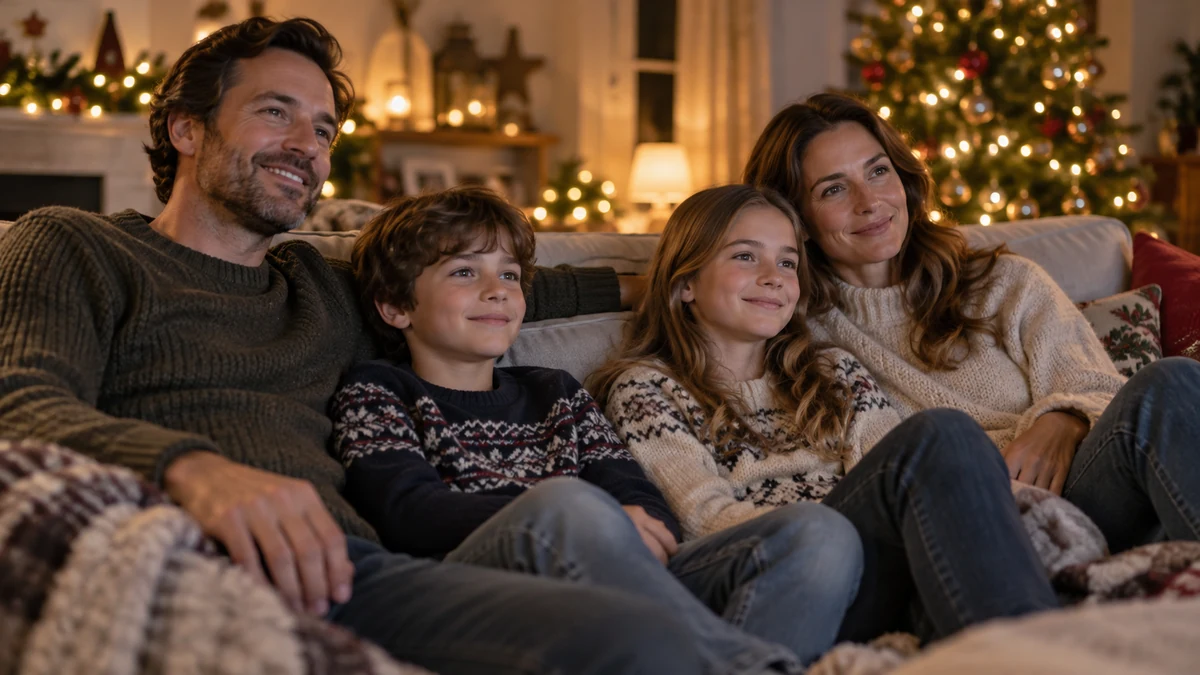
This guide to Christmas films by age offers starting points for preschoolers, school-age children, teenagers and adults. Use the suggestions alongside the film’s UK rating, content advice and your family’s preferences; an age group is not a guarantee that a film will suit every viewer.
Christmas films by age can help you plan a cosy family evening. A thoughtful choice of story, a comfortable room and the freedom to stop or change films matter more than finishing a particular title.
Illustrations in this article are conceptual images, not documentary photographs or evidence of a particular historical event, destination, venue or access route.
Christmas viewing for preschool children

For preschoolers who already watch programmes, consider short episodes with straightforward stories and familiar characters. This is not a recommendation to introduce films to babies: singing, reading and play are good ways for them to join the festivities.
Options to consider with an adult
- Peppa Pig Christmas episodes — familiar characters and short stories may suit some preschoolers. Check the particular episode and its running time.
- Pocoyo Christmas episodes — simple presentation and repetition can appeal to preschoolers. They should not be presented as essential or specially beneficial viewing for babies.
- Mickey’s Christmas Carol — a short adaptation of Dickens’s story, rather than a compilation. Familiar characters do not remove its ghosts, sadness and frightening moments.
- Rudolph the Red-Nosed Reindeer — the classic television special explores exclusion and acceptance, but also includes peril and upsetting moments. Preview the version you intend to show.
- Arthur Christmas — an energetic feature about a Christmas delivery and family relationships. Its length and action may be too much for some younger viewers.
- The Polar Express — a magical train adventure with unsettling images and moments of danger. Save it for children comfortable with that sort of story.
Practical viewing tips
- Keep sessions short: WHO guidance advises against sedentary screen time for children under two, and recommends no more than one hour a day at ages two to four, with less being better. That is a daily limit, not a suggested film length. Source: WHO: screen time and activity for under-fives
- Check the whole story: read detailed content advice or preview the programme. A calm opening does not tell you what happens later.
- Make the room comfortable: keep enough light to move safely, with suitable cushions, blankets and toys nearby.
- Keep sound comfortable: avoid sudden loud volume and explain confusing moments in simple words.
- Watch together: be available for questions, comfort and a pause when needed.
- Follow the child’s lead: if interest fades, stop and move on to play rather than insisting on finishing.
Simple activities afterwards
- A quick drawing: draw a favourite character with age-appropriate crayons or coloured pencils.
- Festive play: arrange large, age-appropriate soft toys on a blanket. Avoid loose cotton wool and small decorations that a young child could put in their mouth.
- A song together: sing a short, familiar tune from the programme.
- A little performance: use soft toys to act out a simple scene and talk about how the characters feel.
Christmas films for children aged 6–10

For school-age children, start with clear stories, humour and characters who show friendship or courage. Adventure can be appealing, but check how frightening or upsetting the particular film becomes.
Films to consider
- Klaus — an animated story about generosity, with humour, conflict and emotional moments to discuss.
- Frozen — a wintry musical about sisters and family relationships. It is a winter-themed choice rather than a Christmas story.
- Arthur Christmas — a lively festive adventure with family disagreements as well as warmth and comedy.
- The Polar Express — a Christmas journey with striking images, but also scenes that may unsettle sensitive children.
- A Christmas Carol — choose the adaptation carefully. Disney’s 2009 animated film contains frightening imagery; animation does not automatically make a version gentle or suitable for young children. Source: New Zealand Classification Office: Disney’s A Christmas Carol
Choosing a film
- Start with their interests: friendship, adventure, music or comedy can help you narrow the choice.
- Check the running time: a feature may need a break or two sittings; a short special can work just as well.
- Check content in advance: use the BBFC’s detailed advice for the exact title and version, rather than relying on the first few minutes. Source: BBFC: parents’ guide and detailed content advice
- Consider the individual child: some enjoy mild suspense, while others prefer a gentler story.
Practical viewing tips
- Prepare the space: comfortable lighting, cushions and blankets help create a relaxed film-night atmosphere.
- Make a small ritual: homemade tickets, choosing a snack and introducing the story can make the evening feel special.
- Be available to talk: answer questions and enjoy funny moments together without making children explain every scene.
- Take breaks: stretch, visit the toilet or divide the film into two parts if attention starts to drift.
- Choose suitable snacks: offer water, appropriately prepared fruit or a small sandwich. Check the needs of younger siblings before putting out shared bowls of snacks.
Creative activities afterwards
- Draw a favourite scene: invite children to explain what they enjoyed about it.
- Put on a short play: use simple props to act out a moment from the story.
- Make a memory poster: add words and drawings about the characters and their choices.
- Make paper decorations: supervise cutting and gluing to create simple ornaments.
Considering sensitive viewers
- Notice sadness and loss: be ready to listen if a scene raises difficult feelings or questions.
- Do not judge by animation alone: a colourful film can still contain frightening ghosts, danger or upsetting events.
- Use the story to start a conversation: talk about friendship, courage or kindness if the child wants to.
Christmas films for preteens and teenagers aged 11–17

Preteens and teenagers have varied tastes. Comedy, adventure, friendship and romance can all appeal, but the difference between an eleven-year-old and a seventeen-year-old is significant. Check each film individually.
Films to consider
- Elf — an exuberant Christmas comedy with a mix of silliness and sentiment.
- The Christmas Chronicles — a festive adventure with action, family relationships and moments of peril.
- Klaus — animation that can also engage older viewers through its themes of empathy and change.
- A Christmas Prince — a festive romance for viewers who enjoy a fairy-tale setting. Check its current availability and rating.
- Let It Snow (2019) — interconnected teenage romances set around Christmas. Check the year: other films share this title.
- The Holiday — a romantic comedy with adult relationships, strong language and sexual references. Assess its content for the particular viewers rather than treating it as a general children’s recommendation. Source: BBFC: The Holiday content advice
Choosing a film
- Check the UK rating: read the associated content advice as well as the certificate.
- Ask about interests: let the group choose between adventure, romance, comedy or another preferred genre.
- Consider emotional readiness: stories involving bereavement or complicated relationships may need more thought.
- Avoid assumptions about taste: some teenagers love fast-paced stories; others prefer older films or quieter drama.
Practical viewing tips
- Agree on the mood: ask what kind of evening everyone wants before selecting a title.
- Plan the length: a long film or marathon may not suit the end of a busy day; include breaks.
- Create a comfortable setting: use soft lighting, cushions and blankets without obstructing walkways.
- Offer a choice of snacks: provide a few sweet and savoury options, taking allergies into account.
- Let conversation happen naturally: save votes and questions for a pause if the group prefers to watch without interruptions.
Activities afterwards
- A relaxed discussion: ask open questions about the characters’ decisions.
- Creative responses: make fan art, a meme or a short acted scene for the family. Ask before recording or sharing anyone’s image online.
- A themed playlist: collect favourite songs from the film and music with a similar mood.
- An alternative ending: write a few lines of extra dialogue or imagine a different conclusion.
Considering sensitivities
- Relationships and loss: be available if separation, grief or romance brings up personal concerns.
- Violence and graphic scenes: a comic tone does not mean everyone will be comfortable with the content.
- Respect a decision to stop: offer an alternative without teasing or embarrassing anyone.
Christmas films for adults: classics and modern choices

For adults, a Christmas film night might mean nostalgia, romance, a musical or a comedy with more mature themes. Choose according to the company and the mood you want.
Classic choices
- It’s a Wonderful Life — a moving story about community and personal worth. It also includes despair and suicidal thoughts, so it is not an entirely light-hearted choice.
- Miracle on 34th Street — a story about belief and hope; check whether you are choosing the 1947 film or its 1994 remake.
- A Christmas Carol adaptations — versions differ considerably in tone, intensity and running time.
- White Christmas — a classic musical for viewers who enjoy festive songs and an older style of film-making.
More recent choices
- Love Actually — an ensemble romantic comedy with adult relationships, sexual content and strong language.
- The Holiday — a romantic comedy centred on personal change and new relationships.
- The Family Stone — a comedy-drama involving family tensions and more serious emotional themes.
- Last Christmas — a festive romance with music and emotional turns.
Choosing between classic and modern films
- Decide on the atmosphere: nostalgic, funny, romantic or reflective.
- Think about the company: agree on a story the people watching actually want to see.
- Check length and pace: leave time for a conversation afterwards if that is part of the plan.
- Consider sensitivities: both old and new films can contain upsetting scenes.
Practical tips for an adult film night
- Lighting: soft lights, battery-operated candles and a few festive decorations create atmosphere without distracting from the screen.
- Drinks: offer tea, hot chocolate and water; any alcoholic drinks should be optional.
- Food: bread, cheese and vegetarian nibbles are easy to share. Check allergies before adding nuts or other common allergens.
- A planned interval: take a break to stretch and chat.
- Two possible titles: let the group vote between a classic and a more recent film.
Conversation starters afterwards
- Which character changed the most? Discuss a decision or development that surprised you.
- What does the film say about family and tradition? Compare it with your own experiences if you wish.
- Music and atmosphere: how did the soundtrack and photography shape the mood?
- A different ending: what would you change, and why?
Choosing films by age, theme and sensitivity

Choosing films by age, theme and sensitivity means looking at the actual viewers as well as the story. Use this guide’s groupings as suggestions, not as official age ratings.
Useful criteria
- Age: the broad groups in this article help organise ideas; they do not replace a film’s certificate.
- Emotional readiness: think about how the viewer responds to sadness, loss and suspense.
- Content information: check the rating and detailed advice for the exact release.
- Length and pace: younger viewers may prefer a short episode, or a film split across different days.
- Themes: match the story to the interests of the group rather than assuming everyone enjoys the same Christmas message.
- Style and dialogue: songs and animation may appeal, but neither is a guarantee of gentle content.
A quick viewing checklist
- Read about the story: look for themes such as grief, violence or difficult relationships.
- Check the running time: leave room for breaks and bedtime.
- Preview when needed: consult detailed content notes or watch ahead; the opening alone may miss the difficult scenes.
- Prepare the room: adjust light and sound, with an alternative activity available.
- Agree who is watching: a family gathering and an evening with friends may need different choices.
Sensitivities to consider
- Fear and suspense: avoid strong scares for viewers who dislike them.
- Loss or separation: listen and offer comfort if the story touches on something personal.
- Religion and tradition: be considerate of the different beliefs in the group.
- Language and violence: check the particular adaptation rather than assuming a familiar title has familiar content.
Adapting the evening to your family
- Personalise the selection: combine preferred genres with each viewer’s comfort level.
- Have another option: keep a gentler story or a screen-free activity ready.
- Use pauses well: answer questions when they arise without turning the whole film into a lesson.
- Remember preferences: note what everyone enjoyed for another evening.
Activities and festive snacks for film night

A simple activity and a few snacks can make a film night feel special. Keep preparations manageable so there is time to enjoy being together.
Activities for different ages
- Preschoolers: sing, play with large soft toys or act out a simple scene. These also work as alternatives to screen time.
- Children aged 6–10: draw a favourite scene, make paper ornaments or follow an easy festive treasure hunt.
- Preteens and teenagers: create fan art, write a quiz or invent a funny response to the story.
- Adults: discuss favourite moments, recognise soundtrack tunes or share Christmas memories.
Snack ideas
- For children: try small sandwiches and fruit or vegetables prepared appropriately for their age. Avoid popcorn and whole nuts for under-fives, and keep young children seated and supervised while eating. Source: NHS: foods and drinks to avoid for young children
- For teenagers: popcorn, nachos with guacamole and non-alcoholic drinks can be options, with allergies considered.
- For adults: a cheese or charcuterie board, roasted nuts and a warm drink are possible choices; include a vegetarian option and water.
- Simple alternatives: offer yoghurt or suitably prepared fruit. Do not give honey to babies under one, and avoid hard or whole foods that pose a choking risk to younger children. Source: NHS: foods to avoid for babies and young children
Quick hot chocolate: ingredients
- 500 ml milk — dairy milk or a suitable plant-based alternative, checking allergies.
- 2 tablespoons unsweetened cocoa powder
- 2 tablespoons sugar — or less to taste.
- A pinch of cinnamon — optional.
Quick hot chocolate: method
- Heat the milk over a medium heat until it is just below boiling.
- Mix the cocoa and sugar with a little of the warm milk to make a smooth paste.
- Stir the paste into the remaining milk until evenly mixed.
- Add the optional cinnamon, remove from the heat and pour into mugs. Let drinks cool to a comfortable temperature before serving, especially to children.
Simple Christmas biscuits: ingredients
- 200 g sugar
- 225 g softened butter — the original allows unsalted margarine, although substitutions can change the texture.
- 260 g plain flour — wholemeal flour may produce a different texture and is not a like-for-like guarantee.
- 1 egg — the source recipe does not specify an egg size.
- 1 teaspoon vanilla extract — optional.
Simple Christmas biscuits: method
- Cream the butter and sugar together. These quantities are retained from the source recipe; this translated version has not been kitchen-tested.
- Mix in the egg and optional vanilla.
- Gradually add the flour and mix to form an even dough. Do not taste raw dough.
- Shape into small balls, flatten with a fork and place on a greased baking tray with space between them.
- Bake in an oven preheated to 180°C, using the original 10–12 minutes as a guide and checking for lightly golden edges. Timing will vary with biscuit size and the oven; the source does not specify a fan setting.
- Allow the biscuits to cool before transferring them to a serving plate.
Practical tips for serving and timing
- Separate the spaces: have a snack area, a place for crafts and a comfortable viewing area.
- Serve small portions: let guests try a little and return for more if they wish.
- Time the activities: crafts and snacks can come before the film, with a short break during it.
- Check allergies: discuss ingredients and avoid cross-contact; a dairy-free or gluten-free label needs to match all ingredients and preparation.
- Keep the room usable: leave clear routes, suitable seating and enough light to move around.
Bringing the evening together
Choosing Christmas films thoughtfully helps everyone enjoy the occasion. Adapt the story, pace and activities to the people watching rather than feeling tied to a rigid age list.
Add simple snacks and games if you like, check the film’s content beforehand and be ready to pause. The evening can still be a success even if you do not reach the credits.
Thank you for reading! Find more festive ideas on our social channels and the I Love Christmas blog, and share your family’s favourite viewing traditions.
Christmas films by age: frequently asked questions
How do I choose a Christmas film for different ages?
Check the exact film’s UK rating and detailed content advice, then consider interests, emotional readiness and running time. A broad age group or a gentle opening is not enough to judge the whole film.
How long should a young child’s film session be?
There is no single ideal film length. For preschoolers who watch programmes, choose something short and be ready to stop. WHO guidance advises no sedentary screen time under two and no more than one hour daily at ages two to four; less is better.
What should I do if a scene frightens my child?
Pause, offer comfort and explain simply if the child wants to talk. Stop or choose something gentler rather than insisting they continue.
How can I offer suitable snacks for different ages?
Check allergies, prepare food for the child’s age and eating abilities, and supervise younger children. Avoid popcorn and whole nuts for under-fives, honey for under-ones and foods with unsuitable hard or round shapes.
Which activities work well after the film?
Preschoolers may enjoy songs and soft-toy play; school-age children can draw or make paper ornaments. Teenagers might choose a quiz or fan art, while adults may prefer a conversation or a shared memory.
Sources and Further Reading
- BBFC: parents’ guide and detailed content advice
- WHO: screen time and activity for under-fives
- NHS: foods and drinks to avoid for young children
- NHS: foods to avoid for babies and young children
- New Zealand Classification Office: Disney’s A Christmas Carol
- BBFC: The Holiday content advice