
A Brazilian Christmas quiz brings together questions about traditions, music, food and films. Choose categories, agree on a scoring system and adapt the pace to your players. Use factual questions for points and open-ended conversation prompts for sharing family memories.
A Brazilian Christmas quiz can bring relatives together for a laugh and a chance to remember past celebrations. Below are practical rules, questions with suggested answers and variations for different ages. You do not need specialist equipment or a competitive crowd.
Illustrations in this article are conceptual images, not documentary photographs or evidence of a particular historical event, destination, venue or access route.
Why play a Brazilian Christmas quiz with your family?
A quiz gives a Christmas gathering a shared activity. It can start conversations and encourage participation, while leaving plenty of room for people who would rather listen or help with the scores.
- Bring generations together: questions about memories and traditions give grandparents, parents and children a chance to exchange stories.
- Learn something new: music, food and festive customs offer an enjoyable introduction to Brazilian culture.
- Make the evening interactive: guests can join teams, discuss answers and celebrate discoveries together.
- Make shared memories: an unexpected answer or a funny story may become something everyone remembers next Christmas.
- Keep costs down: paper, pencils and a timer are enough; adjust the format to the number of guests.
How a quiz can encourage conversation
Questions about celebrations, songs and dishes give people a starting point for personal stories. Someone might explain why a particular song matters to them, while another recalls a family recipe.
Keep competition friendly. Mixed teams can draw on different experiences and knowledge, so nobody needs to be an expert in every category.
Offer easier and harder questions, and ask what would make participation comfortable. Celebrate imaginative contributions separately from the factual score so that everyone can enjoy the game.
How to organise the game: rules, scoring and materials

Gather these basic materials:
- Question cards: print or write them on paper or card, with a clear number and category. Keep the answers on a separate host’s sheet.
- Answer sheets: give each player or team space for their name and answers.
- Pens or pencils: provide at least one per team.
- Timer: use a phone or clock if you want a time limit, such as 15–30 seconds per question.
- Scoreboard: a large sheet of paper, whiteboard or simple spreadsheet will do.
- Small prizes: choose inexpensive keepsakes, certificates or chocolates, checking dietary needs before offering food.
- Comfortable surroundings: keep decorations unobtrusive and make sure everyone has enough light to read.
Basic rules
- Teams: aim for two to five players per team and mix ages and areas of knowledge where practical.
- Taking turns: ask each team a question in turn. If you allow another team to answer after a mistake, explain that rule before starting.
- Time limits: start with 15–30 seconds per answer and allow longer for difficult questions or access needs.
- Question types: one possible system is one point for multiple choice, half a point for true or false and two points for a harder factual question without options.
- Tie-break: prepare a separate factual question worth three points. Give tied teams the same question and have them write answers privately.
- Wrong answers: simply award no points. Avoid penalties or accusations over mistakes; the aim is an enjoyable family activity.
A suggested scoring system
- Multiple choice: one point for a correct answer.
- True or false: half a point for a correct answer.
- Harder factual question: two points for a correct answer, with a short explanation if requested.
- Themed bonus: announce any extra one-point music or food challenge in advance so the scoring is clear.
- Example: give every team ten scored questions of comparable difficulty, then add up the points. Keep personal discussion prompts outside the competitive score.
Planning rounds and timing
- Number of rounds: eight to twelve short rounds can work well, but use fewer if guests prefer a brief game.
- Playing order: draw lots, go alphabetically or move around the table.
- Round length: allow roughly two minutes for a question, answers and a short explanation, adjusting for the group size.
- Recording results: the host checks answers and updates the score after each round.
- Breaks: offer a short pause after about four rounds if people want to chat, stretch or get refreshments.
Variations and adaptations
- Children’s version: use short questions, picture clues and a longer response time, perhaps 30–45 seconds.
- Family teams: combine different generations so players can help one another.
- Music round: play a short clip from a recording you can use for your gathering and ask teams to identify the song. Check licensing requirements for public events.
- Tournament version: elimination rounds are an option for groups that enjoy them, but cumulative scores let everyone keep playing until the end.
Practical tips
- Check questions first: verify the answer key and remove questions with several plausible answers unless those alternatives are accepted.
- Make cards readable: use large lettering and strong contrast for anyone who benefits from clearer print.
- Choose a neutral host: someone outside the teams can keep time and check answers.
- Vary the difficulty: include approachable questions as well as a few challenges.
- Capture memories thoughtfully: ask before taking or sharing photographs, and note favourite moments if people are happy for you to do so.
Suggested questions: traditions, music, food and films
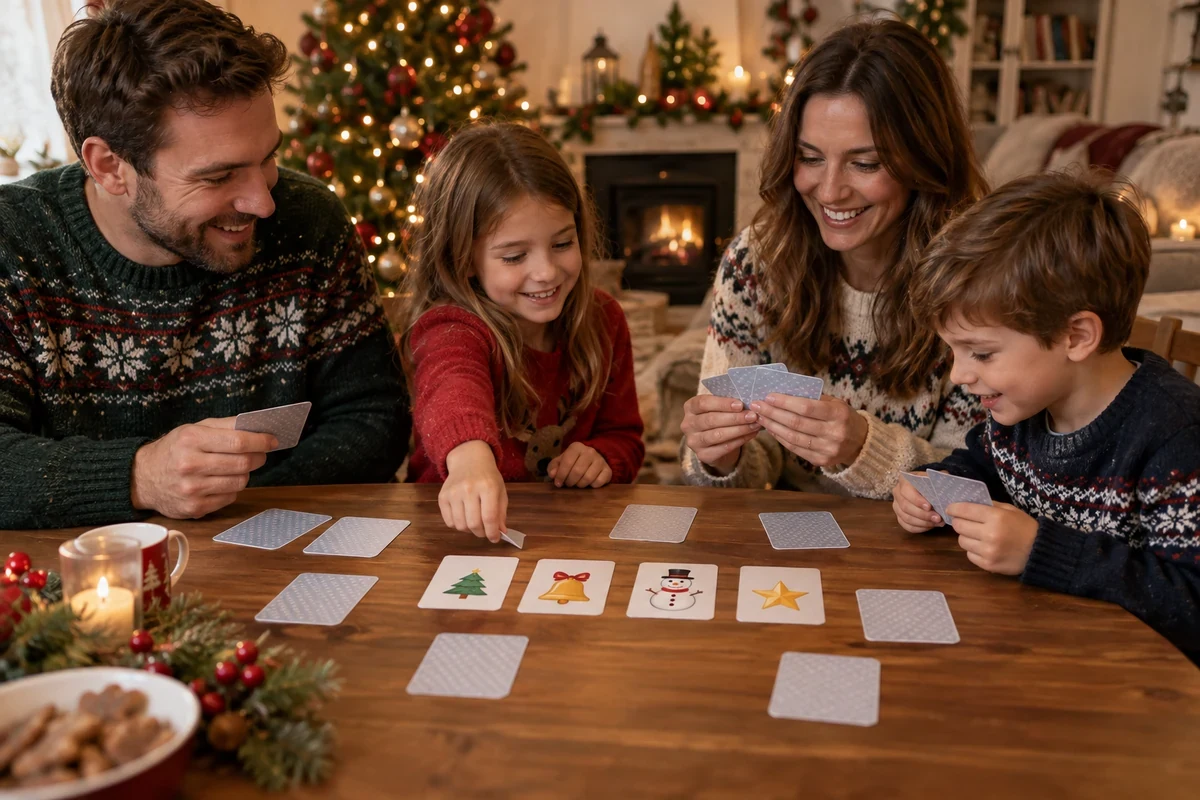
Choose questions to suit your players and the time available. The following list includes factual questions with answers and clearly labelled discussion prompts. Discussion prompts have no single correct answer and need not earn points. For film suggestions, check the age rating and suitability before watching.
Traditions
- What is the Portuguese name for a nativity scene showing the birth of Jesus? Answer: presépio.
- Is there one date on which every Brazilian family must put up its Christmas tree? Answer: no. Timing varies between households and traditions.
- What gift-exchange game involves drawing someone’s name and giving them a present? Answer: amigo secreto or amigo oculto, similar to Secret Santa.
- Which food makes your Christmas table feel especially generous or welcoming? Discussion prompt: invite a personal example; there is no single national answer.
- What is Santa Claus called in Brazilian Portuguese? Answer: Papai Noel. Follow up by asking which Santa traditions your family observes.
- What is the traditional name for the Catholic Christmas night Mass in Portuguese? Answer: Missa do Galo. Other churches have their own services, and not every family attends.
- Which local Christmas custom have you seen in your town or region? Discussion prompt: describe a procession, community event or another local celebration without presenting it as universal across Brazil.
- What does ceia de Natal mean? Answer: the Christmas supper or festive evening meal. Many Brazilian families gather on 24 December, sometimes continuing into Christmas Day; present-opening times vary.
Music
- Which Brazilian Christmas song was written by Assis Valente? Answer: Boas Festas. Source: Rádio MEC — Brazilian Christmas songs
- What is Silent Night called in Portuguese? Answer: Noite Feliz. Use the title as the clue rather than requiring anyone to remember a verse.
- Which instruments can you hear in a short Christmas recording chosen by the host? Listening prompt: prepare the answer from that particular recording; arrangements use different instruments.
- Name a Brazilian singer who has performed Boas Festas. Accepted examples: Caetano Veloso or Gilberto Gil, whose performance appears in Rádio Batuta’s Christmas selection.
- Can a Christmas song have different musical arrangements? Answer: yes. Discuss how samba, bossa nova or another style might change its rhythm and mood; there is no single compulsory Christmas style.
- Which international Christmas song would you add to the family playlist? Discussion prompt: name a song and explain your choice rather than guessing what every radio station plays.
- Which broadcasting medium carried Christmas songs into homes long before online streaming? Answer: radio.
- Which song does your family associate with Christmas supper? Discussion prompt: any genuine family memory is welcome, including not having a particular song.
Food
- Name a roast served at some Brazilian Christmas suppers. Accepted examples include turkey, chicken or pork. Menus vary, and vegetarian meals are also part of family celebrations.
- Which sweet festive bread often contains dried or candied fruit? Answer: panettone, also written panetone in Brazil.
- Name three side dishes that might appear at a Brazilian Christmas meal. Example answers: rice, farofa (toasted cassava flour with additions) and salpicão (a mixed salad, often made with chicken). Accept other suitable examples.
- Suggest a non-alcoholic drink for a Christmas gathering. Discussion prompt: water or fruit juice are examples; there is no single traditional drink for every Brazilian children’s party.
- What sweet topping can be used to decorate Christmas biscuits? Answer: icing; melted chocolate is another acceptable example if the question allows alternatives.
- How might Christmas dishes differ between regions or households? Discussion prompt: ask players for examples they know and check unfamiliar claims later, rather than treating all of northern or southern Brazil as having one menu.
- What main course could suit a smaller celebration? Discussion prompt: a small roast chicken or a vegetable-based dish may work; cost and preparation time depend on the recipe and local prices.
- Which pulse is associated with wishes for prosperity at New Year? Answer: lentils. This is a New Year custom, rather than a rule for Christmas dinner, and it is symbolic.
Films
- In which Christmas comedy is Kevin McCallister accidentally left behind when his family goes away? Answer: Home Alone.
- Which Brazilian Christmas comedy follows a man caught in a repeating Christmas experience? Answer: Just Another Christmas, released in Portuguese as Tudo Bem no Natal Que Vem. Source: Netflix — Just Another Christmas
- Which green character is famous for trying to steal Christmas? Answer: the Grinch.
- Which Christmas comedy would your group choose to watch together? Discussion prompt: name a film, explain its appeal and check its age rating for the viewers present.
- Which animated Christmas film follows a postman whose actions help begin the Santa Claus story? Answer: Klaus. An animated film is not automatically suitable for every young child; check the rating and content. Source: Netflix — Klaus
- Which Christmas adventure features a train journey to the North Pole? Answer: The Polar Express. Source: Warner Bros. — Holiday films
- Why can snowy Christmas films look different from a Brazilian Christmas? Answer: many depict a northern-hemisphere winter, whereas Christmas falls in summer in Brazil. Weather still varies by location.
- What recurring message in Christmas films reminds you of your own celebrations? Discussion prompt: kindness, generosity or reconnecting with others are possible themes, but personal answers are welcome.
Ways to use the questions
- Mix difficulty levels: choose easier, intermediate and more challenging questions for each team.
- Add pictures: simple illustrations of food, instruments or festive objects can help younger players follow the question.
- Keep scoring consistent: use the agreed one-point multiple-choice and two-point factual questions. Reserve the three-point challenge for the announced tie-break; keep unscored discussion prompts separate.
- Include regional knowledge: add local dishes and songs while allowing for differences between families.
- Celebrate creativity: offer a separate light-hearted prize for an imaginative answer without changing the factual answer key.
Quiz variations for children, adults and larger gatherings
Adapt the language, pace, materials and prizes to your guests. Ask about access needs and make participation optional rather than assuming everyone enjoys the same format.
Children
- Format: short questions and clear pictures help explain what is being asked.
- Timing: allow around 30–45 seconds, or leave the round untimed if that works better.
- Scoring: one point per correct answer is easy to follow; use stickers or a separate participation award for creative contributions.
- Materials: picture cards, paper shapes and category symbols such as a star or tree.
- Example questions: show pictures of foods and ask which appears at the child’s celebration, or ask them to identify a familiar festive character.
- Prizes: stickers, a drawing activity or another age-appropriate keepsake keep the focus positive. Check allergies if giving sweets.
Adults
- Format: include more detailed questions about music, cinema and regional traditions, with a checked answer key.
- Timing: 15–25 seconds can suit a quick round, with longer for discussion or access needs.
- Scoring: use one point for multiple choice and two for harder factual questions. Treat personal stories as a separate, optional part of the game.
- Variations: try a food-themed round, a quick-fire challenge or a bonus question. Avoid drinking penalties or pressure to consume alcohol.
- Materials: numbered cards, a timer and a paper or digital scoreboard are sufficient.
- Prizes: a small voucher, homemade keepsake or symbolic trophy can suit the occasion.
Larger gatherings
- Format: organise teams at separate tables, with cumulative scores or an agreed tournament structure.
- Practical arrangements: use a central host, a microphone if needed and a helper at each table to collect answers.
- Special rounds: identify a music clip, recognise a food ingredient from a picture or name a festive film from a suitable visual clue. Picture clues avoid the allergy and dietary problems of blind tasting.
- Pace: alternate short rounds with time to chat and enjoy refreshments.
- Access: keep routes clear, offer seated participation and provide spoken or printed versions of questions as needed.
Build your version in six steps
- Know your players: consider group size, interests, ages and access needs.
- Choose categories: start with four to six themes, such as music, food, traditions and films.
- Prepare cards: create a pool of ten to twenty questions per category if useful, then select only as many as your game needs. Add picture clues where helpful.
- Agree the rules: decide time limits, points, accepted alternatives and the tie-break before play begins.
- Arrange the space: provide comfortable seating, a visible scoreboard, writing materials and any audio equipment needed.
- Try a practice round: check that volunteers understand the wording and have enough time to answer.
Quick tips
- Balance teams: mix different ages and interests to encourage discussion.
- Use visual clues: offer them to anyone who finds pictures helpful, rather than making assumptions based on age.
- Keep things moving: shorten the game if attention starts to wander.
- Recognise participation: a certificate or a photograph shared with permission can be a pleasant keepsake.
Make the game personal and educational
Choose activities that leave room for both learning and conversation. Clear instructions, simple materials and respect for each person’s pace matter more than elaborate rules.
- Invite personal stories: ask whether anyone would like to share a Christmas memory. Let people pass, especially if the subject touches on grief or difficult family experiences.
- Use familiar objects: a family recipe, old decoration or photograph can give a question a personal connection.
- Offer different kinds of clues: music, pictures and safe craft materials can add variety. Ask about sensory preferences and keep food allergies in mind.
- Use clear language: write short instructions and explain unfamiliar terms.
- Encourage discussion: invite a brief memory or explanation after a question, without requiring anyone to share private details.
Practical activities to involve the group
- Decoration workshop: set out simple, age-appropriate craft materials and discuss festive traditions while people make something.
- Family memory round: with permission, read an anecdote and ask players who shared it. Avoid sensitive stories or anything the person wants kept private.
- Shared recipe: invite someone to explain how a dish became part of their family’s celebrations. Keep a personal account distinct from a claim about its historical origin.
- Surprise question box: mix optional memory prompts, such as a memorable present, with checked cultural questions. Label which cards are scored.
Keep learning friendly
- Welcome attempts: acknowledge thoughtful guesses as well as correct answers.
- Add context: follow the answer with a short, verified explanation when useful.
- Use symbolic rewards: certificates or inexpensive keepsakes can celebrate participation rather than just winning.
- Keep a record: collect favourite questions and willingly shared stories in a family album for another year.
Tips for the host
- Be patient: read clearly, explain the rules and keep the atmosphere relaxed.
- Be flexible with time: extend it whenever a player needs longer, or choose a timed round only if the group enjoys it.
- Make print accessible: use large text, uncluttered cards and good contrast.
- Offer other roles: guests may prefer reading questions, recording scores or simply watching.
A relaxed way to celebrate together
A family Christmas quiz can make room for laughter, stories and a little cultural discovery. Start small, check the answers and adjust the questions to the people taking part.
Thanks for reading. Follow our social channels for more festive ideas and inspiration for family gatherings.
Visit the I Love Christmas blog for more seasonal activities and celebration ideas.
Share the quiz with your family and choose a few questions for your next gathering. Happy Christmas!
Family Christmas quiz: frequently asked questions
What materials do I need for the quiz?
Prepare question cards, a checked answer key, answer sheets, pens and a scoreboard. A timer and small prizes are optional. Keep decorations clear of the playing area.
How can different generations take part fairly?
Form mixed teams, use clear print and offer pictures or extra time wherever helpful. Ask about individual needs, and balance question topics rather than assuming knowledge or ability from someone’s age.
How long should the quiz last?
Eight to twelve short rounds can be a useful starting point. Allow roughly 15–30 seconds for a simple question, longer for children or anyone who needs it, plus time for answers and discussion. Shorten the game to suit your group.
How do I create interesting, educational questions?
Mix traditions, music, food and films, and verify the answer to each scored question. Add optional personal-memory prompts, clearly marked as having no single correct answer.
How can I adapt the quiz for a large gathering?
Use teams, a central host and helpers to collect answers. Provide clear instructions, accessible seating and breaks, with optional picture or music rounds to vary the pace.
Sources and Further Reading
- Rádio MEC — Brazilian Christmas songs
- Netflix — Just Another Christmas
- Netflix — Klaus
- Warner Bros. — Holiday films