
Plan a Christmas film night around one or two suitable films, comfortable seating, simple snacks and time for breaks. Use these ten classics as a selection for several evenings, moving between comedy, animation, music and more emotional stories. Check each release’s UK classification before including children.
A Christmas film night is an invitation to share laughter, stories and a cosy evening. Here are ten familiar choices, a suggested order and practical ways to make the occasion enjoyable for your particular group.
Illustrations in this article are conceptual images, not documentary photographs or evidence of a particular historical event, destination, venue or access route.
Why organise a Christmas film night at home?

A home Christmas film night offers a simple way to spend time together and build a tradition around stories you enjoy.
Time together as a family
Watching at home leaves room for conversation, laughter and familiar comforts. Different generations can introduce one another to favourite films, with breaks whenever they are needed.
- Shared memories: stories can become part of the way your family remembers Christmas.
- A setting you can adjust: choose the volume, breaks and content to suit your guests.
- Flexibility: adapt the length and viewing order to your household’s routine.
Cost and convenience
Staying at home avoids travel and cinema-ticket costs, although rentals or subscriptions may still be needed. A few familiar items can create a welcoming setting without an elaborate budget.
Quick ways to set the scene
Use gentle lighting, cushions and blankets, with a clear place for snacks. Tree lights in the background can add atmosphere while enough light remains for everyone to move safely.
Choosing the films
Consider your guests’ ages, interests and available time. Check BBFC ratings and content advice for the exact release; a Christmas theme does not make a film suitable for every child. Alternate styles if you are planning more than one evening.
Choosing a time, setting and guest list

A little planning helps your Christmas film night run comfortably. Agree when it begins, how long it will last and who is coming before choosing the programme.
Choosing a time
Work around bedtimes and other commitments. Check the running time of your selected version and allow for food and breaks instead of squeezing in too many films.
- Families with children: an early start, perhaps between 5 and 7 pm, may work for one suitable film. Choose an afternoon instead if that would run past bedtime.
- An evening with friends: a slot such as 8–11 pm can accommodate a film and conversation, depending on its running time.
- A relaxed afternoon: a Sunday slot around 3–6 pm can suit anyone who prefers an earlier gathering.
Comfort and atmosphere
Arrange comfortable seats with a clear view of the screen. Decoration is secondary to good visibility, a manageable sound level and safe routes through the room.
- Lighting: use warm lamps and suitable tree lights, keeping cables and decorations away from heat.
- Seating: combine the sofa, chairs and cushions without blocking walkways; provide supportive seats for anyone who needs them.
- Sound: test dialogue before guests arrive and keep the volume comfortable.
- Screen: position it for easy viewing and reduce reflections with curtains where useful.
- Snacks: use stable trays or a nearby table, with food and serving containers appropriate for the children attending.
Organising the guest list
Plan around the space and your guests’ preferences. Clear invitations help everyone know what to expect.
- Room capacity: invite only as many people as you can seat comfortably.
- Ages and tastes: choose a shared suitable film or arrange separate family and adult sessions.
- Simple information: explain the start time, meal arrangements and whether guests should bring anything.
- Individual needs: ask about food allergies, accessibility, subtitles and other practical requirements.
- Replies: request an RSVP so you can plan seats and food.
These small arrangements leave you free to enjoy the films and your guests’ company.
Ten Christmas classics and a suggested order

Use these ten classic choices as a seasonal watchlist, not a requirement to watch them all in one sitting. The order moves between moods; rearrange or omit titles according to your guests. Check classifications and running times for the specific version you select.
- Home Alone (1990) — a lively opening choice for viewers who enjoy slapstick. Its comic violence and peril still deserve a content check before showing it to younger children.
- The Polar Express (2004) — an animated adventure with a strong sense of Christmas wonder. Consider whether its intense scenes suit your children rather than assuming all animation is gentle.
- How the Grinch Stole Christmas (2000) — the live-action version brings broad humour and a story about belonging. This is a different film from the 2018 animation, with a different running time and content advice.
- Miracle on 34th Street (1994) — a sentimental choice that moves towards the emotional side of Christmas. If you prefer the 1947 original, check that release separately.
Dividing the watchlist into evenings
Pick one or two films for each gathering, with time for a meal or activity as needed. Alternating animation and live action can add variety, but there is no need to finish the first four before taking a break.
- White Christmas (1954) — a traditional musical for an evening centred on songs and nostalgia.
- A Christmas Carol — choose a particular adaptation of Dickens’s story, then check its rating and running time. Some versions are considerably darker or more frightening than others.
- National Lampoon’s Christmas Vacation (1989) — a more adult comedy option, with crude humour and language. Do not treat it as automatically suitable for a mixed group of young children and adults.
- Elf (2003) — an energetic comedy to bring a lighter mood to the programme, subject to the usual content check for your family.
- Love Actually (2003) — intertwined romantic stories for an older audience. Its UK classification is 15, with strong sex and language; it is not a children’s Christmas-film choice. Source: BBFC: Love Actually
- It’s a Wonderful Life (1946) — an emotional closing choice about community and the value of a life. Its themes include despair and suicidal thoughts, so consider viewers’ sensitivities rather than describing it as unconditionally suitable for everyone.
Practical viewing plans
- A family afternoon: choose one age-appropriate animation or comedy from the list, with an optional second film only if everyone has the time and energy.
- An adult evening: choose a comedy or romance, or make the final film a more reflective one such as item 10.
- Breaks: allow time between films to stretch, have a snack and talk; pause sooner if anyone needs it.
- Adaptation: swap titles and choose available subtitles, audio description or dubbed versions according to your guests’ needs.
Keeping the programme balanced
Start with a mood that suits the group and avoid making the evening an endurance test. A short, enjoyable session is better than finishing a list when everyone is tired.
Total viewing time: ten feature films would occupy most of a day even before breaks. Spread this watchlist across several evenings and calculate each session from the actual running times of your chosen releases.
Easy snacks and drinks

Choose food that is straightforward to prepare and serve without making it difficult to follow the film. Ask about allergies before deciding on a menu.
Quick snack ideas
- Flavoured popcorn: try butter, grated cheese, paprika or cinnamon sugar for suitable older guests. Do not give popcorn to children under five because of the choking risk. Source: NHS: food and drinks to avoid for young children
- Caprese bites: combine cherry tomatoes, mozzarella and basil with olive oil. For young children, cut round foods lengthways into appropriate small pieces and serve without pointed skewers.
- Cheese and cold meats: arrange a small selection with bread and fruit. Adapt grapes and firm foods for children, omit whole nuts for under-fives, and put out small portions of chilled items rather than leaving everything out all evening.
- Mini sandwiches: use sliced bread or small rolls with simple fillings such as turkey, cheese and salad leaves, adjusted for guests’ needs.
- Christmas biscuits: buy ready-made biscuits or decorate a familiar homemade batch before the film.
Quick recipes
Flavoured popcorn
- Ingredients:
- ½ cup popcorn kernels
- 2 tbsp vegetable oil
- 30 g butter, optional
- Salt, to taste
- Optional: 2 tbsp grated cheese, or 1 tbsp sugar mixed with ½ tsp cinnamon
- Pop the kernels: follow your pan’s guidance, heating the oil before adding the kernels and covering securely. Allow steam to escape as appropriate for the pan, shake carefully and remove from the heat when popping slows markedly, before it burns.
- Add flavour: toss with melted butter if using, then add a little salt, grated cheese or cinnamon sugar as preferred.
- Serve: divide into bowls for guests aged five and over, offering different flavours separately. Discard unpopped kernels.
Caprese bites
- Ingredients:
- 200 g cherry tomatoes
- 150 g small mozzarella balls, such as bocconcini
- Basil leaves
- 1 tbsp olive oil
- Salt and pepper, to taste
- Assemble: alternate tomato, mozzarella and basil on small skewers for adults. For younger children, prepare the ingredients in suitable small pieces on a plate instead.
- Finish: drizzle with olive oil, season as appropriate and arrange on a platter. Keep chilled until serving.
Simple, warming drinks
- Hot chocolate: make it with milk and cocoa or chocolate, adding a little cinnamon if liked. Choose toppings suitable for the guests and let children’s drinks cool before serving.
- Spiced apple drink: gently warm apple juice with a cinnamon stick, cloves and orange peel for an alcohol-free option.
- Alcohol-free Christmas punch: combine pineapple or cranberry juice with sparkling water and slices of citrus fruit.
Quick recipe: spiced apple drink
- 1 litre apple juice
- 1 cinnamon stick
- 3 cloves
- Peel from 1 orange
- Honey, to taste, optional; never give honey to babies under one Source: NHS: food and drinks to avoid for young children
- Combine: put the apple juice, cinnamon, cloves and orange peel in a saucepan.
- Infuse: warm gently for 8–10 minutes without boiling.
- Strain and serve: remove the spices and peel, sweeten if desired and pour into suitable mugs. Check the temperature before giving a drink to a child.
Practical serving tips
- Offer variety: include different flavours and textures, adapted to your guests’ ages and needs.
- Keep it manageable: use stable trays and small individual bowls where useful.
- Handle allergies carefully: keep ingredient information and avoid cross-contact when preparing an agreed alternative. A label alone does not make food safe for someone with an allergy.
- Serve warm drinks safely: use a suitable flask kept out of children’s reach. Do not leave a pan unattended on the hob while watching the film.
Activities to involve children
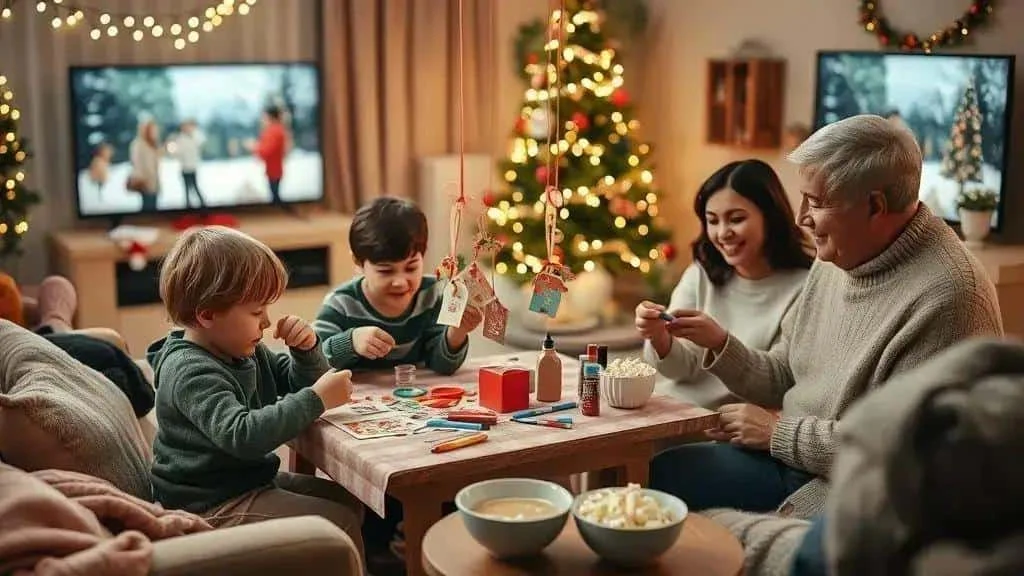
A short activity before the film helps children feel part of the occasion without filling the whole evening with tasks.
Activity ideas
- Personalised tickets: let children decorate coloured paper with pens, stickers and stamps, using age-appropriate scissors with help.
- Decoration workshop: make paper snowflakes or simple paper garlands. Salt-dough ornaments are another supervised craft, but the dough is not edible and should be kept away from pets.
- A cushion den: arrange a stable, airy space for older children to read before the film. Keep it away from heaters, candles and electrical lights; do not put lights inside blankets or use it as a baby’s sleep space.
- Film bingo: draw simple cards featuring a tree, present or sleigh, with a small reward for spotting them.
- Puppet theatre: use clean socks or paper characters for a short scene inspired by the story.
- A Christmas photo corner: provide paper frames and simple props for family photographs.
- A quiet activity for younger children: offer large, age-appropriate soft toys or fabric items under supervision. Avoid loose cotton wool, tiny decorations and other small pieces.
Making personalised tickets
- Gather supplies: coloured paper, pens, suitable stickers, stamps and age-appropriate scissors.
- Cut the tickets: make rectangles approximately 8 × 12 cm, with adult help where needed.
- Decorate: invite each child to draw, add stickers or write a name.
- Hand them out: keep the finished tickets ready as a special invitation when the session begins.
Practical tips
- Keep activities short: around 10–20 minutes can be enough, adapting to the children rather than insisting on a set duration.
- Join in: help with difficult steps and appreciate each child’s creation.
- Choose safe materials: avoid small parts around under-threes and supervise scissors and other tools.
- Connect with the story: choose a simple theme from the film without making the activity compulsory.
Alternatives: adult choices and newer Christmas films

For an adults-only session, a darker comedy, action film or contemporary romance may suit the group. Check content advice and agree the tone beforehand; a seasonal setting is not a guide to suitability.
Suggestions for an older audience
- Bad Santa (2003) — a dark comedy with deliberately crude adult humour. Check the BBFC advice for the version you intend to watch.
- Die Hard (1988) — Christmas-set action for viewers who enjoy the genre, with violence and strong language to consider.
- Krampus (2015) — Christmas horror with threatening creatures and frightening scenes. Do not present it as merely a few mild festive scares.
- The Night Before (2015) — an adult comedy involving drugs, sexual humour and strong language, suited only to an appropriately informed audience.
- Happiest Season (2020) — a contemporary romantic comedy about family relationships and acceptance, offering plenty to discuss afterwards.
- Last Christmas (2019) — a modern festive romance with an emotional turn; check its content advice and whether that mood suits your group.
Newer films and alternative adaptations
- Klaus (2019) — an animated choice for viewers who enjoy a distinctive visual style and an imaginative seasonal story.
- The Christmas Chronicles (2018) — a modern festive adventure. Check the film’s actual classification; there is no separate ‘more adult version’ to choose for older children.
- The Grinch (2018) — the animated adaptation offers a different style from the 2000 live-action film.
- Adaptations of A Christmas Carol — compare the cast, style and content advice of individual versions rather than treating them as interchangeable.
Choosing a classic, contemporary or adult film
- Guests’ interests: ask whether they would enjoy nostalgia, a new discovery or a particular genre.
- The evening’s tone: a disturbing or emotionally heavy film changes the mood. Discuss that choice beforehand and allow time to talk afterwards.
- Length and breaks: leave space for food and conversation rather than packing the programme too tightly.
- Language and access: check subtitles, audio description and available language tracks before guests arrive.
Atmosphere and drinks for an adult session
Gentle lighting, music before the film and a choice of drinks can make the evening feel special without an elaborate setup.
- Wine, if wanted: offer it as an optional choice alongside equally appealing alcohol-free drinks.
- Something warm: mulled wine or an alcohol-free spiced punch can suit the season; label them clearly.
- A festive mixed drink: a citrus drink or cranberry mocktail is easy to serve, with an alcoholic version only for guests who want one.
- Food: small servings of cheese, bread and fruit work well. Ask about allergies before offering nuts.
Planning the adult session
- A short playlist: use background music before and after the film, at a level that allows conversation.
- No pressure to drink: provide water and alcohol-free options, and support safe travel home.
- Adjustable lighting: keep enough light for movement and turn it up during breaks.
- Clear expectations: tell guests the film title and tone so nobody is surprised by unsuitable content.
Keepsakes and small craft-sale ideas

A Christmas film night can inspire small gifts or products, but selling items is a separate undertaking with costs and responsibilities. A private viewing subscription does not authorise a public or commercial film screening; check the necessary permission before advertising one. Source: GOV.UK: showing films in public
Simple keepsake ideas
- Popcorn gift bags: suitable for older recipients, with flavour and ingredient information and food-safe packaging.
- Small hot-chocolate kits: cocoa and optional toppings, packaged with accurate ingredients and preparation instructions.
- Personalised photo cards: a printed photograph from the evening, shared only with the permission of those pictured.
- Handmade decorations: painted ornaments, felt decorations or supervised salt-dough crafts, clearly kept separate from food.
- A home film-night invitation: a handmade voucher for another private gathering with family or friends.
Preparing a small batch of gifts
- Choose an item: select two or three manageable ideas according to your time and materials.
- List supplies: calculate the quantities needed for a small batch, such as ten items.
- Work in stages: prepare, assemble, package and label similar items together.
- Personalise: add names or a short message where appropriate.
- Package carefully: use suitable materials, with instructions for anything that needs preparation.
Pricing items for sale
Include materials, packaging, labour, overheads and fees when working out costs. A price calculation helps planning, but does not guarantee profit or demand.
- A basic calculation: add all costs, including production time multiplied by your hourly rate. For a 30% markup on that total, multiply by 1.30, not 0.30. A markup is different from a profit margin.
- Clear prices: use easily understood figures, such as £9.95 only as an illustrative price, after checking that your actual costs are covered.
- Bundles: offer related items together only if any discount still leaves the sale worthwhile.
- Payment: choose practical options such as bank transfer, card or cash, with clear payment and collection arrangements.
Packaging, presentation and practical arrangements
A tidy presentation helps people understand what they are buying. Keep labels readable and packaging appropriate to the product.
- Clear labels: provide the product name, price and any required food information in legible text.
- Display: use a visible table without blocking doors or walkways.
- Food hygiene: use food-safe packaging and follow the applicable allergen-information and storage requirements.
Offering products beyond the evening
Ask for honest feedback on a small sample before committing to larger batches. Keep a private gathering enjoyable rather than turning it into a sales obligation.
- Samples: offer suitable samples with ingredient information and hygienic handling.
- Social media: use your own product photographs and clear ordering information, respecting guests’ privacy.
- Made-to-order work: set realistic quantities, production times and collection dates.
- Local partnerships: discuss written terms with shops or cafés if exploring resale or consignment.
Practical and legal considerations
- Food information: check the rules that apply to your product and how it is sold, including allergens and labelling.
- Food-business requirements: check with your local authority before starting. Registration is generally required at least 28 days before a new food business begins trading; home production is not automatically exempt. Follow the relevant UK nation’s guidance. Source: Food Standards Agency: registering a food business
- Order records: keep only the customer details needed to fulfil orders and store them securely.
- Quality: use appropriate materials and consistent finishing, with honest descriptions of what you offer.
A thoughtful keepsake can extend the enjoyment of the evening. If you choose to sell products, start small and check the practical requirements before taking orders.
Bringing it together
Choose a suitable film, comfortable seating and manageable snacks, then leave room for conversation and enjoyment. Your Christmas evening does not have to be a long marathon to become a favourite tradition.
Thank you for reading! Follow us for more seasonal ideas, and visit the I Love Christmas blog for recipes and practical inspiration.
Share your favourite film-night ideas in the comments. If posting photographs, ask permission from those pictured. Happy viewing and merry Christmas!
FAQ: planning a Christmas film night
How long should a family Christmas film night last?
Plan around the chosen film and the children’s routine. One film with a short activity or break is often enough; add a second only if everyone is comfortable. Spread a ten-film watchlist across several evenings rather than trying to finish it at once.
How do I choose films suitable for my guests?
Check the BBFC classification and content advice for the exact release, then consider individual sensitivities and access needs. Christmas films and animation are not automatically suitable for every age.
Which snacks work well for a home film night?
Small sandwiches, suitable fruit, caprese bites and warm drinks can work well. Adapt food and serving temperatures for children, avoid popcorn and whole nuts for under-fives, and check allergies in advance.
How can I involve children before the film?
Try a short ticket-decorating activity, paper crafts or simple film bingo. Use age-appropriate materials and supervision, and keep the activity flexible rather than tiring everyone before the film starts.
Can I make keepsakes or sell themed products?
Yes, but distinguish private gifts from a business. Include all costs in pricing and check food-business, labelling and other applicable requirements before selling. Public film screenings need their own permissions; a home subscription is not sufficient.
What if a guest has a food allergy?
Ask about their needs beforehand, retain ingredient information and prevent cross-contact during preparation and serving. Agree a suitable alternative rather than relying on a ‘free-from’ label or removing an ingredient at the table.
Sources and Further Reading
- BBFC: Love Actually
- NHS: food and drinks to avoid for young children
- GOV.UK: showing films in public
- Food Standards Agency: registering a food business