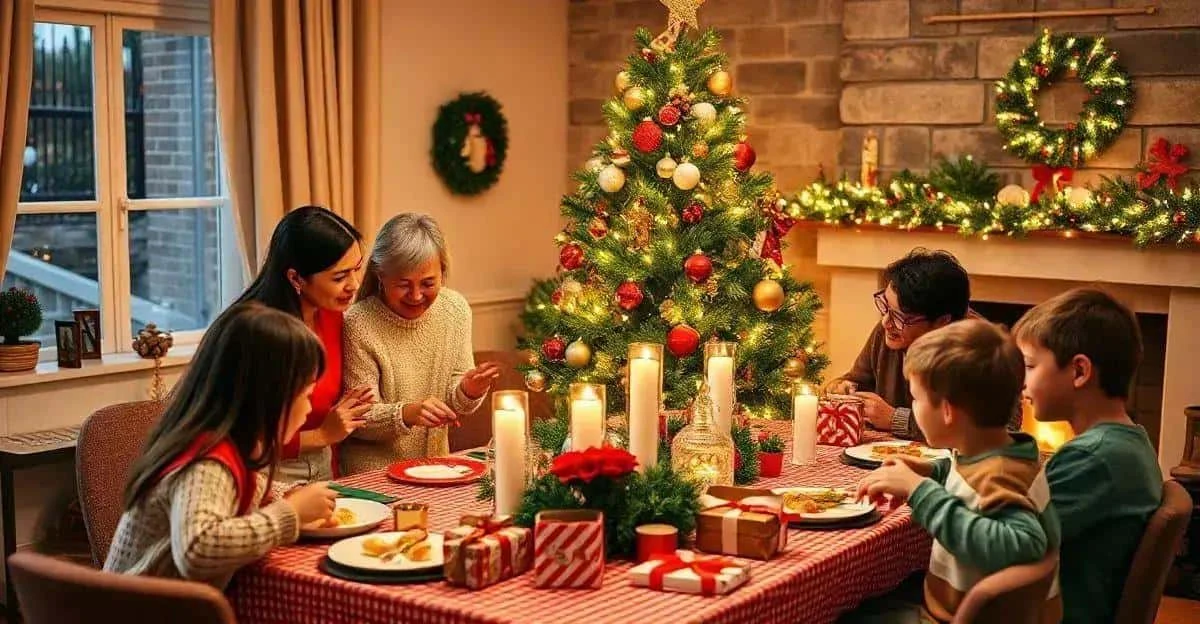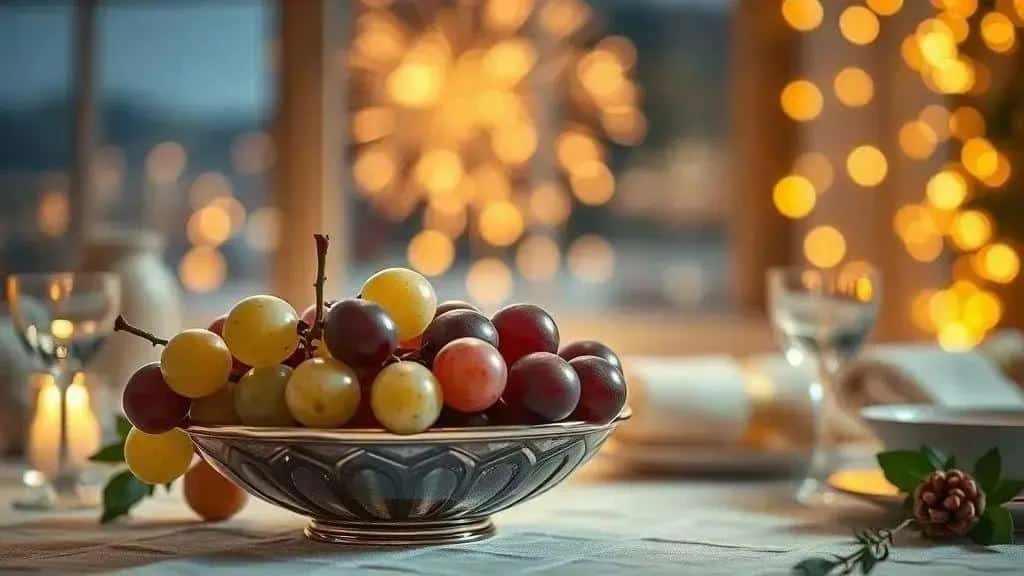
The twelve grapes of New Year are associated with the twelve months and hopes for good fortune. The best-known version is Spanish, with later variations elsewhere. It is a symbolic custom, not a way to guarantee health, love or prosperity, and nobody needs to eat quickly to take part.
Eating twelve grapes at New Year brings together superstition, memories and hopes for the months ahead. Why twelve, and what does each one represent? Here is a look at the tradition, the uncertainty around its origins and thoughtful ways to adapt it at home.
Illustrations in this article are conceptual images, not documentary photographs or evidence of a particular historical event, destination, venue or access route.
The History of the New Year Grapes Tradition
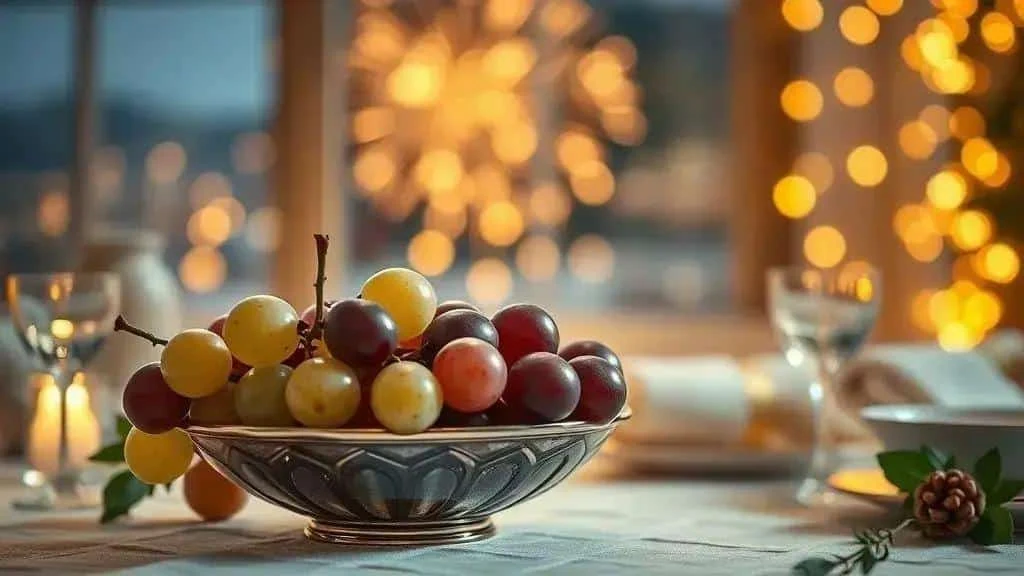
The familiar custom is closely associated with Spain. Twelve grapes represent the months of the coming year, often accompanied by wishes or thoughts of good fortune.
Accounts of Its Origins
- Ancient connections: fruit has appeared in many celebrations of abundance, but that does not establish a direct Roman or ancient harvest origin for this particular twelve-grape custom.
- The modern Spanish tradition: accounts place grape-eating celebrations in Spain in the late nineteenth century, before the often-repeated story about a twentieth-century harvest surplus. Source: RTVE: the history of New Year grapes
- The surplus-harvest story: a familiar explanation links promotion of the custom to growers with extra grapes in 1909. Treat that as an account of its popularisation, rather than proof that the practice began that year. Source: RTVE: the grapes and the harvest-surplus account
How It Became Widely Known
Public celebrations and broadcasts helped make the Spanish custom familiar to a wider audience. Versions are now found in various Spanish-speaking communities and beyond, but the route by which each family adopted it need not be the same.
Symbolism and Interpretation
Each grape is linked to a month and sometimes a wish. Traditionally, people try to match them to the twelve midnight chimes as a gesture of hope. Family variations can change the format; there is no need to keep pace with a clock or finish all twelve.
Variations and Details
- Seedless grapes are convenient, but their shape can still make them a choking hazard.
- Some people make a wish for each month; others enjoy the shared New Year moment without individual wishes.
- The custom brings together celebration, popular storytelling and personal meaning, even though its earliest history is not completely settled.
Grape Colours, Numbers and Personal Wishes
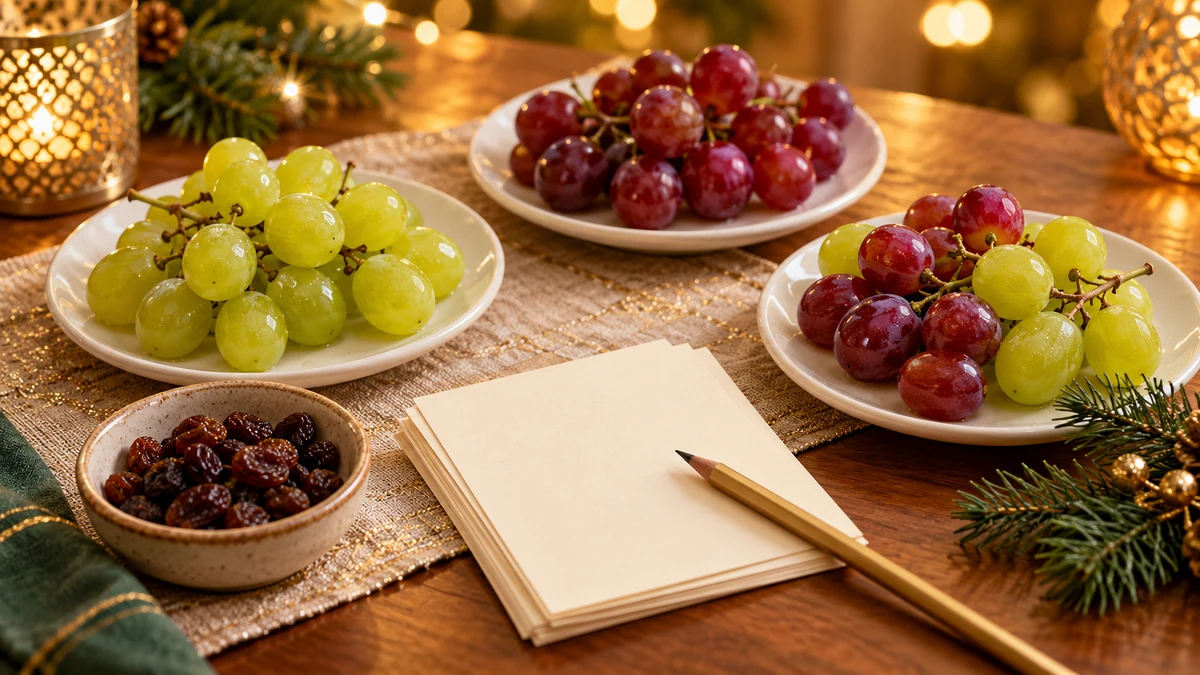
The number twelve has a recognised place in the tradition. Colour meanings are much less fixed and can be chosen as a personal interpretation.
Choosing Your Own Colour Meanings
- Green or white grapes: you might use them to represent renewal, calm or wellbeing. This is a creative choice, not a universal rule.
- Red or purple grapes: you could associate them with affection or a personal ambition, without treating the colour as a promise of financial success.
- Mixed colours: a mixture can simply look attractive or stand for several hopes you want to remember.
Why Twelve Grapes?
Twelve corresponds to the months of the year. In versions involving wishes, each grape stands for a hope for one of those months.
- Twelve grapes can become twelve wishes, one for each month.
- Another interpretation is a general hope for good fortune throughout the year, without assigning a separate wish to every grape.
Choosing Meaningful Wishes
Simple, personal thoughts can make the custom more meaningful. They do not need to be elaborate or spoken aloud.
- Choose themes: these might include health, work, relationships, family or a more balanced routine.
- Match a wish to a month: for example, wellbeing in January or making time for a creative project in February.
- Pause and reflect: think about each wish before eating, rather than trying to think, talk and swallow at the same time.
Taking Part More Safely
- Choose seedless grapes if you prefer, but do not assume removing the pips makes whole grapes safe for young children.
- Wash the fruit and prepare it before the celebration, so there is no last-minute rush.
- For young children, cut grapes lengthways into quarters rather than halves. Anyone with swallowing difficulties needs food prepared according to their individual advice, or a non-food alternative. Source: NHS: preparing food safely for young children
- Do not practise speed-eating or race the twelve chimes. Stay seated, chew properly and take as long as you need.
- Choose colours for personal meaning if you like; no colour is compulsory.
Creative Ways to Adapt the Tradition
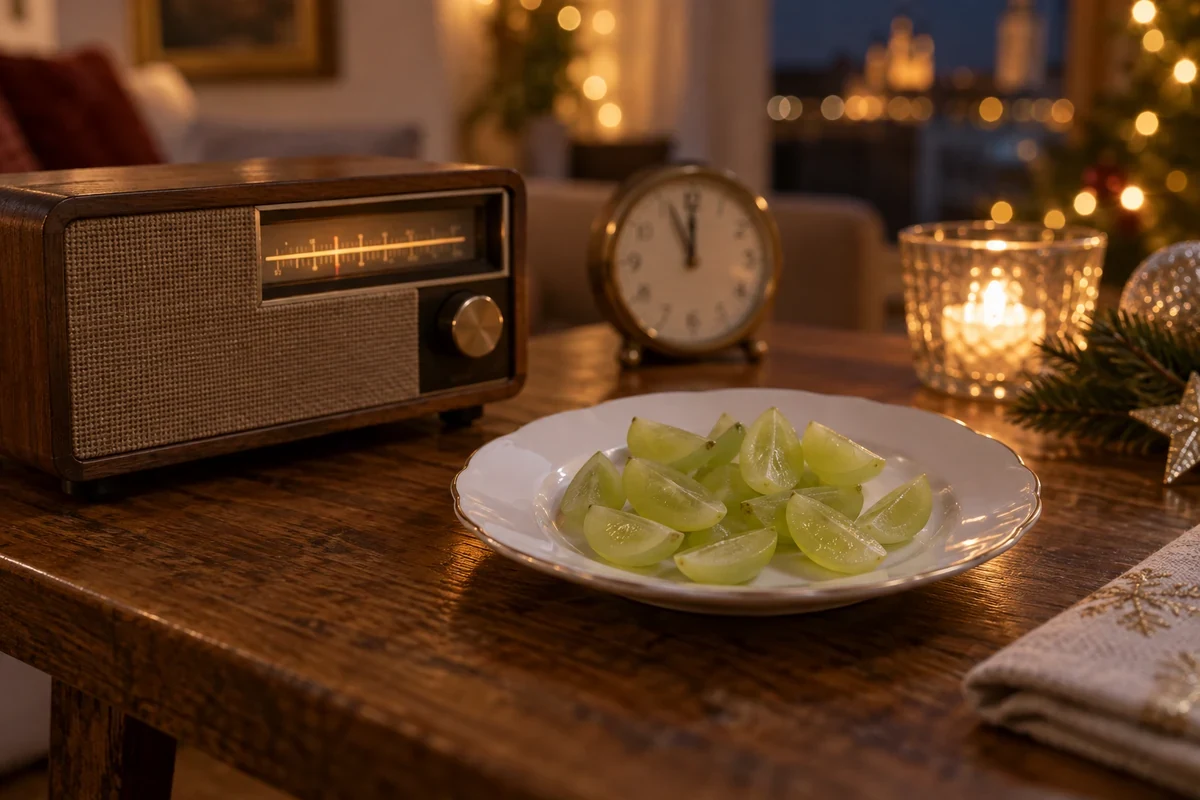
A little preparation makes it easier to include everyone. Keep the symbolism while changing any part that is unsuitable for the people taking part.
Ideas for the Celebration
- Colour groups: arrange different grapes on a plate to represent your chosen hopes, preparing each person’s serving appropriately.
- Festive plates: use small dishes with decorative napkins rather than adding sharp cocktail sticks to a countdown activity.
- A chilled toast: chill the drink itself or use ordinary ice instead of placing hard frozen whole grapes in the glass.
- Wish cards: provide twelve numbered cards or a page with twelve spaces for people to write or draw their hopes.
- A separate snack: serve prepared grapes and cheese on a plate later, when people can eat without the distraction of a countdown.
Points to Remember
- Wash grapes before preparing and serving them.
- Seedless grapes still need suitable preparation. For young children, cut them into lengthways quarters and supervise eating.
- Keep sharp sticks out of children’s servings and use an ordinary bowl or plate.
- Explain the twelve-chime tradition as background, not as a deadline for swallowing.
- Children should sit upright and eat with an adult watching closely.
Organising the Moment with Family or Friends
- Prepare individual servings: wash the fruit and adapt it to each person’s needs before setting out the plates.
- Explain the custom: describe the twelve months and invite everyone to participate at their own pace, or without food.
- Choose a host: someone can introduce the wishes or turn over a card for each month, without timing how quickly people eat.
- Offer alternatives: use large picture cards or spoken wishes for anyone who cannot or does not want to eat grapes.
Inclusive Alternatives
For a grape allergy or swallowing difficulty, raisins are not an automatically suitable substitute. A non-food version with spoken wishes or large cards avoids the need to find another food for the ritual.
Variations Around the World
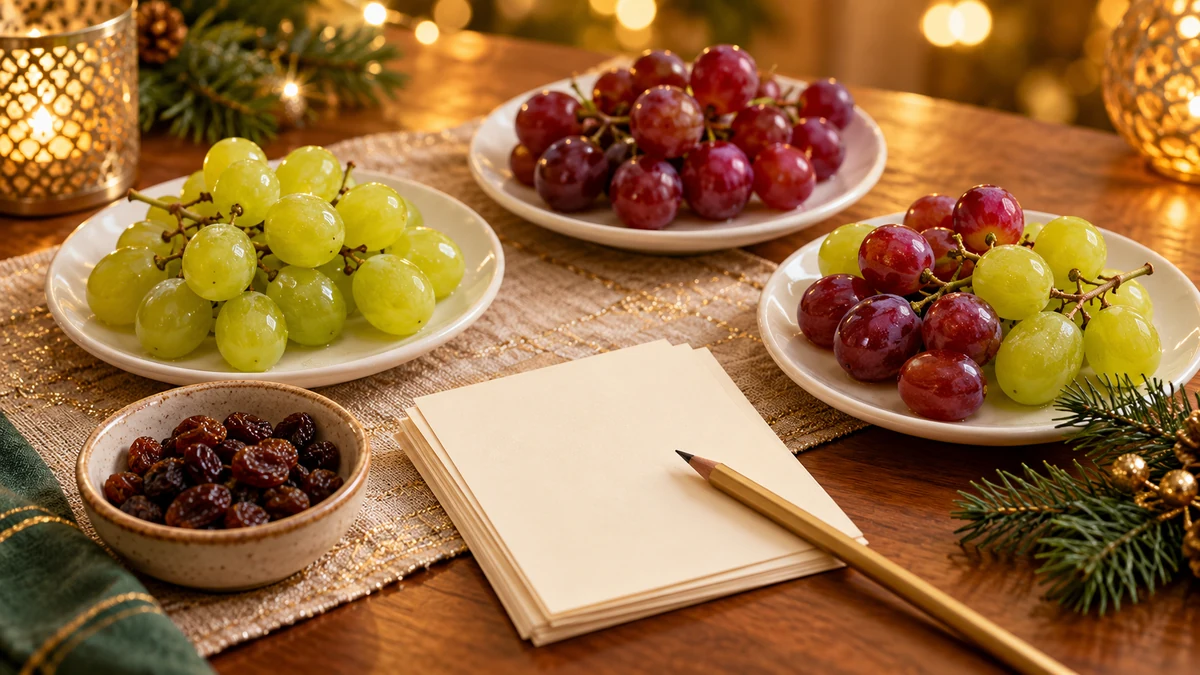
The custom has acquired different forms as families and communities adapt it. Distinguish a recognised local practice from a creative idea for your own gathering.
Regional Traditions
- Spain: the best-known version involves twelve grapes and the midnight chimes, with Madrid’s Puerta del Sol particularly associated with the celebration.
- Portugal: a related New Year custom uses twelve raisins with wishes. This differs from describing the Portuguese tradition simply as eating seedless fresh grapes. Source: RTP: raisins at New Year in Portugal
- Latin America: grape-and-wish customs appear in various communities, with differences between countries and households. Avoid assuming one exact version is followed everywhere.
- Brazil: some families include grapes among their New Year foods and good-luck customs. The details are personal and regional, not a single nationwide rule.
- Elsewhere: families can adopt a symbolic version with wishes or pictures. A modern adaptation does not need to be presented as an established national tradition.
Historical Details Worth Separating
- Broad associations between fruit and abundance do not prove that eating twelve grapes at midnight descends from a particular pagan harvest rite.
- The 1909 harvest-surplus account is often repeated, but descriptions of Spanish grape-eating customs predate it.
- Stories about fashionable urban celebrations are another part of the history. They should be presented as accounts with evidence to examine, not a single definitive explanation for every modern version.
- Changes to the number of grapes or the use of wish cards show how easily a household can adapt the idea to its needs.
Modern Adaptations
Today’s celebrations may use seedless grapes for convenience, suitably prepared fruit at an unhurried pace, or numbered cards instead. The shared moment matters more than reproducing every detail.
Why the Custom Endures
The combination of hopes for the future, a familiar family ritual and a simple visual symbol helps explain its appeal. People can enjoy it without believing it determines the year ahead.
Grapes for the Celebration Table and Small Gifts
Grapes can also be part of the meal or a small take-home gift, separate from the midnight tradition. Choose servings and packaging suitable for the recipients.
Serving Ideas
- Grapes with cheese: offer a few prepared grapes with around 20–30g of cheese as an optional adult snack portion, adjusting to appetite and dietary needs. A plate is simpler than a skewer.
- A chilled drinks corner: keep drinks cold and serve grapes separately rather than dropping frozen whole fruit into glasses.
- A sharing board: around 100–150g of grapes between two adults is one informal serving idea, not a nutritional target. Add suitable cheese or other accompaniments and adapt for allergies.
- Individual bowls: prepare the fruit according to the person’s needs rather than setting a fixed number of grape halves for all children or older adults.
Desserts and Drinks
- Quick grape compote: the source suggests 300g of seedless grapes with two tablespoons of sugar and lemon zest, simmered gently for about 8–10 minutes. Treat the time as a guide and cook until the fruit softens, stirring and adding a little water if needed to prevent catching. Serve with pancakes or ice cream; this is not a shelf-stable preserve.
- A grape drink base: crush eight to ten washed grapes with a teaspoon of sugar and a little mint, strain, then add sparkling water. An adult version can use sparkling wine instead.
- Fruit salad: combine prepared grapes and apple with orange juice. Nuts and honey are optional adult additions; do not serve whole nuts to under-fives or honey to babies under one. Source: NHS: preparing food safely for young children
Assembling Small Take-Home Gifts
- Choose the container: use a clean, food-safe lidded container of a suitable size. Keep glass and loose plastic bags away from young children.
- Prepare the fruit: wash and dry it, and use a quantity that fits without crushing. Children’s portions need the preparation described above, not whole grapes presented as a sweet-like gift.
- Finish and chill: attach a wish card outside the container and refrigerate prepared fruit until serving or handing it over. Tell the recipient to keep it chilled and eat it promptly.
Presentation and Budget Tips
- Compare the price per kilogram and buy only what you expect to use. Wash the fruit shortly before preparation.
- Mix colours if available within your budget; different varieties are not necessarily the same price.
- Reuse suitable, thoroughly cleaned food containers and cloth decorations where practical. Keep ribbons and decorative materials outside the food compartment.
Safety and Accessibility
- Seedless grapes are not choking-proof. Follow the age-appropriate cutting and supervision guidance above, and choose a non-food ritual when needed.
- Clearly distinguish alcoholic drinks from alcohol-free options.
- Check allergies with guests and keep ingredients and utensils separate where necessary; a label alone does not prevent cross-contact.
New Year grapes bring together history, symbolism and time with other people. Enjoying the custom thoughtfully means adapting it rather than rushing to fulfil a superstition.
Thank you for reading! Follow our updates for more seasonal traditions and practical ideas, and visit the I Love Christmas blog for inspiration throughout the festive season.
FAQ: Eating Grapes at New Year
Where did the twelve-grape tradition begin?
It is closely associated with Spain, where accounts describe the custom in the late nineteenth century. A well-known 1909 surplus-harvest story relates to its popularisation, but is not proof of its first occurrence. A direct ancient harvest origin is unconfirmed.
Why twelve grapes, and what do they represent?
They correspond to the twelve months. Some people make a wish for each month; others see them as a general symbol of hope for the coming year.
Do different grape colours have fixed meanings?
No universal colour code defines the tradition. You can give green, red or purple grapes a personal meaning, but colour does not guarantee health, love or prosperity.
How can children or people with swallowing difficulties participate?
Never make eating a race. For young children, quarter grapes lengthways and supervise them sitting upright. Follow individual swallowing advice where relevant, or use spoken wishes and cards instead of food.
What if someone dislikes grapes or has an allergy?
Offer a non-food version using twelve wishes or large picture cards. Raisins are still grapes, so they are not an appropriate workaround for a grape allergy.
Sources and Further Reading
- RTVE: the history of New Year grapes
- RTVE: the grapes and the harvest-surplus account
- NHS: preparing food safely for young children
- RTP: raisins at New Year in Portugal
- Spain tourism: New Year celebrations