Artisan sourdough panettone requires its own process. Here we use domestic versions made with commercial yeast and clearly identified adaptations. They do not promise to reproduce a professional panettone’s crumb. Allow several hours for proving, baking and cooling.
Before mixing
- Weigh ingredients and eggs without their shells. Use strong white bread flour for gluten-containing breads and instant dried yeast, not cake baking powder.
- Use milk only lukewarm, up to about 30°C, and softened rather than hot butter. Instant yeast can be mixed with flour; also follow its packet.
- Dough rises according to temperature and yeast activity. Timings are estimates; watch its volume rather than promising it will double within an hour.
- Use oven-safe moulds within their manufacturer’s stated raw-dough capacity. The first three formulas use two moulds intended for approximately 600g dough each.
- For simpler cooling, the domestic doughs below cool upright on a rack. Do not suspend bread from skewers pushed through its top.
1. Homemade fruit panettone — 2 loaves
- 500g strong white bread flour, 100g sugar, 7g instant dried yeast and 6g salt
- 150ml whole milk, 150g beaten egg without shells, approximately 3 eggs, and 100g softened unsalted butter
- 5ml vanilla extract, finely grated zest of 1 orange and half a lemon
- 150g chopped candied fruit and 100g raisins; do not soak them for this formula
- An additional 10g butter, divided between the two tops
- Mix flour, sugar, yeast and salt. Add milk, eggs, vanilla and zest. Mix until no dry flour remains and rest for 10 minutes.
- Knead for about 5 minutes, then incorporate the 100g butter in small additions. Continue until smooth, elastic and tacky, generally another 10–15 minutes with a dough hook on low speed; hand kneading may take longer.
- If the dough becomes hot and greasy, pause and refrigerate for 15 minutes before continuing. Do not correct merely tacky dough by adding large amounts of flour.
- Fold in the fruit and raisins. Cover and leave in a draught-free place, ideally at 24–26°C, until almost doubled, approximately 2–3 hours.
- Divide equally, shape and place in the moulds. Cover and prove until airy and about 2cm below the rim, around 1–2 hours or longer. Do not let it overflow.
- Heat the oven to 170°C conventional or 150°C fan. Make a shallow cut in each top and divide the extra 10g butter between them. Bake for approximately 40–55 minutes, loosely covering with foil if browning early.
- Check for a baked crumb without wet dough and approximately 93–95°C at the centre. Cool completely on a rack before slicing or wrapping.
2. Chocolate chip panettone — 2 loaves
Use all recipe 1’s dough ingredients, including the 10g butter for the tops, but replace the 150g candied fruit and 100g raisins with 250g oven-suitable chocolate chips. Do not add cocoa or extra liquid. Fold in the chips only when the dough is developed and cool to the touch. Follow the same proving and baking method. Check the crumb away from chips: melted chocolate can mark a skewer even when the bread is baked.
3. Filled panettone — 1 finished loaf
Start with 1 approximately 500–600g loaf from recipe 1 or 2, fully baked and completely cold. Use 200g ready-made dulce de leche as the filling. Cut into three horizontal layers and spread 100g between each pair. Reassemble and refrigerate. Do not put a large core of cream into raw dough, since it changes baking behaviour.
For brigadeiro instead of dulce de leche, cook 395g condensed milk, 15g butter and 15g cocoa over a low heat, stirring until thick, about 8–12 minutes. Cool promptly and use 200g in the bread; refrigerate the remainder separately. An optional topping uses 100g chocolate and 50ml single cream: heat the cream, pour over the chocolate, stir and apply once lukewarm. Filled or cream-topped panettone must be kept at 0–5°C and eaten within 48 hours.
4. Part-wholemeal Christmas bread — 2 loaves
Ingredients: 300g strong white bread flour, 200g wholemeal bread flour, 80g sugar, 7g instant dried yeast, 6g salt, 220ml milk, 100g beaten egg without shells, 80g softened butter, 180g chopped dried fruit, 5ml vanilla extract and zest of 1 orange. Set aside up to 30ml extra milk only if the flour absorbs a great deal of liquid.
Follow recipe 1’s sequence: combine dry and wet ingredients, rest, knead and gradually add the butter; fold in fruit last. The dough should be soft and tacky rather than dry; gradually add the extra milk if needed. Prove twice, watching volume, divide between two 600g moulds and bake at 170°C conventional or 150°C fan for about 40–55 minutes, checking the centre. The crumb will be denser. We do not call it light: reducing some ingredients does not establish a particular nutritional reduction.
5. Gluten-free panettone-inspired cake — 1 cake
This is a fruit-and-citrus cake adaptation, not a direct flour swap in yeasted dough. Use 200g fine rice flour, 100g cornflour, 2g xanthan gum, 12g baking powder, 120g sugar, 150g beaten egg, 200ml milk, 100ml neutral oil, 150g chopped dried fruit, 5ml vanilla extract and zest of 1 orange. All products must be labelled gluten-free where required, with utensils protected from cross-contact.
Mix rice flour, cornflour, xanthan gum and baking powder. In another bowl, hand-whisk eggs and sugar for 1 minute, then add milk, oil, vanilla and zest. Mix in the dry ingredients until smooth and fold in the fruit. Transfer to a lined loaf tin approximately 24 × 10cm with at least 1.5 litres capacity, filling no higher than two-thirds. Bake at 170°C conventional or 150°C fan for approximately 50–65 minutes until a skewer comes out without raw batter. Cool for 15 minutes in the tin, then on a rack. There is no kneading or proving. Contains eggs and milk.
6. Vegan Christmas sweet bread — 2 loaves
Ingredients: 500g strong white bread flour, 90g sugar, 7g instant dried yeast, 6g salt, 300ml unsweetened soya drink, 80g vegan block butter, 200g chopped dried fruit, 5ml vanilla extract and zest of 1 orange. Check that fruit, fat and other ingredients are vegan. This formula contains wheat and soya.
Mix dry ingredients, soya drink, vanilla and zest, rest for 10 minutes and knead. Gradually add softened fat and continue until elastic, then fold in fruit. Leave until almost doubled, approximately 1.5–3 hours. Divide between two 600g moulds, prove again until airy and bake at 170°C conventional or 150°C fan for 40–55 minutes, checking for a cooked crumb and about 93–95°C at the centre. Cool on a rack. There is no need to add flaxseed, aquafaba or water to this formula.
Why substitutions need their own formula
Flour, eggs, sugar and fat perform different jobs. King Arthur Baking’s gluten-free baking guidance distinguishes blends and recipes suited to different preparations. That is why the gluten-free option above is a separately formulated cake, while the vegan option remains wheat bread.
Wrapping, storage and gifts
Wrap only when completely cold, using food-safe material. Plan to eat unfilled breads and cake within 2 days when kept cool and dry; freeze portions promptly after cooling if keeping them longer. In very warm conditions, prefer refrigeration or freezing. Discard any mouldy loaf rather than cutting away only the visible patch.
Versions with dulce de leche, brigadeiro, cream or ganache must stay refrigerated, including during transport, and be eaten within 48 hours. Label ingredients, allergens and date. Vacuum packaging does not justify weeks of storage. Sales require a separate assessment of shelf life and local requirements; these domestic recipes do not provide a validated commercial shelf life.
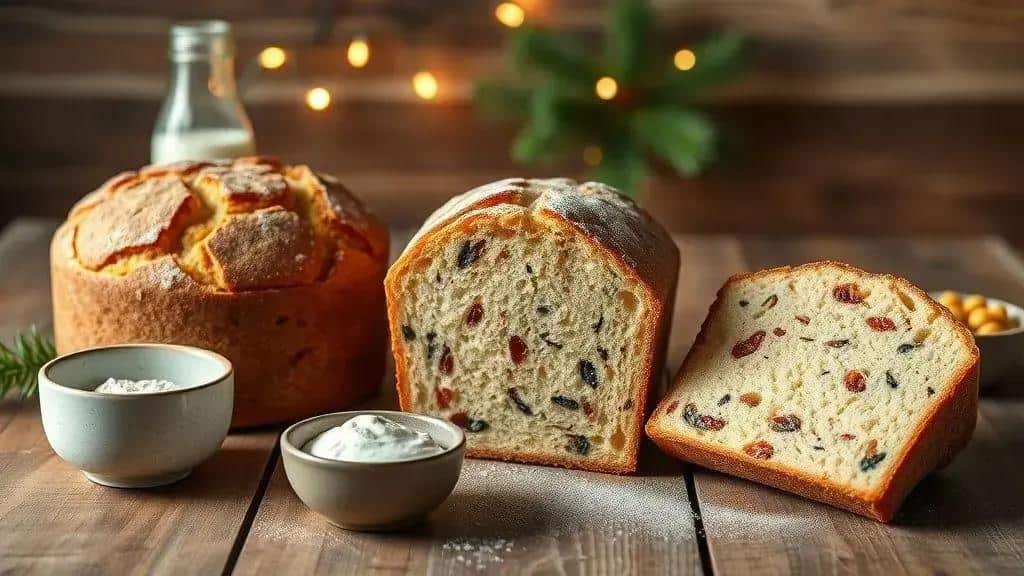
AI-generated illustration; adapted breads and cakes have different textures.