Plan a Christmas treasure hunt around the children taking part: choose suitable clues, define the search area, check the route and arrange attentive adult supervision. Adapt maps and tasks to different abilities, select appropriate prizes and agree responsibilities beforehand. A short, cooperative game with optional help can be more enjoyable than a race.
A Christmas treasure hunt can give children a shared adventure during a family celebration. You do not need elaborate equipment: a few thoughtful clues, suitable hiding places and a little preparation are a good starting point.
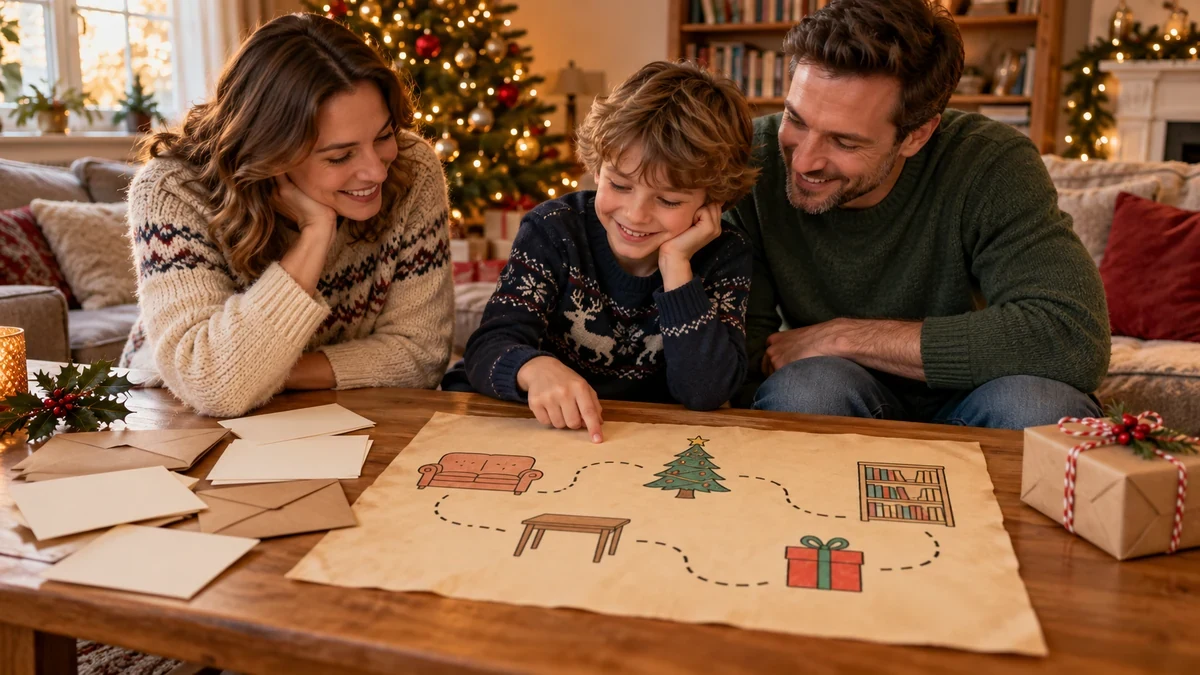
Illustrations in this article are conceptual images, not documentary photographs or evidence of a particular historical event, destination, venue or access route.
The pictures illustrate a homemade game; they are not printable playing cards or a downloadable game set. Follow the instructions to create and check your own cards and route.
Why children may enjoy a Christmas treasure hunt

A treasure hunt combines curiosity, play and a shared goal. Some children enjoy the surprise of the next clue; others prefer helping to draw a map or hand out cards. Make room for both.
What the activity offers
Curiosity: looking for a clue gives children a reason to explore an agreed area and notice details.
Thinking practice: simple reading, maps and puzzles offer opportunities to use attention and reasoning, without promising a particular developmental outcome.
Cooperation: working towards a shared treasure lets children practise listening and taking turns.
A sense of achievement: solving a manageable clue can feel satisfying, especially when adults value everyone’s contribution.
Gentle movement: walking between checked clue points adds variety. Do not encourage opening random drawers, climbing or searching outside the route.
A festive theme: Christmas drawings, a pretend North Pole map or a story about missing decorations can give the game a setting.
- Adaptable participation: change clues and tasks for different ages, reading levels and access needs.
- A manageable setting: a defined area and supervision help reduce risks, although no game is automatically risk-free.
- A modest budget: use paper you already have and a shared activity as the reward.
These choices provide a useful framework. Watch how the children respond and shorten or change the game if it stops being enjoyable.
Planning around age, space and supervision

Choosing the level of challenge
Around 3–4 years: try large picture clues, obvious locations and a very short route with an adult alongside. Match all materials to the child’s needs.
Around 5–7 years: combine pictures with brief instructions or simple riddles. Pairs can help each other read.
Around 8–10 years: introduce a sequence, a simple code or a small puzzle if the group enjoys that challenge. Keep help available.
Choosing and preparing the space
Decide whether the hunt will be indoors or outdoors. Make the boundaries clear with a demonstration and suitable signs. Avoid loose ropes or tape stretched across walking routes; use proper barriers where a hazard requires them.
- Choose good lighting and stable, clear walking surfaces.
- Exclude stairs, cooking areas, roads, water, sockets and fragile displays from the route.
- Have an indoor alternative for bad weather or an unexpectedly crowded space.
Safety arrangements
Agree who is supervising each group and how children will remain in view. Ask parents or carers about access needs, relevant allergies and any arrangements the activity requires.
- Choose prizes suitable for the youngest participant and keep choking hazards away from young children. Source: NHS: baby and toddler safety
- Remove hazards where possible and prevent access to areas that are out of bounds.
- Make sure the responsible adults can access first-aid supplies and a phone.
Preparing the clues
Use sturdy, easy-to-handle cards or envelopes. Choose words and pictures that suit the children, and avoid sharp laminated edges, staples or detachable small decorations.
- Picture clues: drawings of familiar objects or colours for children who are not yet reading.
- Mixed clues: a picture with a short word or instruction.
- Written clues: short riddles or a clearly explained code for confident readers.
Groups and timing
Balance groups so that everyone can contribute. Avoid making the strongest reader solve every clue, and use a shared goal rather than elimination.
- A group of three to five may work in some settings; choose the size according to space, supervision and the children involved.
- Allow a few minutes per clue, with help available before frustration builds.
- A timer is optional. Leave it out if it creates pressure or rushing.
Inclusion and adjustments
Ask what would help each child participate. Keep clue points reachable and offer spoken, pictured or tactile alternatives where appropriate. A seated version can work as well as a walking route.
- Offer hints and alternative formats to everyone, without singling a child out.
- Allow a trusted adult or partner to assist when useful.
- Choose a shared reward or a range of suitable options rather than assuming everyone wants the same item.
Checks before starting
- Show the search area and explain which places are out of bounds.
- Test every clue in the intended order.
- Check prize age guidance, ingredients and any relevant allergy information with carers.
- Confirm the supervising adults and explain a few simple rules.
- Have first-aid arrangements and an alternative for unsuitable weather.
Five essential tips for a Christmas treasure hunt

- Match the clues to the children: use pictures for early readers and manageable riddles for those who enjoy them. Start with fewer clues and adjust the length to the group.
- Around 3–4 years: perhaps four to six simple picture stops, or fewer if attention is fading.
- Around 5–7 years: perhaps six to eight picture-and-word clues, with help available.
- Around 8 and over: try a longer sequence only if the children want one; more clues do not automatically make a better game.
- Define and check the space: show exactly where searching is allowed, remove hazards and keep the route well lit and clear.
- Make clues clear and varied: combine a map, envelopes and short tasks, using language the children understand.
- Choose suitable rewards with little waste: a shared film choice, drawing activity or age-appropriate keepsake may be enough. Food is optional and needs separate checks for allergies and choking risks.
- Arrange groups and supervision: assign adult responsibilities, allow flexible time for clues and explain the rules before starting.
A checklist to copy or print
- Decide who is taking part and how many clues to prepare.
- Define the search area and remove or exclude hazards.
- Prepare and test the full sequence.
- Check the rewards and relevant allergies with carers.
- Agree adult supervision and a flexible timetable.
- Prepare first-aid arrangements and a backup plan.
Practical tip: walk the route without the children first. Check that each clue leads to the intended place and that nobody needs to climb, reach into a hidden space or move heavy objects.
Clue and map ideas for different ages
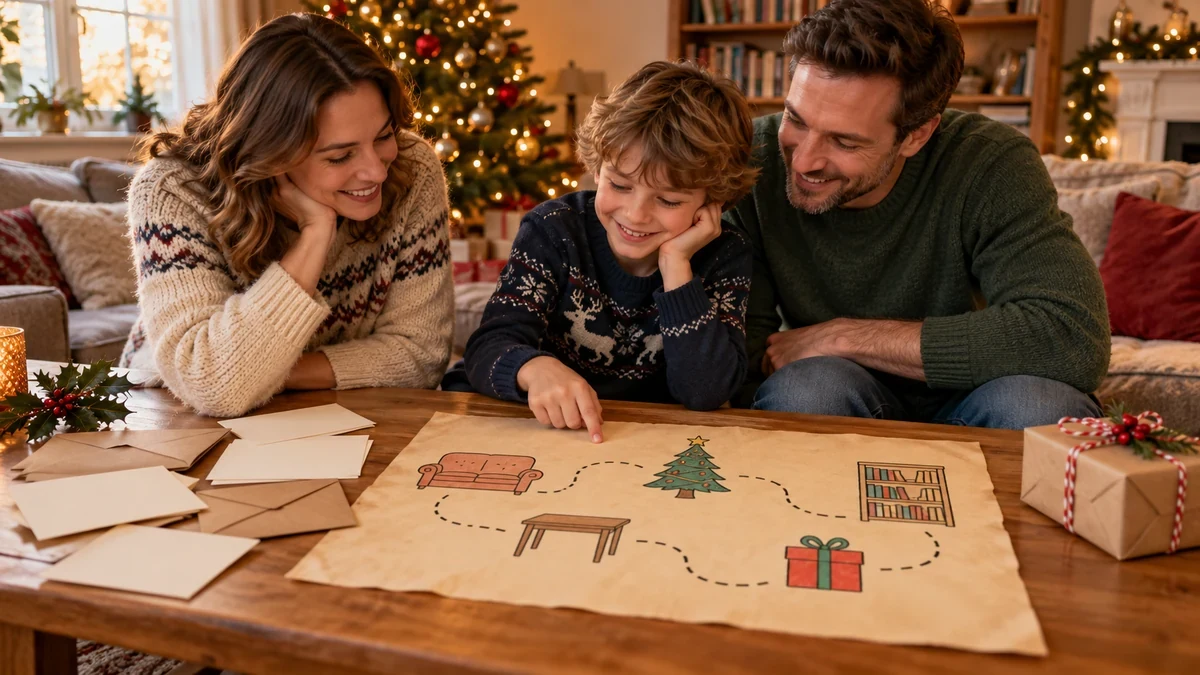
Choose challenges that are interesting without being discouraging. The age groups below are examples, not fixed rules about what a child can do.
Ideas for younger children
- Picture clues: show a checked landmark such as a sofa or a paper Christmas tree displayed at child height.
- Simple directions: try “Look beside the red paper tree”, with the clue visible and safely reachable.
- A short task: find a large picture card and bring it to the supervising adult.
Ideas for developing readers
- Picture and word: pair a drawing with a familiar word such as “stocking”.
- A short rhyme: use two clear lines that point to a single prepared location.
- A simple map: draw the room’s main furniture and mark one safe clue point with an X.
Ideas for confident readers
- A short riddle: write two or three lines with a definite answer.
- A simple code: supply a key such as A=1, B=2, or use arrows for a short sequence.
- A small puzzle: assemble a few suitable large pieces to reveal the next location.
Giving the map a theme
Draw a fictional Father Christmas island, a reindeer trail or a numbered North Pole route that corresponds to the actual room. Adjust the style to the group: clear pictures for younger children and a simple grid for those who understand it.
- Picture map: large drawings of the furniture and clue points.
- Numbered route: a sequence showing the order of the stops.
- Map puzzle: each solved clue supplies part of a map that reveals the final location.
Practical details
- Use sturdy cards or envelopes that can be opened easily without tools.
- Number clues discreetly so adults can check their order.
- Prepare an optional hint card for each difficult clue.
- Avoid small prizes for young children; a suitable book or a shared activity is often simpler.
- Offer tactile or recorded spoken clues when they help a participant, checking the materials and sound level first.
Example clues
- For a picture-led hunt: “Look beside the red stocking.” Hang the paper stocking at child height, away from a fireplace or heater.
- For a short rhyme: “Where we sit to read a book, beside the cushion take a look.” Put the clue beside a checked, reachable sofa cushion.
- For a number clue: “Start with 5 and add 3. Find the book labelled 8.” Prepare numbered books on a low shelf beforehand, with the clue visible beside the correct book.
Mix clue types while keeping the route coherent. Test the actual wording rather than assuming every child will interpret it as intended.
Rewards and keepsakes on a modest budget

A reward need not be expensive or edible. Aim for something suitable for the children and avoid unnecessary packaging or a large pile of disposable trinkets.
Possible rewards
- Age-appropriate toys or books: follow manufacturer guidance and check for loose parts. A small rubber ball or miniature is not a suitable default prize for young children.
- Shared experiences: choosing a song, a family film or a supervised decorating activity.
- Creative supplies: suitable colouring pencils, a drawing pad or other materials approved by the child’s carer.
- Food, if appropriate: keep ingredient labels and check suitability with carers, including cross-contact and choking risks. Sugar-free or gluten-free does not mean free of every allergen. Children should sit to eat, separately from the search. Source: GOV.UK: allergen labelling
Simple keepsakes using existing materials
- Felt decorations: an adult can make a flat ornament without loose small parts; treat it as decoration, not an automatically safe toy.
- A fabric keepsake pouch: use a simple adult-made pouch for an older child’s card or drawing. Do not fill a young child’s sensory bag with buttons or other loose choking hazards.
- Personalised paper cards: use suitable reused card and a drawing, without a loose string loop for young children.
- A supervised planting activity: offer older children an activity voucher rather than an unsupervised pot of soil and loose seeds; arrange adult help and handwashing.
Preparing simple keepsakes
- Choose materials: use clean paper or fabric offcuts and appropriate adult craft supplies.
- Make a template: draw an uncomplicated star or heart and prepare the pieces.
- Assemble in stages: cut, attach and decorate, keeping sharp tools and hot glue away from children.
- Add a message: use a first name or short greeting where appropriate, without unnecessary personal details.
Packaging and presentation
- Use a suitable envelope or reusable box rather than several layers of wrapping.
- Avoid unnecessary plastic, loose strings and ribbon loops around younger children.
- Retain genuine manufacturer age guidance and ingredient information; a homemade label is not a safety certification.
Ideas for different participants
- Around 3–4 years: a suitable picture book or shared story-time reward may work well.
- Around 5–7 years: consider appropriate drawing supplies or a simple activity chosen with carers.
- Around 8 and over: a suitable puzzle, shared experience or small game may appeal.
Final checks
- Tell carers what foods and materials are involved and ask about individual requirements.
- Check age warnings, condition and loose parts; packaging claims do not replace supervision.
- Offer a suitable non-food alternative without drawing attention to a child’s restrictions.
Practical tip: prepare a few keepsakes together beforehand if the family enjoys making things. Reuse supplies where suitable, but do not assume handmade always costs less.
Involving the family: roles, rules and a timetable
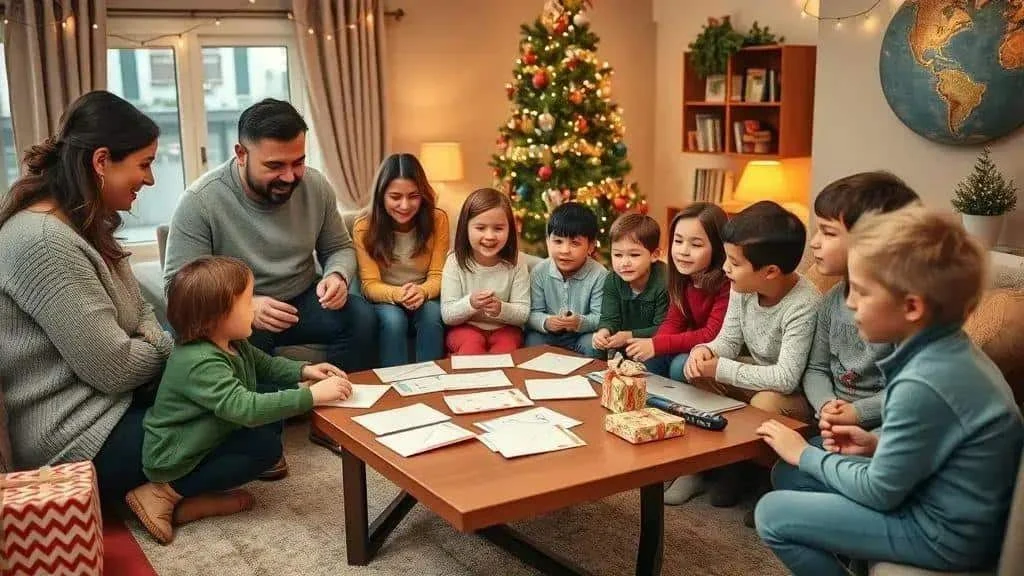
Agreeing roles helps the activity run smoothly. Adults should know their responsibilities before the children arrive.
Roles and responsibilities
- Adult coordinator: prepares the clues, checks the route and adjusts the timetable.
- Safety lead: checks the space and first-aid arrangements while making sure supervision is maintained throughout.
- Clue helper: explains tasks, offers hints and helps children take turns.
- Additional helpers: adults or teenagers can assist with materials and timing, but teenagers do not replace the required adult supervision.
- Optional photographer: asks before taking or sharing images and respects children’s wishes and parent or carer permissions. Source: NSPCC: photographing and filming children
Simple rules
- Listen to the supervising adult before starting.
- Stay within the agreed search area.
- Walk between clues; stairs and climbing are not part of the route.
- Leave sockets, fragile objects, appliances and other people’s belongings alone.
- Ask the clue helper if something is missing rather than searching elsewhere alone.
- Take turns and include everyone in the shared reward.
An example afternoon plan
- Welcome, around 10 minutes: settle the children and privately confirm relevant information with carers; avoid pin badges or neck cords.
- Rules and groups, 5–10 minutes: introduce the adults and show the boundaries.
- Practice clue, around 5 minutes: solve one example together.
- The hunt, perhaps 20–45 minutes: choose the shorter end for younger children and stop earlier if needed. Avoid keeping another group waiting unnecessarily.
- Optional seated snack break, 10–15 minutes: offer suitable food and water under supervision, separate from the game.
- Shared reward, around 10 minutes: celebrate the discoveries; photographs remain optional.
- Finish and tidy, 5–10 minutes: thank everyone, collect materials and check the space.
Practical tips
- Test the complete route with another adult beforehand.
- Assign clear responsibility for each group, with enough adult support for the setting and participants.
- Keep emergency contacts and relevant allergy information accessible to responsible adults, not publicly displayed.
- Provide a supervised quiet place and drinking water for children who need a break.
- Adjust the schedule to the children’s energy and reactions.
Adapting the hunt for small parties and schools
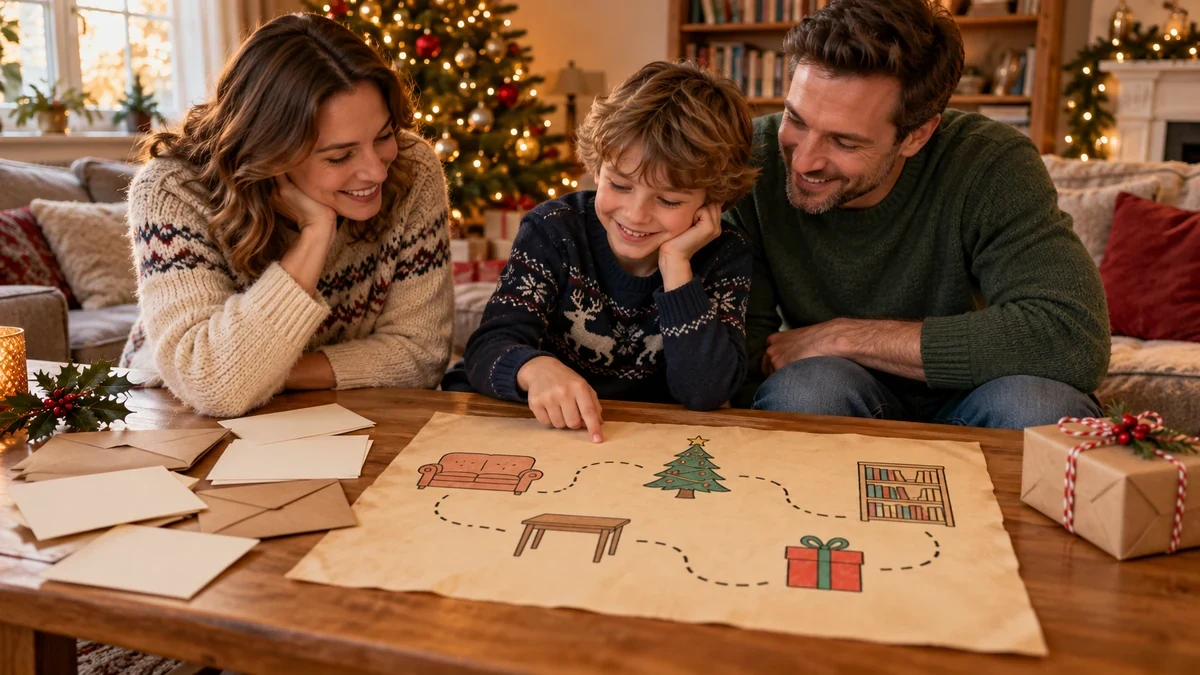
The same basic idea can work in different settings, but group size, supervision and available space matter more than a fixed number of clues.
Small gatherings
At home or in a small room, use short, visual clues, a few search points and a shared finish. One cooperative group may be simpler than several competing teams.
- Use one group, a few small groups or turns, depending on space and available adults.
- Four to six clues can be a starting point; add or remove stops to suit the children.
- Place clues visibly beside checked furniture or in shallow open boxes, without heavy lids or climbing.
- Twenty to thirty-five minutes is an example, not a target children must complete.
School events
Agree the activity with the school, follow its safeguarding and supervision arrangements and check access and allergy needs. Clues can practise reading, shapes or simple arithmetic without making the event feel like a test.
- Use classes or clearly supervised stations to manage movement.
- Adapt clue formats to the actual children, not only their school year.
- Plan adult supervision through the school’s requirements and a risk assessment. There is no universal ratio of one adult to six or eight children that suits every age, venue and need. Source: NSPCC: recommended adult-to-child ratios
Useful formats
- Separate turns: one group starts after another finishes, with a supervised activity for those waiting.
- Rotating stations: small groups move between staffed clue points.
- One shared route: everyone follows the same sequence with adults managing movement and helping participation.
Materials and logistics
- Use sturdy cards and suitable rewards, checking for sharp edges and detachable small parts.
- Show boundaries with clear signs and a walk-through; keep walking routes free of trailing tape or cords.
- Arrange a supervised rest point, water and first-aid provision.
Final checklist
- Confirm the children attending and their relevant needs.
- Define the space and test clues in order.
- Check allergies and restrictions privately with carers.
- Confirm supervision and arrival or collection arrangements.
- Prepare an alternative for unsuitable weather or a change of venue.
Conclusion
A Christmas treasure hunt works best when its clues and pace suit the children. A checked space, attentive adults and a shared goal can make the activity easier to enjoy.
Test the route, offer help and keep rules clear. Let children join in at their own level, and be willing to shorten the game or change the reward.
Thank you for reading. Visit the I Love Christmas blog for more seasonal activities and ideas to adapt for your family.
Christmas Treasure Hunt: Frequently Asked Questions
How do I choose suitable clues?
Start with pictures for children who are not reading, combine words and images for developing readers, and offer short riddles or explained codes to those who enjoy them. Test the clues and provide optional hints.
What should I check before the game?
Define and inspect the route, exclude hazards, choose age-appropriate materials and rewards, and agree attentive adult supervision and first-aid arrangements. Keep young children away from loose small parts.
What rewards work on a small budget?
A shared film choice, story or drawing activity may be enough. A suitable book or creative supply is another option. Check any physical or edible prize with carers rather than assuming it is safe for every child.
How long should the hunt last?
A short home game might take 20–35 minutes, while an older group may enjoy longer. These are planning examples: reduce the number of clues, offer breaks and finish when children have had enough.
How can I adapt it for a school or large event?
Work with the organisers, follow their safeguarding requirements and assess the actual group and venue. Use supervised stations or small groups, accessible clues and a clear timetable; do not rely on one fixed adult-to-child ratio.
Sources and Further Reading
- NHS: baby and toddler safety
- GOV.UK: allergen labelling
- NSPCC: photographing and filming children
- NSPCC: recommended adult-to-child ratios