
A Christmas wreath can represent welcome, continuity and hope. Its circular shape and evergreen foliage carry different meanings for different households, including Christian ideas of eternal life. Ancient wreaths, Advent wreaths and today’s door decorations have related visual features, but should not be treated as one unbroken tradition with a single origin.
Christmas wreath meaning goes beyond decoration: for many people, it is a welcoming sign at the entrance to a home. Why do we hang one on the front door, and what do the materials represent? Explore the history and symbolism, then find practical ways to choose, make and look after a wreath.
Illustrations in this article are conceptual images, not documentary photographs or evidence of a particular historical event, destination, venue or access route.
The history behind Christmas wreaths

Wreaths existed long before Christmas decorations. In the ancient Mediterranean world, leaf wreaths and crowns could mark honour, achievement or religious occasions. The Metropolitan Museum of Art describes a laurel wreath on a Roman portrait of Augustus as a symbol of victory. That example shows an older use of the form, not proof that today’s Christmas door wreath came directly from it. Source: The Metropolitan Museum of Art: Augustus with a laurel wreath
Older forms and Christian interpretations
Evergreen foliage stays green when many other plants lose their leaves, which makes it an evocative winter decoration. A circle can suggest continuity, and in Christian interpretations the greenery may symbolise eternal life and hope. These meanings developed in different settings; it is too simple to describe every Christmas wreath as an ancient pagan custom adopted unchanged by Christians.
Advent wreaths and door wreaths are different
Das Rauhe Haus in Hamburg records that Johann Hinrich Wichern introduced an Advent wreath there in 1839, using candles to help children count the days before Christmas. That is a documented story about an Advent practice, rather than a complete history of door decorations. A wreath on the entrance now commonly offers a festive welcome, whether or not the household gives it a religious meaning. Source: Das Rauhe Haus: Wichern and the Advent wreath
Materials and styles around the world
Available plants, climate and personal taste influence the design. Conifer branches and pine cones create one familiar winter look; olive or bay foliage offers another. Modern wreaths may include dried fruit, ribbons or reused decorations. These are choices rather than strict rules for particular regions, and practical considerations matter as much as symbolism.
What this history helps us understand
A wreath does not have to carry the same meaning for every household. Recognising the difference between an ancient ceremonial crown, an Advent wreath and a modern door decoration lets you enjoy the design without repeating an oversimplified origin story.
Religious meanings and broader seasonal symbolism

Christmas wreaths can bring together religious interpretation, memories and a love of seasonal decoration. Similar shapes and materials can appear in different traditions without having exactly the same meaning or a proven direct historical connection.
Christian interpretations
In some Christian readings, the circular wreath represents eternal life and victory over death. Its unbroken shape suggests eternity, while evergreen foliage expresses hope. Advent candles belong to a practice of preparation for Christmas. Colours such as green, red and gold can be given religious interpretations, but these are not universal rules for every wreath or denomination.
Looking beyond a single origin story
Older cultures used wreaths and plants in a variety of ceremonial settings. That does not establish that every modern Christmas wreath descends from one winter-solstice ritual. Ideas of renewal, protection and abundance may appear in interpretations of seasonal greenery, but it is better to describe them as beliefs and associations than as a proven history shared by all communities.
Symbols you might choose
- Evergreen foliage: continuity, resilience and life during the winter months.
- Red berries and fruit: colour and vitality; some Christian interpretations connect holly berries with the blood of Christ.
- Pine cones and seeds: a possible reminder of renewal and future growth, as well as an attractive texture.
- Bows and ribbons: a celebratory finishing touch that can carry family memories or favourite colours.
What a wreath can mean today
For many households, the central message is simply welcome. Others see Christian hope, a connection with nature or memories of making decorations together. You can choose a design that fits your beliefs and home without needing to assign a fixed meaning to every leaf or ornament.
Materials, colours and decorative details

The materials determine the wreath’s appearance, weight and care needs. Any symbolism is an extra layer of meaning, rather than a substitute for choosing something that will work safely on your door.
Common materials
- Evergreen foliage, such as pine, fir or cypress — gives a classic green appearance and can suggest continuity. Cut foliage still dries out, even when it comes from an evergreen plant.
- Holly and bay — offer glossy leaves and contrasting shapes. Identify plants correctly, wear gloves where appropriate and keep decorative foliage and berries away from children, pets and food; the RHS lists potentially harmful garden plants. Source: RHS: potentially harmful garden plants
- Pine cones and seeds — provide texture and may suggest renewal. Choose clean, sound pieces and attach them securely.
- Dried fruit and berries — add colour, but can deteriorate or become mouldy in damp conditions. Treat craft fruit as decoration rather than food.
- Ribbons and bows — bring colour and movement. Choose material suitable for the exposure and keep trailing ends clear of handles and hinges.
- Artificial foliage — may be reused for several seasons if cared for, but is not automatically rainproof or UV-resistant. Check whether it is intended for outdoor use.
Colour associations
- Green: life, hope and continuity.
- Red: warmth and celebration, or sacrifice and love in some Christian interpretations.
- Gold: light, richness and festivity.
- White and silver: a snowy appearance, brightness or a simple winter palette.
- Blue and purple: colours that appear in some religious traditions as well as contemporary decorative schemes. Their use varies rather than following one universal code.
The role of smaller details
Candles in an Advent wreath mark preparation for Christmas, but a hanging door wreath should never carry a naked flame. Bells can suggest celebration, while suitable lights bring out texture. Keep any lighting proportionate to the design and use only products appropriate for the location.
Practical choices with reuse in mind
- Start with a sound frame and decorations you already own. Local sourcing or a ‘recyclable’ label does not by itself settle the environmental impact; durability, transport and what your local collection accepts also matter.
- Dried or preserved foliage creates a different look, but remains combustible and may need a sheltered indoor position. It is not automatically longer-lasting outdoors.
- If you add LED lights, follow the manufacturer’s instructions for location, power supply and batteries. Use rechargeable batteries only where compatible, and never try to recharge a disposable battery.
- Keep the overall weight within the capacity of the door and fixing. Do not attach a wreath to a lock or handle in a way that interferes with its operation.
Choosing details for your entrance
- Check the exposure to rain, sun and wind. An artificial decoration needs an outdoor-use rating where relevant; its appearance alone does not establish weather resistance.
- Choose colours that work with the door and surrounding paintwork, or deliberately use a contrasting bow as a focal point.
- Leave enough space around the wreath for the door to open, close and latch normally.
- Add a small family keepsake or favourite ribbon if it is secure and suitable for the conditions.
Quick care reminders
Remove loose or deteriorating foliage and inspect lights and fixings. Fresh greenery may benefit from appropriate moisture, but do not spray dried, preserved or artificial materials indiscriminately. Remove electrical components before any wet care and follow their instructions; fresh foliage is not something to box up for next Christmas.
Choosing the right wreath for your front door
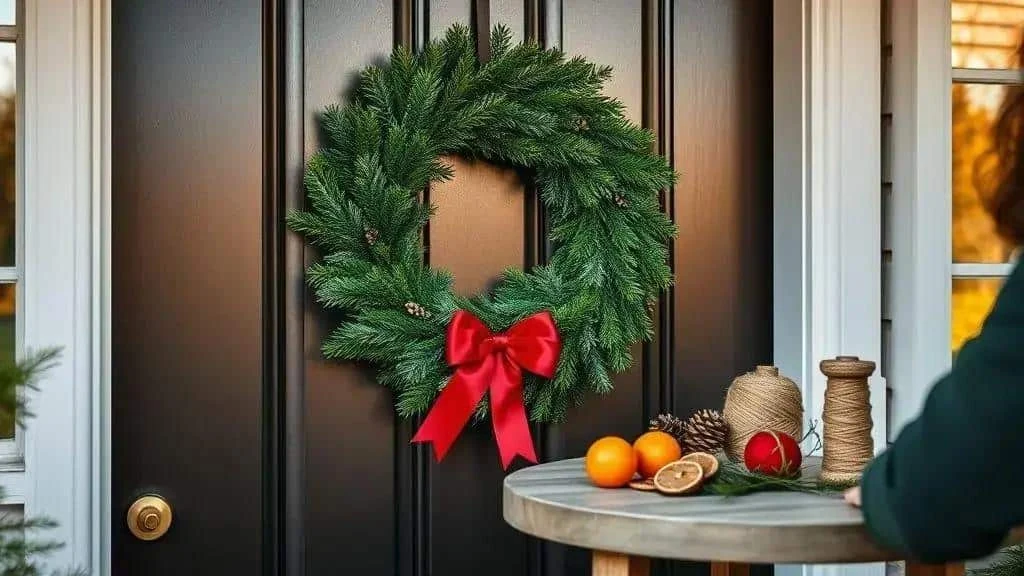
Look at the width, construction and use of the door before choosing a design. The wreath should fit the available space without covering a viewer, obstructing hardware or preventing the door from closing properly.
Size and proportion
As a design starting point, a diameter of around 40–60% of the door’s width can work. For doors 80–90 cm wide, that spans roughly 32–54 cm, depending on the width and proportion chosen. This is an aesthetic suggestion, not a safety standard; clearance, weight and the fixing matter more than the percentage.
Materials and weather
- Damp or exposed entrances: use decorations and fixings intended for those conditions, and inspect for water damage or mould. Neither natural nor artificial materials are automatically suitable.
- Cool, sheltered entrances: fresh conifer foliage can be attractive and fragrant, but still needs inspection and eventual replacement as it dries.
- A reuse-focused option: combine a durable frame with sound decorations you already own. Keep materials easy to separate for storage or disposal later. Source: RHS: making Christmas wreaths
Matching the house and door
A pale ribbon or red bow can stand out against a dark door; deep green foliage can contrast with a lighter one. Repeating a colour elsewhere in the entrance creates visual consistency. These are suggestions to adapt, rather than rules that require a matching set of new decorations.
Fixing the wreath safely
- Choose a fixing suitable for the door surface, environment and loaded weight, following its instructions. Check building or landlord requirements where relevant, especially for communal entrances and fire doors.
- A lightweight design may be better for a delicate or hollow door. Do not assume that a larger adhesive hook or a loop over the top is suitable without checking clearance and the manufacturer’s guidance.
- Avoid drilling, damaging seals or using a hanger that stops the door closing and latching correctly. For a fire door, do not make changes or add decorations that compromise its function or conflict with building rules.
Cleaning and storage needs
Fresh wreaths need seasonal care and should be dismantled when they deteriorate. Artificial wreaths and reusable decorations can be cleaned and stored once completely dry. Check lights and ornaments before display, and replace damaged components rather than concealing them in the foliage.
Personalising the design
A family ribbon or small keepsake can make the wreath distinctive. Keep a door wreath separate from any plan for a candle display: if you reuse it on a table, choose flameless candles rather than placing real flames among combustible materials.
Budget and useful life
Compare the full cost of the frame, foliage, decorations and fixing. Fresh materials may be inexpensive if you have suitable garden prunings; artificial wreaths vary greatly in price and quality. Reusing a good frame or existing ornaments may be more practical than buying a complete new wreath each year.
A short checklist before buying
- Measure the door and the clear space around its hardware.
- Check exposure to wind, rain and direct sunlight.
- Select a fixing appropriate to the surface and weight that will not compromise the door.
- Plan for seasonal maintenance, and storage of reusable parts afterwards.
- Choose a colour scheme you will enjoy rather than one that needs constant updating.
Making a simple Christmas wreath at home

- A wreath frame — a sound reusable wire or suitable natural frame, approximately 25–40 cm across for this project. Choose its size to fit your door; a foam base is not necessary.
- Greenery — enough identified, suitable branches to cover the frame without making it too heavy. The quantity depends on the foliage and design, so work in small bundles and check the total weight rather than aiming for a fixed kilogram amount.
- Florist’s wire or an appropriate binding — enough to secure the bundles, with cut ends tucked away safely.
- Secateurs and suitable wire cutters — use the correct tool for each material; these are adult tasks.
- Decorations — clean pine cones, dried orange slices, small ornaments or bows. Identify any berries and keep the finished decoration away from children or pets who may mouth it.
- Ribbon for a bow — about 2–3 metres is an example allowance, depending on width and bow size. Choose a ribbon suited to the location and avoid long trailing ends.
- Hot glue, if needed — only for compatible, lightweight details, following the product instructions. Hot glue can burn and is not a substitute for a reliable structural fixing.
A straightforward method
- Prepare the branches: cut manageable lengths, roughly 10–15 cm as a starting point, adjusting them to the frame and foliage.
- Make small bundles: group about 3–5 stems, or fewer for bulky foliage, and bind their bases securely.
- Attach the first bundle: lay it against the frame and wrap the binding around the frame and stem bases so it cannot slide free.
- Work in one direction: overlap the next bundle to cover the previous stems, keeping the thickness even without adding unnecessary weight.
- Secure every bundle: check the work regularly as you go. Do not leave several bundles unsecured and rely on the next one to hold them in place.
- Add decorations: attach cones and ornaments with suitable wire or bindings. Use compatible glue only for details where appropriate, and keep the weight balanced.
- Attach the bow: place it at the top or side, secure it and tuck away sharp wire ends. Check that ribbons will not catch in the door.
- Test the finished wreath: check all attachments, weigh it if necessary for the fixing’s limit, and confirm that the door still operates normally.
- Add lights only if suitable: use a set rated for the location and follow its instructions. Secure the cable and battery compartment without damaging them; keep batteries inaccessible to children, especially button batteries, and do not obstruct door hardware. Source: London Fire Brigade: Christmas fire safety Source: NHS: small objects and battery safety
- Care for it during display: inspect fresh foliage and remove it when it becomes brittle or deteriorates. At the end of the season, separate suitable plant material from reusable parts; store only clean, dry components, not a fresh wreath packed away intact.
Keeping the project practical
- Use suitable garden prunings only with permission and after identifying the plant. Wear gloves for prickly or irritating foliage and wash your hands afterwards.
- Dried orange slices can add a simple decorative touch. Keep them dry, remove them if mould appears and do not eat fruit that has been used in a craft arrangement.
- If you use artificial foliage outdoors, check the product guidance. Adding a synthetic section does not make the rest of a wreath weatherproof.
- Work on a stable table with a protective covering. If using hot glue, provide the heat-resistant surface specified for the tool rather than relying on newspaper alone.
Safe finishing touches
Adults should handle sharp tools and hot glue, following the equipment instructions. Keep loose wire, berries and ornaments away from young children and pets. Check the fixing and the condition of the wreath regularly, particularly after windy weather.
Caring for, storing and reusing a wreath
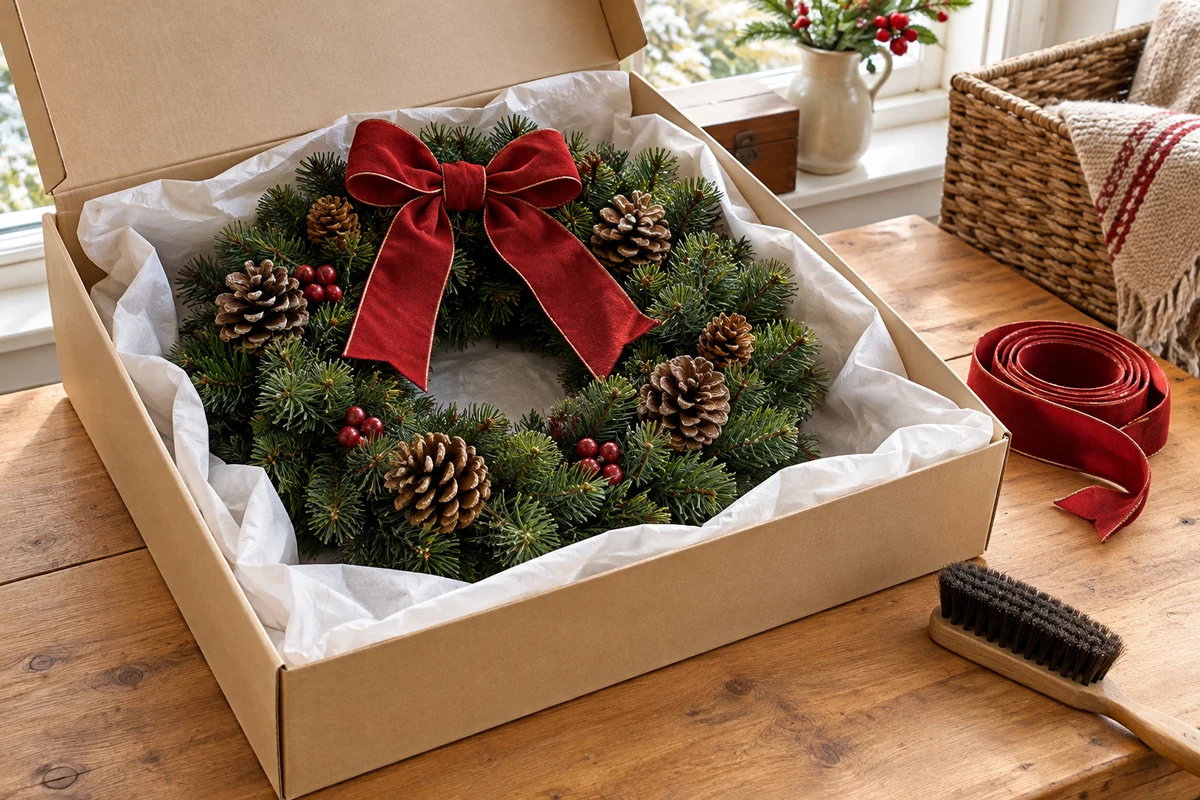
Regular inspection helps you spot loose ornaments, worn bindings and deteriorating foliage. Separate care during display from storage afterwards: reusable decorations can be kept, while fresh cut greenery has a limited life.
Cleaning and maintenance
- Remove loose debris: gently brush or shake away dust and fallen needles, taking care not to dislodge ornaments.
- Care for fresh greenery: follow appropriate advice for the foliage and base. If moistening it, remove electrical parts first and protect anything that may stain; do not apply the same treatment to dried or preserved materials.
- Clean artificial foliage: follow the manufacturer’s instructions. Some products allow a damp cloth; others need dry cleaning only. Let washable components dry completely before storing them.
- Inspect lights and batteries: disconnect power before maintenance, check for damage and remove batteries for storage where instructed. Keep removed batteries securely away from children.
- Repair loose attachments: use bindings or compatible materials appropriate to the ornament and setting. Do not cover damaged electrical wiring with glue or tape as a repair.
Storing reusable parts
- Place a clean, dry artificial wreath or dismantled reusable components in a rigid box or suitable wreath bag that protects their shape. Do not store fresh foliage in a closed box for next year.
- Use tissue paper or other clean, reused packing material to cushion delicate ornaments. Avoid crushing one wreath under another.
- Store in a cool, dry place away from strong light, and check that the contents are fully dry before closing the container.
- If a suitable desiccant sachet is used, keep it intact and out of reach of children and pets. It does not make damp foliage suitable for storage.
- During display, follow the materials’ exposure guidance. Heat and prolonged direct sunlight can dry fresh foliage and fade some decorations.
Simple repairs
- Replace a small missing fresh sprig while the rest of the wreath remains sound, securing it with a suitable binding.
- Replace corroded or weakened wire with material appropriate for the frame and location, tucking cut ends away safely.
- Remove broken ornaments and replace them with sound, lightweight pieces rather than leaving sharp edges hidden in the greenery.
- If fresh foliage is very dry or deteriorating, dismantle it and recover the reusable frame and ornaments. Adding new material over a brittle wreath does not solve the problem.
Ideas for a second use
- A table centrepiece: place a suitable wreath on a tray around a vase or flameless candle, keeping it away from food and out of children’s reach.
- Smaller decorations: carefully remove reusable ornaments or foliage sections and reattach them to smaller frames. Do not cut blindly through a wired arrangement.
- A vertical swag: dismantle the bindings and use suitable branches to make a hanging arrangement. Keep it clear of handrails needed for support, windows used for escape and door mechanisms.
- A framed wall decoration: secure a light wreath within a decorative frame, using a wall fixing rated for the combined weight.
- An Advent-inspired display: reuse a suitable base with flameless candles. Do not turn a combustible door wreath into a real-candle holder without a purpose-designed safe arrangement.
- Gift decorations: use small, securely attached ornaments on wrapping, keeping plant material separate from food gifts and away from young children.
- Composting: suitable untreated plant material may be composted after all wire, ribbons, plastic, glue-contaminated pieces and other unsuitable components have been removed. Follow local garden-waste rules if using a collection service.
Making reuse easier
- Repair a sound frame or attachment where practical instead of replacing the entire decoration.
- Keep ribbons and ornaments in good condition so they can be used in another design.
- Donate only clean, sound decorations, or arrange a community swap for reusable materials.
Safety when displaying and reusing
- London Fire Brigade advises keeping decorations away from naked flames. Use flameless candles for arrangements with foliage, and keep the whole display away from heat sources; LED lighting still needs to be suitable and used as instructed. Source: London Fire Brigade: candle and decoration safety
- Check the total weight and the fixing before hanging a reused decoration. Changes to the design may have made it heavier.
- Use suitable fixings without damaging seals or preventing the door from closing and latching. Observe any rules for communal entrances and fire doors.
A welcoming decoration with a meaning of its own
Knowing the different histories and interpretations of wreaths can make choosing one more enjoyable. A suitable design, sound fixing and realistic care plan help it welcome visitors throughout the season, whether you value its religious symbolism, family associations or simply its appearance.
Thank you for reading! Follow us on social media and explore the I Love Christmas blog for more seasonal inspiration and practical projects to try at home.
Frequently asked questions about Christmas wreaths
What does a Christmas wreath mean?
It can symbolise welcome, continuity and hope; some Christians interpret its circle and evergreen foliage as eternal life. Meanings vary, and ancient wreaths, Advent wreaths and modern door decorations should not be treated as one identical tradition.
Which materials work best for a door wreath?
It depends on exposure, weight and maintenance. Fresh foliage gives a classic appearance but dries out; artificial materials need to be suitable for the location and are not automatically waterproof. Identify plants correctly and keep berries and small decorations away from children and pets.
What size wreath should I choose?
Around 40–60% of the door width is one visual starting point. Across doors 80–90 cm wide, that means roughly 32–54 cm. More importantly, allow clearance for hardware and normal closing, and stay within the fixing’s weight limit.
How should I store a wreath after Christmas?
Clean and dry reusable parts, inspect lights, remove batteries as instructed and pack in a protective box in a dry place. Dismantle fresh wreaths rather than storing the foliage for next year, separating suitable plant material for composting from the frame and ornaments.
Can I make an inexpensive wreath at home?
Yes, if you have suitable prunings, a reusable frame and sound decorations. Work with manageable bundles and secure each one. Lighting is optional; check the full cost and safety requirements rather than assuming a battery-powered set is always cheap or suitable outdoors.
Sources and Further Reading
- The Metropolitan Museum of Art: Augustus with a laurel wreath
- Das Rauhe Haus: Wichern and the Advent wreath
- RHS: potentially harmful garden plants
- RHS: making Christmas wreaths
- London Fire Brigade: candle and decoration safety
- London Fire Brigade: Christmas fire safety
- NHS: small objects and battery safety