Savoury stuffed panettone makes a versatile festive starter. This guide covers chicken, cheese, smoked salmon and vegetable fillings, followed by variations, dietary adaptations and practical advice on assembly, refrigeration and serving. Use a plain savoury panettone suitable for filling, rather than assuming a sweet fruit panettone will give the same result.
Savoury stuffed panettone brings a different centrepiece to a Christmas buffet. The Brazilian-style fillings below range from creamy chicken to sun-dried tomato and rocket, with ideas for adapting them to your guests. There are four main filling combinations followed by further variations; choose a few rather than feeling you must prepare them all.
Why choose savoury panettone for festive starters?

A savoury panettone can be a practical, attractive festive starter: the filled slices look striking, the fillings are flexible and some preparation can be done ahead.
Advantages of savoury panettone
- Convenient preparation: prepare suitable fillings ahead and assemble close to serving, following the chilling guidance below.
- An appealing presentation: colourful filled slices add interest to the table without elaborate decoration.
- Versatility: try cold or hot fillings, from chicken with Catupiry — a Brazilian creamy cheese spread — to sun-dried tomato and rocket.
- Easy serving: individual slices work well at a buffet or reception.
- Dietary adaptations: suitable bread and filling combinations can accommodate different diets. Check every ingredient and preparation surface; a single cheese swap does not make the whole dish vegan, gluten-free or suitable for a milk allergy.
Serving and pairing ideas
- Temperature: keep cold, perishable fillings chilled until serving. Serve hot versions promptly after heating thoroughly; melted cheese on top does not show whether the centre is hot.
- Drinks: citrus-flavoured soft drinks or juice can complement the fillings. Adults who drink alcohol might choose a light wine, sparkling wine or a mild beer.
- Assembly: use a serrated knife and arrange the slices on a tray with washed, dried salad leaves for contrast.
- Portions: allow roughly 1–2 slices per guest, depending on slice size and the other starters.
Preparation and storage guidance
- Heating: wrapping the loaf in foil and using an oven at 160°C can help keep the bread soft. The original 8–12 minutes is only a finishing guide for a filling already hot throughout, not a safe reheating time for a cold stuffed loaf. Reheat cooked fillings only once, until steaming hot throughout; a thermometer can check 70°C for 2 minutes or 75°C for 30 seconds at the coldest point. Temperatures below refer to a conventional oven; adjust for a fan oven according to its guidance.
- Preparing ahead: prepare suitable cold fillings the day before and refrigerate promptly. Assemble only a few hours before serving and keep the filled bread in the fridge to limit sogginess and maintain safe storage.
- Keeping leftovers: refrigerate perishable fillings at 0–5°C and use within 48 hours of preparation, or sooner if an ingredient’s label requires it. Assembly does not restart that storage period. Cool cooked food and refrigerate within 1–2 hours; do not keep repeatedly reheating leftovers.
- Simple variations: change the herbs, seasonings or cheese to make different versions from a shared base.
Attention to the filling, temperature and presentation helps make savoury panettone a useful option for a festive gathering.
Planning a selection of savoury panettones for Christmas
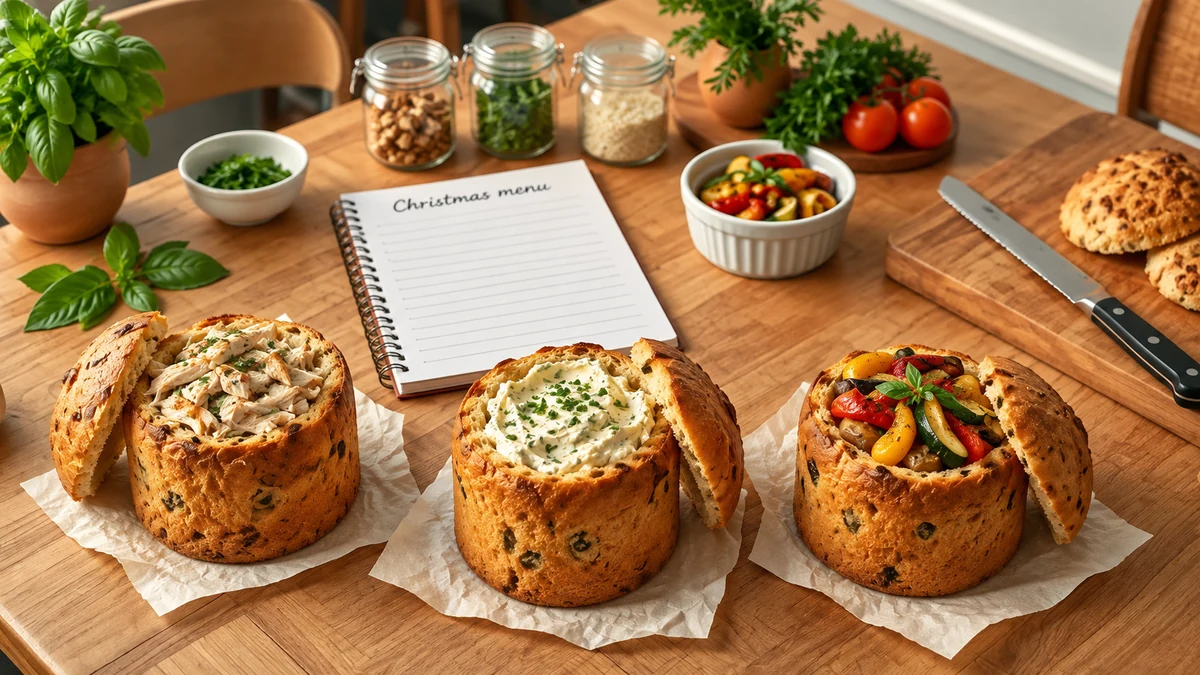
When planning several savoury panettone fillings, think about variety, fridge space and the time needed to assemble and serve them.
Essential checklist
- Guest numbers: allow around 1–2 slices each, taking the other appetisers into account.
- Number of loaves: a medium loaf might give 12–16 small slices, depending on its shape and filling. For 20 guests, 2–3 loaves is a starting estimate, not a guaranteed yield; check the size you buy.
- Filling choices: offer a few contrasting options, perhaps meat, cheese and a genuinely vegetarian or vegan version.
- Equipment: a serrated knife, spatula, oven trays, foil, serving platters and covered containers for fillings.
- Storage: reserve enough fridge space and suitable covered containers.
A practical timetable
- Three days before: buy the bread and non-perishable ingredients, check use-by dates and scale the recipes to your guests.
- Two days before: plan the fillings and organise equipment. Do not make every perishable filling this early if you also want to keep leftovers after the celebration; its storage time starts when it is prepared.
- The day before: prepare fillings suitable for overnight refrigeration, cool cooked ingredients promptly and label the containers. A small trial portion can help you check texture and seasoning.
- On the day: assemble cold versions a few hours before serving and refrigerate. Cook or thoroughly reheat hot fillings once, close to serving time.
- Shortly before serving: finish hot versions, arrange small batches on trays and add fresh garnishes. Keep reserve cold portions in the fridge until needed.
Balancing flavours and textures
- Contrast textures: pair a creamy filling such as Catupiry or cream cheese with a suitable crunchy addition, such as toasted nuts or crisp onions.
- Vary the intensity: include both robust savoury fillings and milder options.
- Add fresh herbs last: this helps retain their colour and aroma.
Planning the shopping
- Bread: start with 2–3 medium savoury loaves and adjust to your guest numbers. The following quantities are planning examples, not the exact combined shopping list for every recipe; add up the fillings you actually choose.
- Meat, fish or vegetable fillings: possible shopping quantities include 600–800 g cooked shredded chicken, 400 g smoked salmon or 500 g mushrooms, depending on the combinations and number of loaves.
- Dairy: 300–400 g Catupiry or cream cheese and 200–300 g grated cheese may suit a small selection, but check each recipe before buying.
- Vegetables and herbs: sun-dried tomatoes, rocket, red onion, basil and parsley.
- Extras: olives, chopped nuts, pesto, olive oil and lemon, as required for the chosen fillings.
Dietary adaptations
- Gluten-free: use a labelled gluten-free savoury loaf or suitable gluten-free rolls, then check the fillings and avoid cross-contact during preparation.
- Vegan: choose bread without eggs, dairy or other animal-derived ingredients, use plant-based spreads and choose vegetable or tofu fillings. Check pesto and other sauces too.
- Lactose-free: choose suitable lactose-free bread and dairy products, or appropriate plant-based alternatives. Lactose-free dairy still contains milk proteins and is not suitable for a milk allergy; nut-based spreads introduce their own allergens.
Assembly and presentation tips
- Even slices: mark the loaf before cutting with a serrated knife.
- Serving: arrange slices on platters with salad leaves and small bowls of accompanying sauces.
- Clear labels: identify each filling and its ingredients and allergens. Decorative colour markers alone are not enough.
A little planning helps limit waste and makes it easier to serve a varied festive selection.
Main fillings: ingredients, methods and variations

Chicken and Catupiry panettone
Ingredients for chicken and Catupiry panettone
- 1 medium savoury panettone (500 g) — choose a plain loaf suitable for filling; cut off a lid as described below.
- 500 g cooked, shredded chicken breast — seasoned; cooked roast chicken is an alternative. This is the cooked weight, not 500 g raw chicken.
- 200 g Catupiry or cream cheese — for a creamy filling. Plant-based cream cheese changes the dairy component but does not make a chicken filling vegan.
- 1 small onion — finely chopped.
- 2 garlic cloves — finely chopped.
- 2 tablespoons olive oil — for cooking the onion and garlic.
- Salt and black pepper to taste
- Chopped parsley and chives — the Brazilian herb mixture known as cheiro-verde, to finish.
How to make chicken and Catupiry panettone
- Soften the aromatics: heat the 2 tablespoons of oil and gently cook the onion and garlic until softened, without burning the garlic.
- Add the chicken: stir in the cooked, shredded chicken and season. Stir for 2–3 minutes to combine, but if reheating chilled chicken continue until steaming hot throughout; the clock alone is not a safety check.
- Add the cheese: stir in the Catupiry or cream cheese until creamy. For a hot serving, ensure the filling remains steaming hot throughout before assembly. For a cold version, cool promptly in a shallow container and refrigerate within 1–2 hours.
- Prepare the bread: cut off the top and remove some of the soft centre, leaving a sturdy base and walls. Save the removed bread for another use.
- Fill: spoon in the creamy chicken without forcing in more than the loaf can hold. Keep any excess filling separately and refrigerate promptly.
- Finish: replace the lid. If the filling is already hot throughout, 8–10 minutes at 160°C can warm the bread; this is not a reliable reheating time from cold. Serve promptly and do not repeat reheating.
- Serve: slice with a serrated knife and scatter with parsley and chives.
Chicken and Catupiry variations
- Crisp bacon: add 100 g bacon, cooked until crisp and chopped.
- Sweetcorn and peas: add ½ cup drained sweetcorn and ½ cup peas, prepared according to the packet. Cup measures here use a 240 ml measuring cup.
- Reduced-fat cream cheese: use a reduced-fat product and chicken cooked without additional oil if desired; the full dish’s fat content depends on all its ingredients.
Sun-dried tomato, rocket and cheese panettone
Ingredients for sun-dried tomato, rocket and cheese panettone
- 1 medium savoury panettone (500 g)
- 150 g sun-dried tomatoes — drained or rehydrated as appropriate, then chopped; slow-roasted tomatoes are an alternative.
- 100 g rocket — washed and dried thoroughly.
- 200 g mozzarella or provolone — sliced or grated; choose vegetarian-labelled cheese if needed.
- 2 tablespoons olive oil — to drizzle over the filling.
- Black pepper and oregano to taste
How to make sun-dried tomato, rocket and cheese panettone
- Prepare the filling: chop the drained tomatoes and dry the washed rocket with kitchen paper or a salad spinner.
- Prepare the loaf: cut off the lid, remove some of the centre and line the cavity with cheese.
- Add the tomatoes: spread them over the cheese and drizzle with the olive oil.
- Add the leaves: finish with rocket, black pepper and oregano. For a warmed version, reserve the rocket until after warming if you prefer it crisp.
- Optional warming: about 5–7 minutes at 160°C may soften the cheese, depending on the loaf. This is a serving preference for ready-to-eat ingredients, not a cooking step that makes unsuitable ingredients safe.
- Slice and serve: add any reserved rocket and serve promptly. Keep cold portions refrigerated until needed.
Sun-dried tomato, rocket and cheese variations
- Walnuts: add ⅓ cup chopped walnuts for crunch, subject to guests’ allergies.
- Pesto: spread 2 tablespoons inside the bread before adding the cheese. Use vegetarian or vegan pesto where required.
Smoked salmon and cream cheese panettone
Ingredients for smoked salmon and cream cheese panettone
- 1 medium savoury panettone (500 g)
- 200 g ready-to-eat smoked salmon — thinly sliced. Cold-smoked salmon is not fully cooked. Pregnant people and those with weakened immunity should avoid eating it cold; use an appropriate thoroughly cooked alternative. Older guests should also consider the listeria risk.
- 200 g cream cheese — stir to soften rather than leaving it out for a prolonged period.
- 1 tablespoon lemon juice
- Chopped dill or chives — to taste.
- Freshly ground black pepper
How to make smoked salmon and cream cheese panettone
- Season the cream cheese: mix with the lemon juice, pepper and herbs. Lemon juice does not cook the fish or remove its food-safety risks.
- Prepare the bread: open the loaf and spread the seasoned cream cheese inside.
- Add the salmon: distribute the slices evenly without compressing them too firmly.
- Chill: refrigerate for 20–30 minutes to firm up before slicing, and keep chilled until serving.
- Serve cold: slice and garnish with dill or chives. Follow the fish’s storage and use-by instructions, including any shorter limit after opening.
Smoked salmon and cream cheese variations
- Capers: add 1 tablespoon chopped, drained capers.
- Cucumber: add thin slices of washed cucumber for freshness, patting them dry first.
Vegetarian pesto and roasted vegetable panettone
Ingredients for vegetarian pesto and roasted vegetable panettone
- 1 medium savoury panettone (500 g) — check that the bread is vegetarian.
- 1 cup roasted vegetables — diced pepper, courgette and aubergine, measured after roasting.
- 100 g vegetarian pesto — bought or made using a suitable recipe; ordinary pesto may contain cheese made with animal rennet.
- 50 g grated vegetarian hard cheese — use a vegetarian Parmesan-style alternative, as traditional Parmigiano Reggiano is not vegetarian. For a vegan version, choose a plant-based alternative and check the bread and pesto too.
- 2 tablespoons olive oil
- Salt, pepper and herbs to taste
How to make vegetarian pesto and roasted vegetable panettone
- Roast the vegetables: dice, toss with the oil, salt and pepper, and roast at 200°C for about 20–25 minutes, until tender and beginning to colour. Measure 1 cup for the filling.
- Prepare the pesto: use a suitable ready-made vegetarian pesto or your usual measured recipe with basil, pine nuts or walnuts, olive oil and vegetarian hard cheese. These ingredient suggestions are not a separate fully measured pesto recipe.
- Assemble: open the loaf, spread pesto inside and add the roasted vegetables.
- Add the cheese: scatter the vegetarian hard cheese or plant-based alternative over the vegetables.
- Optional warming: 6–8 minutes at 160°C may warm the bread when the vegetables are freshly cooked and hot. Previously chilled cooked vegetables must instead be reheated until steaming hot throughout, not merely warmed for this fixed time.
- Slice and serve: garnish with fresh basil and serve promptly, or follow the cold-storage guidance for a chilled version.
Vegetarian pesto and roasted vegetable variations
- Grilled tofu: add cooked tofu cubes for a different texture and protein source.
- Goat’s cheese: replace the hard cheese with a vegetarian-labelled goat’s cheese for a tangier flavour.
Ingredients for chicken and Catupiry panettone
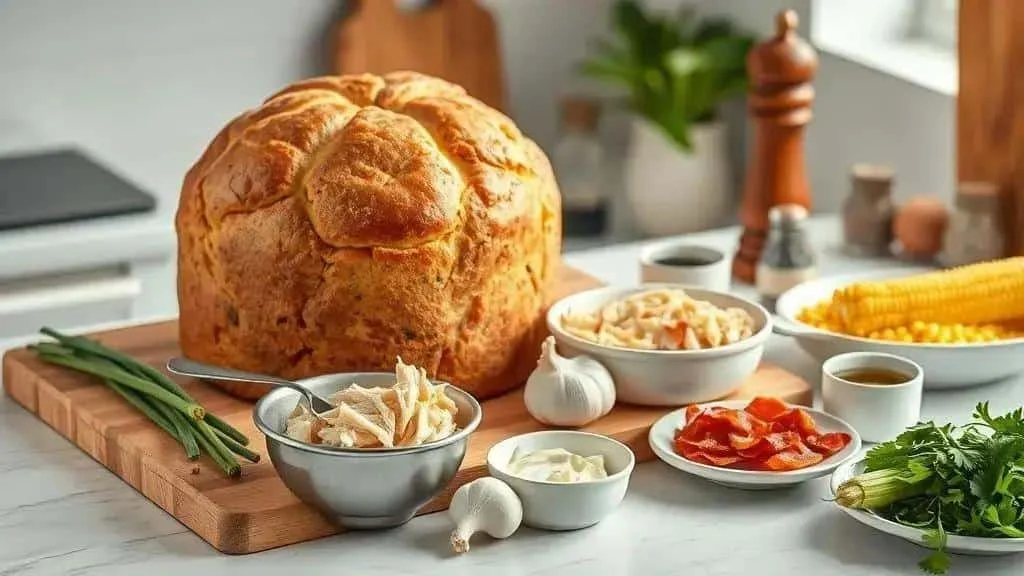
For a more detailed version of the chicken and Catupiry panettone, use the ingredients and substitution notes below. The chicken quantity is cooked weight throughout.
- 1 medium plain savoury panettone (about 500 g) — suitable for filling; a large sturdy round bread loaf is an alternative, although its texture will differ.
- 500 g cooked, shredded chicken breast — seasoned; alternatives include cooked roast chicken or well-drained canned chicken used according to its label.
- 200 g Catupiry or cream cheese — stir to soften. Plant-based cream cheese or a nut spread can replace the dairy component, but the chicken must also be replaced for a vegan dish.
- 1 small onion (about 80 g) — finely chopped; red onion gives a different colour and flavour, not necessarily a milder one.
- 2 garlic cloves — chopped or crushed; alternatively, start with a little garlic powder and taste. The original 1 teaspoon can be quite strong and is not an exact equivalent to two cloves.
- 2 tablespoons olive oil — alternatively, use vegetable oil or butter for a different flavour.
- Salt to taste — add gradually, as the cheese and any pre-seasoned chicken may already be salty; there is no need to start with a full teaspoon.
- Freshly ground black pepper to taste — up to about ½ teaspoon as a flavour guide, adjusted to preference.
- 2 tablespoons chopped parsley and chives — or basil for a different aroma.
- ½ cup sweetcorn, optional — drained ready-to-eat sweetcorn or cooked according to the packet; cooked peas are an alternative.
- 100 g bacon, optional — cook until crisp and chop. Crisp onions or toasted nuts can replace the bacon, but the chicken filling itself remains non-vegetarian.
Useful notes
- Filling temperature: mix the cheese into the hot chicken so it blends easily. Serve hot after thorough heating, or cool quickly and refrigerate before cold assembly; do not leave the filling on the worktop until the event.
- Texture: a little milk loosens a stiff filling. Extra cream cheese changes the richness and consistency but is not guaranteed to make every brand’s filling firmer; add gradually.
- Reduced-fat option: choose reduced-fat cream cheese and chicken cooked without additional oil if preferred.
- Gluten-free option: choose a suitable gluten-free loaf, check every filling ingredient and prevent cross-contact.
- Storage: keep the prepared filling covered at 0–5°C and use within 48 hours of preparation, or sooner if an ingredient’s label requires it. Count any earlier storage of cooked chicken as well.
How to make chicken and Catupiry panettone

Follow these detailed steps for chicken and Catupiry panettone. Choose either a hot serving or a chilled make-ahead version, and avoid repeatedly warming and cooling the filling.
- Cook the chicken if starting from raw: poach enough chicken breast to provide 500 g after cooking and shredding; 500 g raw will yield less. A bay leaf and ½ an onion are optional poaching aromatics, additional to the onion used in the filling. The original 20–25 minutes is only a guide: check the thickest part reaches 75°C for 30 seconds or 70°C for 2 minutes. Alternatively, use safely stored cooked chicken.
- Shred: let freshly cooked chicken cool only enough to handle, then shred with two forks. A mixer on low speed is another option if suitable for your equipment; avoid splashing hot food.
- Cook the aromatics: heat the 2 tablespoons of olive oil and soften the chopped onion and garlic. Allow longer than 2–3 minutes if needed and avoid scorching the garlic.
- Add the chicken: stir in the shredded chicken, season and cook for a few minutes to combine. If using chilled cooked chicken for a hot meal, heat it until steaming hot throughout, rather than relying on 2–3 minutes.
- Mix in the cheese: stir in 200 g Catupiry or cream cheese until smooth. Reduced-fat cream cheese is an option if preferred.
- Adjust the consistency: loosen with 1–2 tablespoons milk if needed. An extra tablespoon of Catupiry changes the creaminess; add gradually rather than treating it as a guaranteed thickener. Keep a hot serving steaming hot throughout.
- Prepare the loaf: cut off a lid with a serrated knife and remove some of the centre. Leave at least about 1 cm at the sides, and more if the bread is soft, with a sturdy intact base so the filling cannot break through.
- Fill: spoon the filling into the cavity without packing it too tightly, then replace the lid. The amount it holds depends on the loaf; keep excess filling separately.
- Finish hot or chilled: for an already-hot filling, wrap in foil and warm the bread at 160°C for about 8–12 minutes, then serve promptly. For a cold version, cool and refrigerate the filling promptly before assembly; a further 20–30 minutes in the fridge may firm the assembled loaf, but cannot replace proper cooling. Do not reheat a filling again after it has already been reheated once.
- Slice: cut gently with a serrated knife, allowing roughly 1–2 slices per guest according to the rest of the menu.
Quick tips
- Limit moisture: use a well-drained filling and, for a cold loaf, chill it before assembly so steam does not soak the bread.
- Add variety: cooked sweetcorn, peas or crisp bacon give extra texture.
- Watch storage time: keep covered in the fridge and use within the original filling’s 48-hour limit or any shorter ingredient limit. Reheat only once and thoroughly, if appropriate; foil helps prevent the bread drying out.
- Present simply: arrange slices with washed salad leaves or small bowls of sauce.
Chicken and Catupiry variations

Chicken and Catupiry variations — where a variation uses 200 g of the base filling, it is a smaller test quantity, not the full 500 g chicken recipe. Scale it to the number and capacity of your loaves rather than assuming every variation fills a whole panettone.
Crisp bacon and golden onions
- 100 g bacon — cooked until crisp and chopped.
- 1 medium onion — thinly sliced.
- 1 tablespoon sugar — optional, for a sweeter glazed onion. Also allow 1 tablespoon olive oil for cooking the onion, as used in the method.
- 200 g prepared chicken and Catupiry filling — made using the base recipe.
- Cook the bacon: fry until cooked and crisp, then drain on kitchen paper and chop.
- Cook the onion: soften in 1 tablespoon olive oil, add the optional sugar and cook until tender and golden. The original 5–8 minutes gives lightly glazed onion, not necessarily deeply caramelised onion; allow longer over gentle heat if needed.
- Combine: gently fold the bacon and onion into the chicken filling.
- Fill and serve: assemble as in the base recipe, following the same hot-serving or chilled-storage instructions. Do not add another reheating cycle to a filling already reheated.
Sweetcorn, peas and fresh herbs
- ½ cup sweetcorn — prepared as required and drained.
- ½ cup peas — cooked and drained.
- 2 tablespoons chopped parsley and chives
- 200 g prepared chicken and Catupiry filling
- Drain well: remove excess moisture from the sweetcorn and peas.
- Combine: fold the vegetables and herbs into the prepared chicken filling.
- Taste and adjust: check salt and pepper before filling the bread.
Mozzarella and oregano topping
- 150 g grated mozzarella — for the topping.
- 1 teaspoon dried oregano
- 200 g prepared chicken and Catupiry filling
- Fill the bread: add the filling, leaving space above it for the cheese.
- Add the topping: scatter with mozzarella and oregano.
- Brown the cheese: bake at 180°C for about 6–10 minutes until bubbling and lightly coloured. This only describes browning the topping: the chicken filling must also be steaming hot throughout, within a single reheating cycle.
Reduced-fat cream cheese and grilled chicken
- 200 g reduced-fat cream cheese
- 500 g cooked, shredded grilled chicken — cooked without additional oil if preferred.
- 1 tablespoon plain yoghurt, optional — to loosen the filling.
- Mix: combine the chicken and cream cheese, adding the yoghurt if needed for consistency.
- Season: add salt, pepper and herbs to taste.
- Assemble and serve chilled: use safely cooled and refrigerated ingredients, fill the bread and keep it chilled until serving. Serving cold does not itself change the dish’s fat content.
Chilli and pickled biquinho peppers
- 1 dedo-de-moça chilli — deseeded and finely chopped; a red chilli of your preferred heat is an alternative, added gradually.
- 2 tablespoons pickled biquinho peppers, optional — drained and chopped; these small Brazilian peppers are usually mild, but check the product.
- 200 g prepared chicken and Catupiry filling
- Prepare the chilli: remove seeds and some of the inner membrane for a milder result, then chop finely. Wash hands afterwards and avoid touching your eyes.
- Combine: add the peppers to the filling a little at a time and taste for heat.
- Label clearly: identify this as the spicy version when serving.
Walnuts and fresh herbs
- ⅓ cup chopped walnuts — lightly toasted.
- 2 tablespoons chopped fresh herbs — basil or parsley.
- 200 g prepared chicken and Catupiry filling
- Toast the walnuts: stir in a dry frying pan for about 2–3 minutes, until fragrant, watching carefully to prevent burning.
- Combine: fold the nuts and herbs into the filling.
- Assemble: fill the loaf and garnish with chopped nuts if appropriate. Do not serve whole nuts to children under five, and check guests’ allergies.
Individual mini savoury panettones
- 6 mini savoury panettones (100–150 g each) — these are individual starters, not necessarily one-bite canapés.
- Chicken and Catupiry filling — scale to the combined capacity of the mini loaves.
- Herbs or suitable garnishes — to finish each portion.
- Divide the filling: share it between the loaves according to their size, keeping any excess separately.
- Fill gently: spoon into each loaf without compressing too firmly.
- Present: arrange on individual plates and garnish with herbs or a thin slice of cheese. Follow the base recipe’s temperature and storage guidance.
Ingredients for sun-dried tomato, rocket and cheese panettone
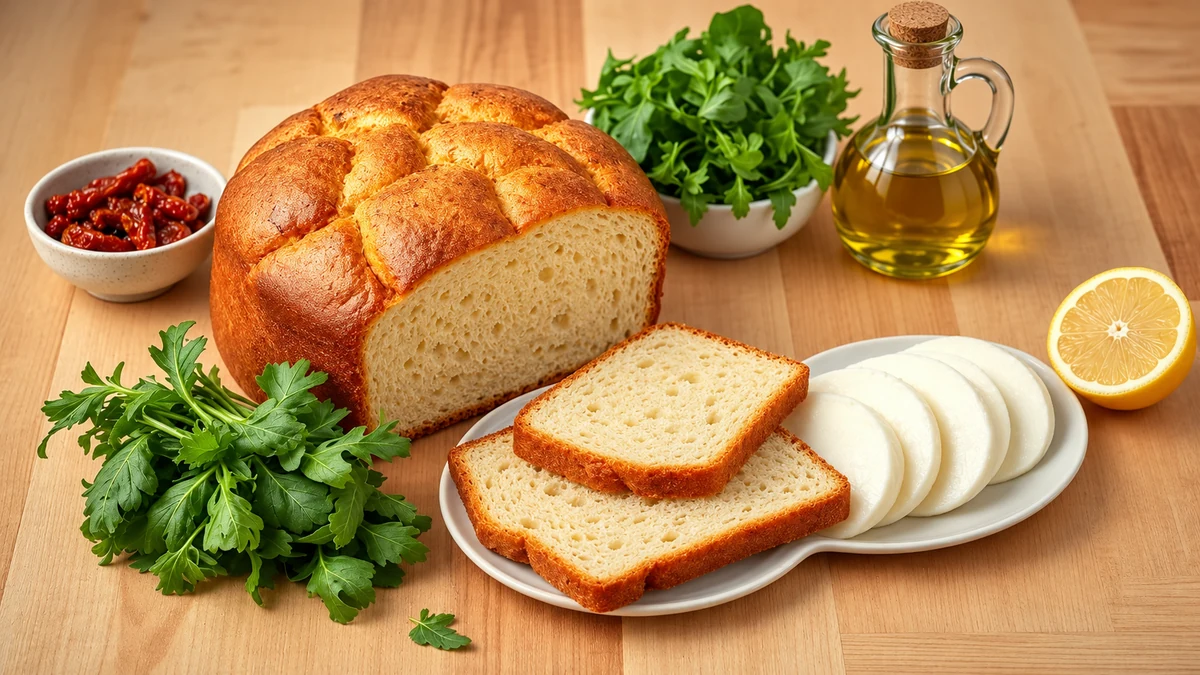
For this more detailed sun-dried tomato, rocket and cheese panettone, gather the following ingredients. The extra hard cheese and optional balsamic finish are additions to the simpler version above.
Ingredients for sun-dried tomato, rocket and cheese panettone
- 1 medium plain savoury panettone (about 500 g) — suitable for filling; a sturdy round bread loaf is an alternative.
- 150 g sun-dried tomatoes — drained from oil or rehydrated as appropriate, then chopped; alternatively, use 150 g well-drained slow-roasted tomatoes.
- 100 g rocket — washed and dried well; watercress or mixed baby leaves are alternatives.
- 200 g mozzarella or provolone — sliced or grated; goat’s cheese or a plant-based cheese gives a different variation. Check suitability for the intended diet.
- 50 g grated Parmesan or a suitable alternative — to scatter over. Choose vegetarian-labelled hard cheese for a vegetarian version, or a plant-based alternative for a vegan one.
- 2 tablespoons extra virgin olive oil — or a milder olive oil.
- 1 teaspoon dried oregano
- Freshly ground black pepper to taste — around ¼–½ teaspoon as a starting flavour guide.
- Salt to taste — tomatoes and cheese may already be salty; taste before adding any, rather than automatically adding ¼ teaspoon.
- 1 tablespoon balsamic vinegar or glaze, optional — add gradually; glaze is sweeter and thicker than vinegar. A little lemon juice gives a different sharp finish.
Useful notes
- Sun-dried tomatoes: if very salty, rinse or briefly soak as suitable for the product, then drain and pat dry. Follow preparation and storage instructions on the packaging.
- Rocket: dry it thoroughly to reduce sogginess.
- Cheese: choose a texture suited to a cold filling or to gentle melting, according to how you intend to serve it.
- Vegan version: use bread free from eggs, milk and other animal-derived ingredients, plus plant-based cheeses and suitable sauces. Gluten-free is a separate requirement, not part of the definition of vegan.
How to make sun-dried tomato, rocket and cheese panettone
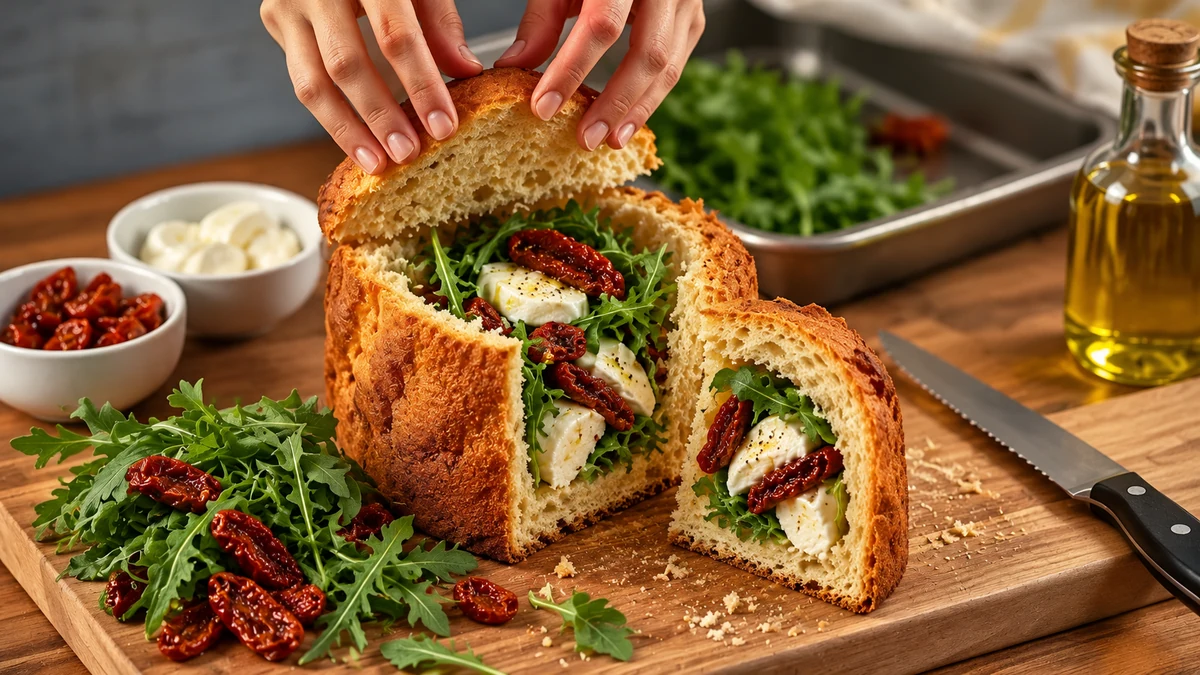
- Prepare the tomatoes: drain oil-packed tomatoes and chop. Rehydrate dry tomatoes according to the packet; around 10 minutes in warm water may suit some products, but drain thoroughly afterwards.
- Dry the rocket: wash, then use kitchen paper or a salad spinner to remove excess water.
- Prepare the cheese: slice thinly or grate the mozzarella or provolone.
- Open the loaf: cut off a lid and remove some of the centre with a serrated knife. Leave a firm base and sides at least about 1 cm thick, or thicker if necessary to keep the bread intact.
- Line with cheese: cover the base of the cavity; this may slow moisture soaking into the bread but does not make it waterproof.
- Add the tomatoes: distribute the chopped tomatoes evenly over the cheese.
- Add rocket: place the dry leaves on top and season with the oil, pepper and oregano. If warming the loaf, reserve the leaves until afterwards for a crisper finish.
- Add the finishing touches: scatter over the grated hard cheese or suitable alternative. Add the optional balsamic vinegar, glaze or lemon juice sparingly, tasting for balance.
- Close and optionally warm: replace the lid, wrap in foil and warm at 160°C for about 5–7 minutes if you only want to soften ready-to-eat cheese. Removing the foil for the last 1–2 minutes may lightly crisp the bread, but is not a guarantee of browning. These times are not a safe reheating guide for cooked meat or other chilled cooked fillings.
- Slice and serve: add any reserved rocket, cut gently with a serrated knife and serve promptly. Keep unserved cold portions refrigerated.
Practical tips
- Reduce moisture: drain tomatoes and dry salad leaves well.
- Check salt carefully: sun-dried tomatoes and cheese can provide plenty already.
- Cold or warmed: serve chilled for fresher leaves or gently warm ready-to-eat cheese for a softer texture, while following the relevant food-safety advice.
- A quick variation: use mixed baby leaves instead of rocket and a suitable pesto instead of balsamic glaze.
Sun-dried tomato, rocket and cheese variations

Sun-dried tomato, rocket and cheese variations
Toasted walnuts and honey
- 1 medium savoury panettone (500 g)
- 150 g sun-dried tomatoes — rehydrated or drained from oil.
- 100 g rocket — washed and thoroughly dried.
- 150 g sliced mozzarella — or provolone, checking vegetarian suitability if required.
- ⅓ cup chopped walnuts — lightly toasted; chopped Brazil nuts give a different variation. Check allergies and prepare appropriately for children.
- 2 tablespoons honey — to drizzle; maple syrup is a vegan alternative, but the bread and cheese must also be suitable. Do not give honey to children under one.
- Olive oil, salt and pepper — to taste.
- Toast the nuts: stir in a dry frying pan for around 2–3 minutes until fragrant, taking care not to burn them.
- Prepare the bread: open the loaf, remove some of the centre and line the cavity with mozzarella.
- Add tomatoes and rocket: distribute over the cheese.
- Finish: add the toasted nuts, a little olive oil, salt only if needed, pepper and the honey drizzle. Slice close to serving and keep chilled until needed.
Pesto and goat’s cheese
- 1 medium savoury panettone (500 g)
- 3 tablespoons pesto — homemade or bought; a mild tapenade is an alternative. Check for animal rennet in pesto or anchovies in tapenade if serving vegetarians.
- 120 g goat’s cheese — sliced or crumbled; seasoned ricotta is an alternative. Use vegetarian-labelled products if needed.
- 150 g sun-dried tomatoes — prepared and well drained.
- 80 g rocket — washed and dried.
- Olive oil and pepper — to taste.
- Spread the pesto: open the loaf and spread the pesto inside.
- Add cheese: distribute the goat’s cheese throughout the cavity.
- Add the vegetables: layer with sun-dried tomatoes and dry rocket.
- Finish: drizzle with a little oil, season with pepper and close the loaf. Refrigerate until ready to slice and serve.
Prosciutto and fresh figs
- 1 medium savoury panettone (500 g)
- 100 g prosciutto — thinly sliced. This is cured ham, not cooked ham; people who are pregnant should follow NHS advice and only eat it after thorough cooking until steaming hot.
- 3–4 fresh figs — washed and sliced; soaked dried figs are an alternative with a different sweetness and texture.
- 150 g mozzarella or Brie — sliced. During pregnancy, mould-ripened soft cheese such as Brie must be thoroughly cooked until steaming hot; pasteurised mozzarella is an alternative for a cold filling.
- Rocket and olive oil — to finish.
- Prepare the figs: wash and cut into thin slices.
- Layer the filling: line the bread with cheese, then alternate the prosciutto and figs, using a suitable alternative combination for guests who need it.
- Add leaves: finish with washed, dried rocket and a little olive oil.
- Serve: keep refrigerated until shortly before serving. Do not leave the filled loaf at room temperature for a prolonged period simply to soften the cheese or improve the figs’ texture.
Gorgonzola and walnut topping
- 1 medium savoury panettone (500 g)
- 120 g Gorgonzola — crumbled; Roquefort or another mild blue cheese is an alternative. For pregnant guests, soft blue cheese must be cooked until steaming hot throughout, not merely melted on top.
- ⅓ cup chopped walnuts
- 150 g sun-dried tomatoes — prepared and drained.
- 80 g rocket — washed and dried.
- 100 g grated mozzarella, optional — for the topping.
- Fill: add the blue cheese and tomatoes to the bread, with the rocket. Alternatively, reserve the rocket to add after baking if you want it crisper.
- Top with mozzarella: scatter over the optional grated cheese.
- Bake: cook at 180°C for about 6–10 minutes until the topping bubbles, taking care not to dry the bread. Where thorough cooking is required, check that the centre is steaming hot as well and allow longer as necessary.
- Finish with nuts: lightly toast the chopped walnuts in a dry pan, watching them carefully, then scatter over the loaf. Add any reserved rocket and serve promptly.
Vegan version
- 1 vegan savoury panettone (500 g) — or another suitable vegan loaf; verify the ingredients.
- 150 g sun-dried tomatoes — rehydrated as required and drained.
- 100 g rocket — washed and dried.
- 200 g vegan cream-cheese-style spread
- ¼ cup chopped walnuts or other suitable nuts, optional — for crunch, subject to allergy requirements.
- Olive oil, herbs and pepper — to taste.
- Prepare the spread: if stiff, stir in a little olive oil to loosen it, according to the product’s texture.
- Assemble: line the loaf with the vegan spread, then add tomatoes and rocket.
- Add crunch: finish with chopped nuts or suitable vegan crisp onions.
- Serve chilled: refrigerate for about 20 minutes to firm up if needed, and keep chilled until serving.
Individual mini panettones
- 6 mini savoury panettones (100–150 g each)
- Base filling: chopped sun-dried tomatoes, rocket and sliced cheese, scaled to the mini loaves’ capacity.
- Herbs and suitable garnishes — for each portion.
- Scale the filling: divide it between the loaves without overfilling; six 100–150 g loaves are larger in total than one 500 g loaf, so check quantities accordingly.
- Spoon in gently: fill each loaf without compressing it too firmly.
- Finish: garnish with rocket or a little cheese and serve as individual starters, cutting into smaller portions if you need bite-sized buffet food.
Presentation, storage and serving as a starter

Plan the presentation and temperature control together so the filled loaves are appealing and handled appropriately throughout the meal.
Presentation ideas
- Even slices: use a serrated knife and mark portions first, allowing roughly 1–2 slices per guest.
- Show the filling: fan slices across a platter or overlap them slightly so the layers are visible.
- Contrast colours: garnish with salad leaves, cheese, suitable chopped nuts or thin tomato slices.
- Serve sauces separately: small bowls let guests add the amount they prefer; keep perishable sauces chilled until needed.
- Use meaningful labels: identify fillings and dietary suitability in words. Coloured flags can help guests distinguish options but do not replace ingredient or allergen information.
Serving as a starter
- Arrange by flavour: put milder fillings together and stronger flavours, such as bacon or blue cheese, elsewhere. This is a serving suggestion, not a claim that salmon or vegetarian fillings are necessarily lower in fat.
- Keep the right temperature: cold perishable fillings should remain chilled until serving; hot versions should be thoroughly heated and served promptly. Merely warming the cheese is not enough to reheat a cold chicken filling safely.
- Make serving easy: keep small plates and cutlery nearby so guests can take a slice without blocking the table.
- Use serving utensils: provide tongs or spatulas rather than handling shared slices directly.
- Explain allergens: keep a clear ingredient list available, checking allergens such as milk, eggs, wheat, nuts, fish, soya, sesame or mustard as relevant to the actual products. Lactose intolerance and milk allergy are different. Tell anyone helping serve about requirements and prevent cross-contact.
Storage and leftovers
- Prepared fillings: refrigerate in covered containers at 0–5°C and use within 48 hours of preparation, or earlier according to ingredient instructions. For the smoked-fish version, plan to prepare and eat it the same day where possible, following its use-by and opened-pack limits; this is not a recipe for using raw fish.
- Filled bread: cover and refrigerate, counting storage time from when the filling was made. Filling the bread does not give it an additional 48 hours. The bread may soften before that limit.
- Reheating: foil and a 160°C oven help protect the bread, but 8–12 minutes cannot guarantee that a cold filled loaf is safe. Reheat suitable cooked fillings only once, until steaming hot throughout, and check the centre rather than the surface cheese. Do not repeatedly warm and cool leftovers.
- Freezing: freezing the assembled loaf can spoil the texture of leaves and creamy fillings. Freeze only suitable components promptly, following ingredient guidance; up to 2 months is a quality suggestion, not a universal safety limit. Defrost in the fridge and use within 24 hours, following any stricter product advice.
- Transport: use an insulated cool bag or box with sufficient frozen packs and keep perishable fillings cold. There is no guaranteed 2–3-hour safe period independent of the actual temperature; minimise travel time and refrigerate on arrival.
Make-ahead preparation and organisation
- Prepare the day before: make suitable fillings, cool cooked ingredients promptly and refrigerate in labelled containers.
- Assemble near serving time: cold versions may be assembled 2–3 hours ahead if kept refrigerated. Prepare hot versions close to serving and heat thoroughly once.
- Equipment checklist: serrated knife, spatula, trays, sauce bowls, foil, ingredient labels and separate utensils for different fillings.
Finishing the presentation
- Choose suitable platters: clean food-safe wooden boards, white dishes or serving trays can suit different table styles.
- Keep decoration simple: warm room lighting and fresh culinary herbs add atmosphere. Keep non-food Christmas decorations away from the food and avoid heat sources that warm chilled dishes.
- Easy-to-handle portions: use small plates or suitable serving picks for adult buffet portions. Avoid sharp picks where young children may handle the food.
Checklist before serving
- Temperature: confirm that cold fillings are chilled and hot fillings have been heated thoroughly throughout.
- Quantity: check the planned 1–2 slices per guest against slice size and the other starters.
- Allergens: have the ingredient list available and tell anyone serving about guests’ requirements.
- Presentation: wipe serving edges, check sauce bowls and arrange the slices neatly.
Vegetarian, vegan and gluten-free adaptations
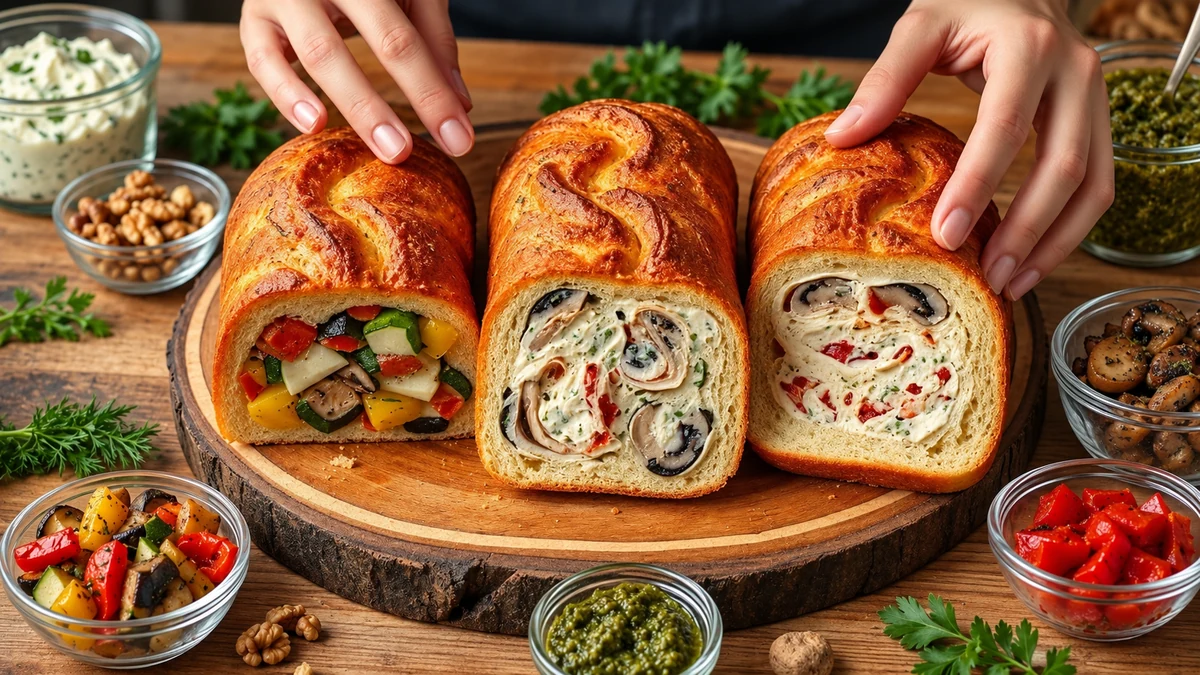
Vegetarian
- 1 medium vegetarian savoury panettone (500 g) — or a suitable sturdy round loaf.
- 1 cup roasted vegetables — diced courgette, pepper and aubergine, measured after roasting.
- 150 g vegetarian mozzarella or panela cheese — sliced or grated; a plant-based alternative can be used if suitable for the guest’s needs.
- 2 tablespoons vegetarian pesto or 3 tablespoons chopped sun-dried tomatoes
- Salt, pepper and fresh herbs — basil, parsley or thyme to taste. Allow a little olive oil for roasting, as used in the method.
- Roast the vegetables: toss with a little oil, salt and pepper, then roast at 200°C for about 20–25 minutes until tender and golden. Measure 1 cup for the filling.
- Prepare the bread: cut off the lid, remove some of the centre and line with cheese.
- Add the vegetables: distribute them inside, with the pesto or chopped tomatoes.
- Finish: add fresh herbs and a little oil if desired. Serve promptly while hot, or use safely cooled ingredients and keep the assembled cold version refrigerated.
Vegan
- 1 vegan savoury panettone (500 g) — verify that it contains no eggs, dairy or other animal-derived ingredients.
- 1 cup cooked grilled vegetables — peppers, mushrooms and onion.
- 200 g plant-based cream-cheese-style spread — for example, a nut- or soya-based product, checking allergies.
- ¼ cup chopped walnuts or other suitable nuts — for crunch.
- 2 tablespoons vegan pesto or vegan tapenade, optional — check that tapenade does not contain anchovies. Allow olive oil for loosening the spread and cooking the vegetables, as described below.
- Prepare the spread: if very firm, stir in up to 1 tablespoon olive oil, adding gradually until spreadable.
- Cook the vegetables: use a frying or griddle pan with a little oil and cook until tender and lightly coloured. Measure 1 cup after cooking; cool promptly for a cold filling.
- Assemble: open the loaf, spread with the plant-based cream cheese and optional vegan pesto or tapenade, then add the vegetables and chopped nuts.
- Chill: refrigerate the assembled cold version for 20–30 minutes to make slicing easier, and keep chilled until serving. This short firming period does not replace prompt cooling of cooked vegetables.
Gluten-free
- 1 gluten-free savoury panettone (500 g) — or a suitable large gluten-free loaf.
- Your chosen filling: cooked shredded chicken, a suitable smoked-salmon filling or roasted vegetables, following the relevant instructions above.
- Consistency adjustments — drain wet ingredients and choose a suitably thick gluten-free spread. Do not stir uncooked rice flour into a ready-to-eat filling or add an unspecified xanthan-gum mixture without a tested recipe and the manufacturer’s instructions.
- Check the labels — confirm that the bread, cheese spreads, pesto, seasonings and other ingredients meet the guest’s gluten-free requirements.
- Prevent cross-contact: use clean, separate utensils, boards and containers, away from ordinary bread crumbs.
- Assemble: fill the gluten-free loaf with your chosen suitable filling and follow its cooking or chilling instructions.
- Identify clearly: label the gluten-free option in words and use a separate platter and serving utensils to avoid mix-ups.
Quick substitutions and reminders
- Plant-based fillings: seasoned tofu or cooked chickpeas provide alternatives to meat; cooked shiitake mushrooms add savoury flavour but are not nutritionally equivalent to chicken.
- Creamy vegan binders: try a nut purée, tahini or vegan mayonnaise, checking allergens and storage instructions.
- Cheese alternatives: nut-based spreads, creamy tofu or nutritional yeast can provide different textures and savoury flavours; they are not interchangeable in identical quantities.
- Texture: suitable chopped nuts or crisp onions can balance a creamy filling. Adapt to allergies and children’s ages.
- Taste before salting: cheese and sun-dried tomatoes may already provide enough salt.
Conclusion
Savoury stuffed panettone offers a flexible way to serve festive starters. Choose a few fillings, adapt them carefully to guests’ needs and plan the assembly and refrigeration in advance.
Changing herbs, textures or presentation can give a familiar base a different character. Try a small version first, then choose the combinations your guests enjoy.
Thank you for reading. Follow our social media for more recipes and festive inspiration, and visit the I Love Christmas blog for more Christmas ideas.
FAQ: savoury stuffed panettone
How long can I keep savoury stuffed panettone in the fridge?
Keep it covered at 0–5°C and use within 48 hours of the filling being prepared, or sooner if any ingredient requires it. Assembly does not restart the storage clock. Follow smoked fish use-by and opened-pack instructions; making and eating that version on the same day is a practical approach.
How do I stop the bread becoming soggy?
Drain tomatoes and dry salad leaves well, use a filling that is not too wet, and chill ingredients promptly before assembling a cold version. A layer of cheese may slow moisture soaking in. Assemble close to serving rather than storing the filled loaf for longer than necessary.
Can I prepare the fillings ahead?
Yes, suitable fillings can be prepared the day before and kept covered in the fridge. Cool cooked ingredients promptly and count all storage time, including any earlier storage of cooked chicken. Prepare hot versions close to serving, and reheat cooked food only once until steaming hot throughout.
How can I make vegan or gluten-free versions?
For vegan versions, choose suitable bread, plant-based spreads and vegetable or tofu fillings, checking sauces and cheese substitutes too. For gluten-free versions, use a suitable labelled loaf and filling ingredients, with separate clean preparation and serving equipment to prevent cross-contact. These are separate dietary requirements.
What is the best way to reheat a cheese-filled panettone?
Foil and an oven at 160°C can help protect the bread, but the time depends on the loaf’s size, filling and starting temperature. The suggested 8–12 minutes is only a finishing guide for already-hot fillings. Reheat suitable cooked fillings only once until steaming hot throughout; melted surface cheese is not enough to judge the centre.
Sources and Further Reading
- Food Standards Agency: cooking and reheating
- Food Standards Agency: chilling, freezing and defrosting
- NHS: foods to avoid for babies and young children
- NHS: foods to avoid in pregnancy
- Food Standards Agency: smoked fish and listeriosis risk
- Parmigiano Reggiano: product specification and calf rennet