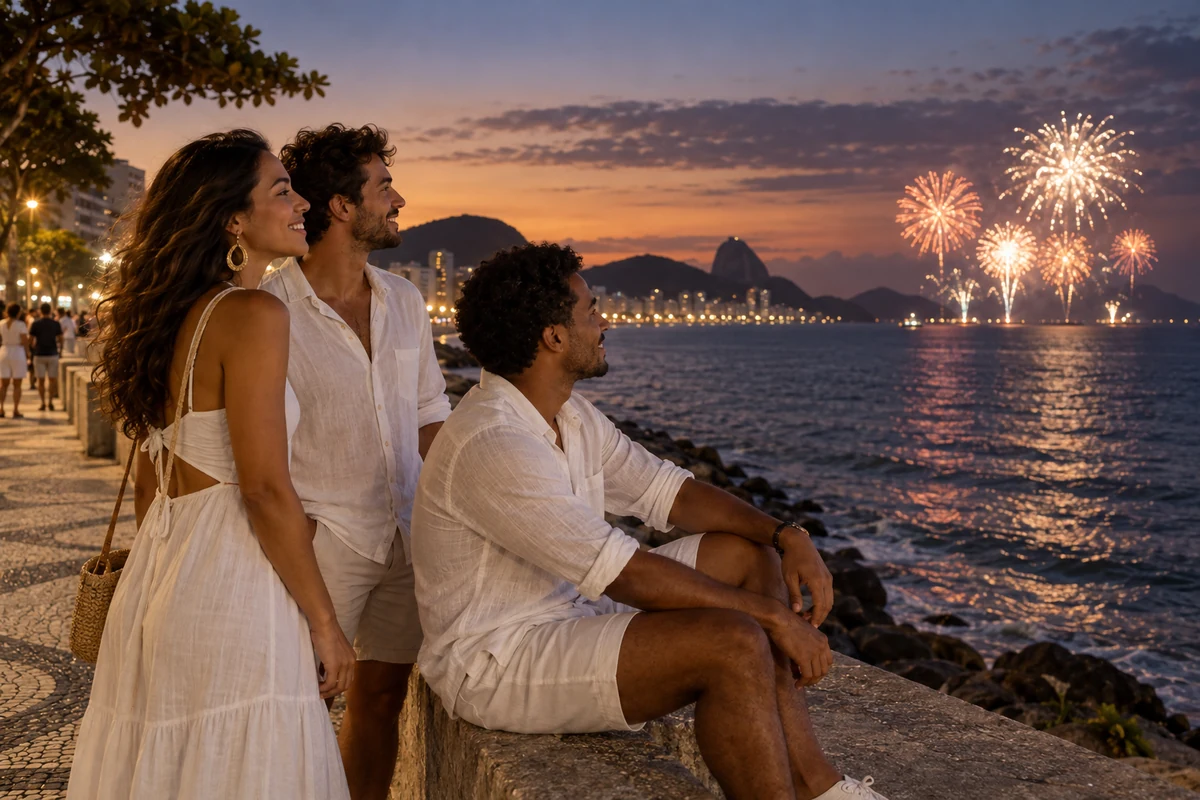
Wearing white on New Year’s Eve is a familiar Brazilian custom with important roots in Afro-Brazilian religious traditions. Today, people of different beliefs adopt it as a symbol of peace and a fresh start. Its meaning is cultural and personal: clothing does not guarantee luck, protection or a particular outcome.
Wearing white on New Year’s Eve in Brazil is about more than a dress code. This guide looks at the custom’s background, popular beliefs and simple ways to choose an outfit that feels meaningful to you.
Illustrations in this article are conceptual images, not documentary photographs or evidence of a particular historical event, destination, venue or access route.
Where the New Year tradition of wearing white comes from

Brazil’s New Year custom has strong connections with Afro-Brazilian religions, including Umbanda and Candomblé. As it spread into wider public celebrations, wearing white also became a secular expression of hopes for peace. Recognising those religious roots matters even when your own reason for wearing it is simply personal. Source: MultiRio: origins of Brazilian New Year customs
Important influences
- Afro-Brazilian religious traditions: white has a place in religious dress and ceremonies. Its meaning depends on the tradition and context; it should not be reduced to a generic good-luck accessory.
- Wider colour symbolism: white can carry associations with purity or renewal in different cultures. Those parallels alone do not establish the historical origin of Brazil’s New Year custom.
- Religious and cultural exchange: Brazilian celebrations bring different practices into contact, but the religions involved retain their own identities and should not be treated as interchangeable.
- Public celebrations: crowds dressed in white at beach parties and other festivities have made the custom recognisable far beyond religious communities.
For many people, white now expresses a wish for peace and renewal. Flowers and ceremonies by the sea may also feature in some celebrations. These gestures can have specific religious meanings, rather than being merely decorative additions to a party.
Other colours have popular associations too: yellow with prosperity, red with love or passion, and green with hope or health. These are symbolic beliefs, not promises that a colour can produce those results.
White as a symbol of peace, renewal and protection

In many Brazilian New Year celebrations, white communicates a wish for peace and a new beginning. Some people also connect it with spiritual protection. These meanings vary with belief and experience; they are not measurable effects of wearing the colour.
Why people associate white with peace
A shared colour can give a gathering a sense of unity. Whether white feels peaceful is personal and cultural, rather than an automatic psychological response. For example:
- A group dressed in white may choose to express a shared hope for a calmer year.
- White flowers can form part of a display that symbolises serenity to its maker.
- A white outfit by the sea may remind someone of a particular celebration or family tradition.
Renewal and a fresh start
Wearing white can serve as a reminder of intentions for the year ahead. Some people use it to reflect on habits they would like to change or relationships they hope to nurture.
- White clothing: can represent a blank page and the possibility of a new beginning.
- Symbolic gestures: a quiet moment of reflection or holding a flower can mark renewal without entering the sea or leaving anything behind.
- Practical comfort: choose clothes suited to the weather and the setting so you can enjoy the gathering.
Protection and purification
In some traditions, white is associated with purification or spiritual protection. These are matters of religious or personal belief, and their meanings are not identical across communities.
- Religious use of white may accompany prayers, songs or offerings within a particular tradition.
- Flowers and other objects can have meanings that go beyond their appearance.
- For someone celebrating without a religious practice, white might simply represent self-care or a personal boundary they wish to maintain.
Simple ways to wear white with intention
Think about what the colour means to you: peace, a fresh start, or a connection with a family custom. Then keep the practical choices straightforward:
- Wear something comfortable and suitable for the temperature.
- Add a coloured accessory if you enjoy its symbolism, without expecting it to bring health or wealth.
- At the beach, choose a gesture that leaves no litter and does not involve an open flame or entering unsafe water.
Religious and cultural influences on New Year celebrations
Brazil’s New Year festivities include both religious practices and secular customs. Understanding the particular community and occasion is more useful than assuming that every ritual has the same origin or meaning.
Afro-Brazilian religions
Candomblé and Umbanda are distinct religions with diverse communities. Depending on the tradition and occasion, celebrations may include:
- White clothing and flowers with a religious significance.
- Offerings or prayers connected with orixás, including Iemanjá in celebrations associated with the sea.
- Songs and ceremonies led by members of the religious community.
Christian observances alongside New Year customs
Some families combine their New Year gathering with Christian worship or reflection. This does not mean that every use of white has the same religious origin. Examples of family observances include:
- Attending a church service or giving thanks in prayer.
- Making time for reconciliation and discussing hopes for the coming year.
Regional and family variations
Customs differ between regions, communities and households. Avoid assigning a general nature-based ritual to Indigenous peoples without identifying a specific tradition and reliable context.
- A family’s use of plants or fragrances may be a personal custom rather than evidence of a shared historical origin.
- Celebrating near a river or the sea does not, by itself, establish a ritual’s cultural background.
Religious roots and popular celebration
Practices can take on new meanings when adopted beyond their original communities. Keep these distinctions in mind:
- A secular New Year custom may still have religious roots worth acknowledging.
- Public celebrations can make a style of dress widely recognisable without making it compulsory.
- Wearing an ordinary white outfit is accessible to many people, but participating in a religious ceremony involves its own expectations.
Thoughtful ways to celebrate today
Religious observances and personal celebrations can coexist. A few useful principles are:
- Respect: ask whether visitors are welcome and follow the hosts’ guidance. Do not touch offerings or photograph ceremonies without permission.
- Care for the setting: do not leave flowers, packaging, containers or other items on a beach or in the water; natural materials are not automatically harmless there.
- Personal choice: choose a simple reflective gesture that is meaningful to you, without presenting it as an authentic religious rite you do not practise.
Choosing a white New Year outfit

A good outfit combines comfort, appearance and personal meaning. Think about the venue and weather: Brazil’s summer celebrations and a British winter evening call for very different clothing.
Fabrics and fit
- Cotton: a comfortable option for warm conditions; add appropriate layers in cooler weather.
- Linen: works well for a relaxed summer look, though a fabric’s name alone does not establish its environmental impact.
- Lightweight jersey: offers stretch and freedom of movement for a relaxed gathering or dancing.
- Silk or satin: can suit a dressier evening; check comfort, care instructions and whether the fabric becomes see-through under the lighting.
Easy outfit combinations
- A midi or long dress for a flowing summer look, with footwear suited to the ground.
- A loose white shirt with shorts or linen trousers for a warm-weather gathering.
- A coordinated top and skirt or trousers for a simple, put-together outfit.
- A jumpsuit for a comfortable one-piece option; use warmer layers for an outdoor winter celebration.
Accessories and their symbolism
- A white flower worn as an accessory can represent peace to you; take it home afterwards.
- A bracelet or ribbon in a contrasting colour can suggest a personal intention, such as yellow for prosperity or red for love.
- Gold- or silver-coloured jewellery adds contrast without needing to change the main outfit.
- Choose comfortable shoes appropriate to the venue: sand, wet paths, cold weather and indoor dance floors need different footwear.
Practical choices with less waste
- Start with clothes you already own, borrow an item or look for something second-hand that you will wear again.
- Consider a spare layer if spills would make you uncomfortable, rather than buying a whole outfit for one evening.
- Follow the garment’s care label when treating a stain; test any cleaning product on an inconspicuous area first.
- Keep flowers and decorations out of the sea and take everything home, including reusable containers.
Giving your outfit personal meaning
- Try a quiet intention, a moment holding a flower or a conversation with someone you care about. You do not need to enter the water to mark the occasion.
- Choose an accessory that reminds you of a goal, such as courage, gratitude or making more time for loved ones.
- Putting an intention into words: say or write what you hope to work towards. Your outfit can be a reminder, rather than a guarantee.
Myths, interesting details and other New Year colours

Beliefs about New Year colours range from family traditions to claims without historical support. It helps to distinguish symbolism from factual explanation.
Common misconceptions
- White guarantees a peaceful year: it can express a wish for peace, but resolving disagreements still takes practical effort.
- A colour determines your luck: choosing a colour can be meaningful without having the power to change your circumstances.
- Everyone must jump seven waves: this is not a requirement for celebrating New Year. Do not enter the sea in unsafe conditions, in darkness or after drinking to complete a ritual.
- A meaningful gesture must be expensive: a private reflection or a flower kept at home can be enough; spending money or leaving an offering in the sea is not necessary.
Points worth remembering
- The Brazilian custom of wearing white has important Afro-Brazilian religious roots; describing it only as a fashion trend overlooks that background.
- White now also serves as a shared visual theme at secular New Year gatherings.
- Neither the price of an outfit nor its colour tells you how sincerely someone approaches the celebration.
- Colour traditions vary between countries and families, so Brazil’s custom should not be assumed to apply everywhere.
Other colours and popular meanings
- Yellow: prosperity, money and opportunity in popular New Year symbolism.
- Red: passion, energy and courage.
- Green: hope, balance and wishes for good health.
- Pink: love, affection and relationships.
- Blue: serenity, protection or communication, depending on personal interpretation.
- Gold and silver: abundance, celebration and sparkle.
- Purple: spirituality or intuition in some popular interpretations.
Choosing a colour that means something to you
- Decide what you would like the choice to remind you of before planning the outfit.
- Combine white with a coloured accessory if you enjoy both meanings.
- Reuse clothes and accessories where possible instead of buying something solely for one night.
- If you hope to attend a religious ceremony, ask about its expectations beforehand and respect the organisers’ answer.
- A scarf, ribbon or bracelet provides a small touch of colour while keeping a mainly white outfit.
Final thoughts
Wearing white at New Year brings together history, faith and personal custom. It can express peace, renewal or spiritual belief, while its religious roots deserve recognition and respect.
Choose something comfortable, celebrate with care for the people and place around you, and turn your hopes into achievable actions in the year ahead.
Thank you for reading. Follow our social channels and explore the I Love Christmas blog for more on festive traditions, clothing ideas and thoughtful ways to celebrate.
Frequently Asked Questions about Wearing White at New Year
Why do so many Brazilians wear white on New Year’s Eve?
The custom has important Afro-Brazilian religious roots and has become popular among people of different beliefs. White often symbolises peace and a fresh start, although its meaning varies between traditions and individuals.
Does wearing white guarantee a good year?
No. It can express an intention or remind you of a goal, but it does not guarantee health, protection, luck or prosperity.
Can I attend a ceremony if I do not belong to the religion?
Ask the organisers first. Some events welcome visitors and others do not. Follow their guidance, and never assume permission to touch offerings, take photographs or join a ritual.
What do other New Year colours symbolise?
Popular associations include yellow for prosperity, red for passion, green for hope or health, pink for affection and blue for serenity. These are symbolic interpretations, not guaranteed effects, and they vary.
How can I choose a practical white outfit with less waste?
Start with clothes you own or can borrow, consider second-hand items, and dress for the actual weather. Choose pieces you will wear again and leave no decorations or offerings behind at the venue or beach.