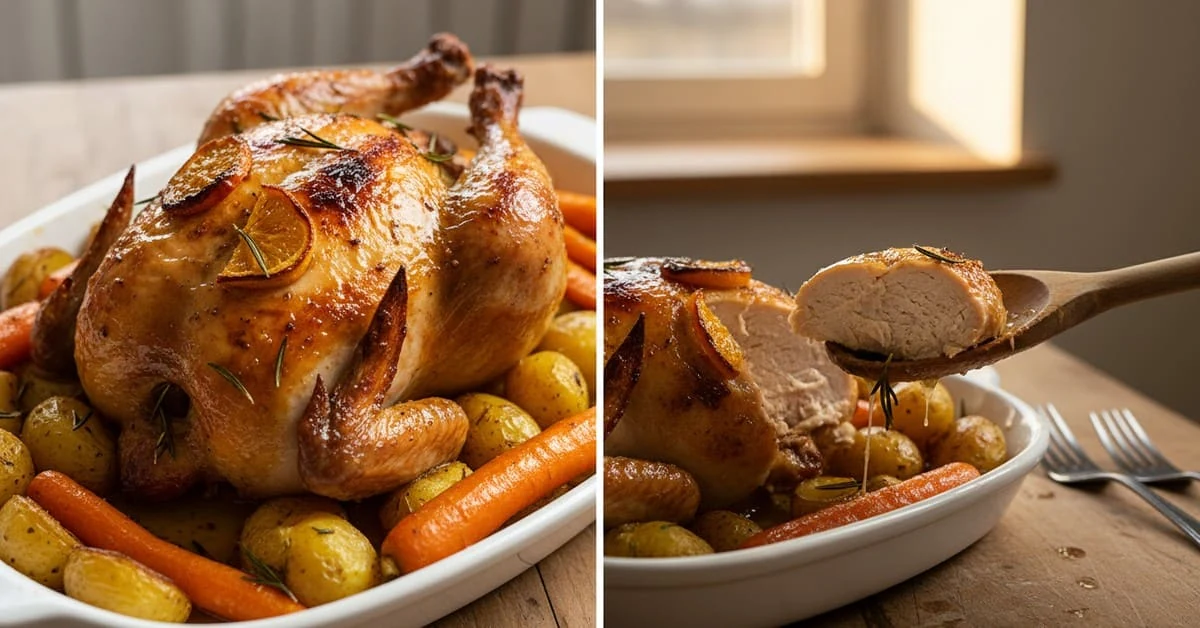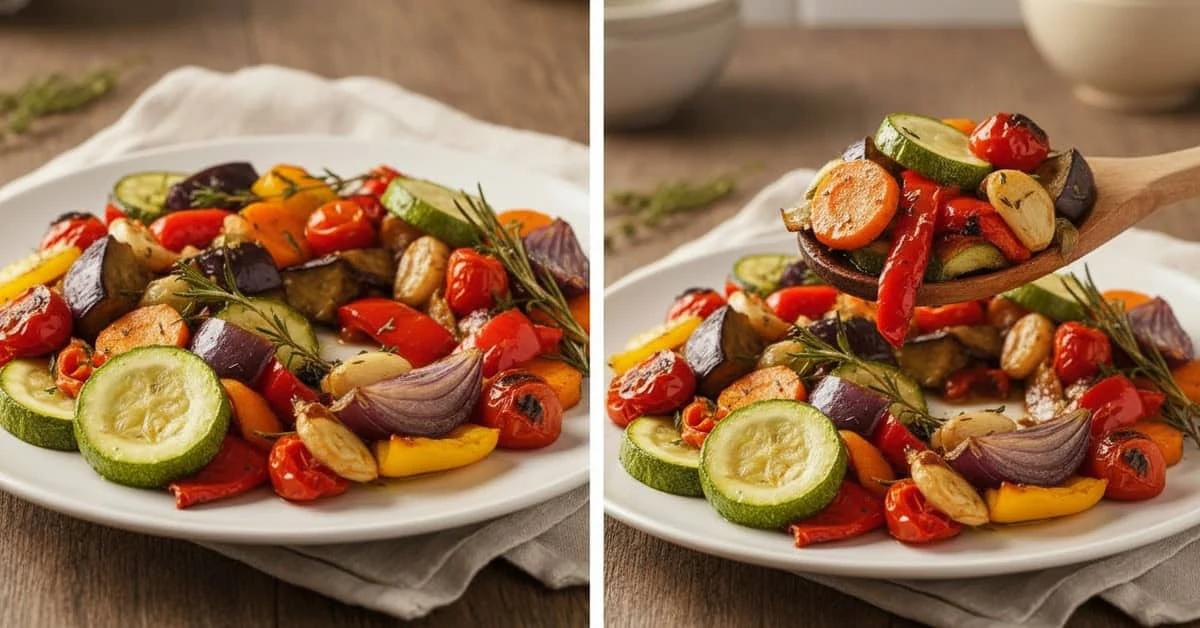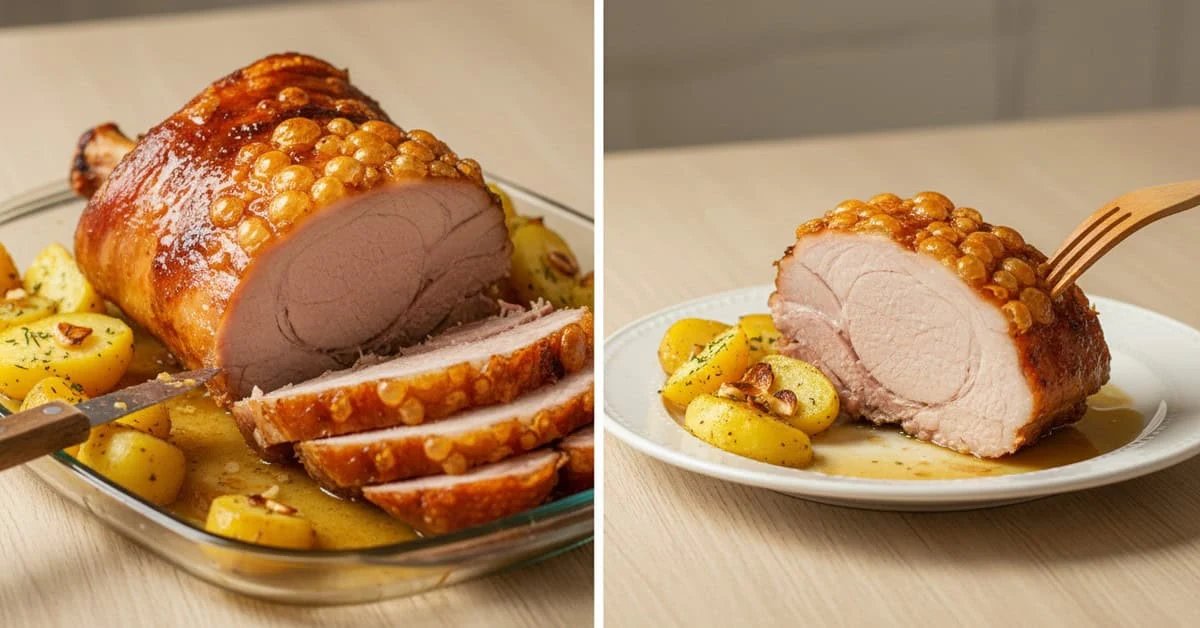
Christmas roast pork leg uses fresh, uncured boneless pork, marinated in the fridge with citrus, garlic and herbs. Roast until the centre reaches 75°C for 30 seconds or 70°C for two minutes; resting is not a substitute for cooking it through. Cool leftovers promptly and eat within 48 hours or freeze.
Christmas roast pork leg, known as pernil in Brazil, makes a generous centrepiece with citrus and herbs. This is fresh pork, rather than cured gammon. The recipe below has been editorially reviewed, but not kitchen-tested; follow the joint’s instructions and check its centre with a clean food thermometer.
Ingredients for boneless Christmas roast pork leg
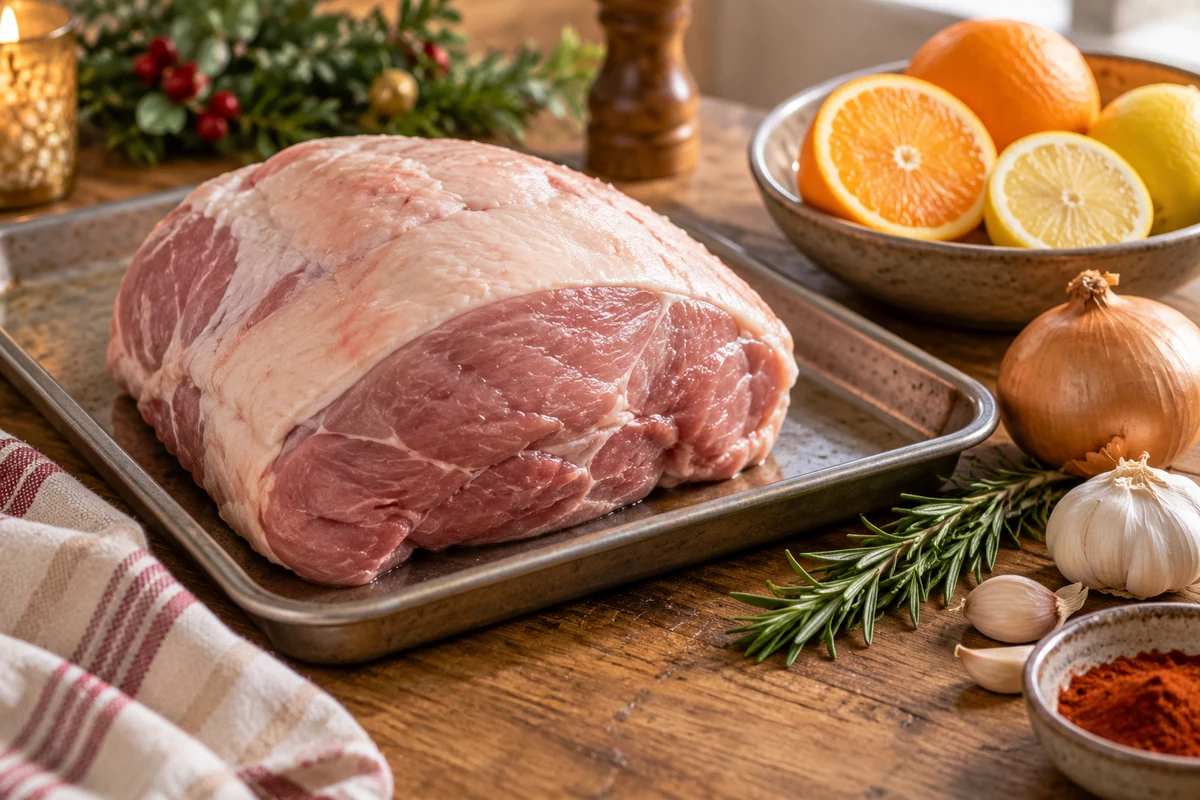
For this boneless Christmas roast pork leg, gather the following ingredients. The later marinade section repeats these quantities for convenience; do not add a second batch.
- 3.5–4 kg fresh, uncured boneless pork leg – a whole joint with a modest covering of fat. A 2.5–3 kg joint suits a smaller gathering and needs its cooking time adjusted.
- 10 garlic cloves – crushed, or about 2 tbsp garlic paste; check the paste for added salt.
- Salt, to taste – use sparingly because the soy sauce also adds salt. Fine and coarse salt cannot be substituted spoon for spoon reliably.
- 1 tsp freshly ground black pepper – adjust to taste.
- 1 large onion – roughly chopped, or 2 medium onions.
- 240 ml orange juice – for citrus flavour and sweetness. Apple juice or pasteurised pineapple juice gives a different flavour.
- 120 ml lemon juice – alternatively, use 60 ml cider vinegar.
- 80 ml olive oil – or vegetable oil.
- 3 tbsp light brown sugar – for sweetness and browning; honey or maple syrup are possible alternatives.
- 1 tbsp smoked paprika – or sweet paprika for a less smoky flavour.
- 1 tsp ground cumin – optional.
- 2 fresh rosemary sprigs – strip and chop the leaves; sage is an alternative.
- 2 fresh thyme sprigs – leaves only, or 1 tsp dried thyme.
- 2 bay leaves – remove before serving.
- 60 ml soy sauce – for savoury flavour. Alternatively, use 2 tbsp Worcestershire sauce; this changes the flavour and may introduce fish as an allergen.
- 120 ml dry white wine – for the roasting tin, not an additional marinade ingredient. Use stock instead if avoiding alcohol; cooking does not guarantee that all alcohol disappears.
- 30 g butter, optional – to brush over the joint before roasting, or use 2 tbsp olive oil for a dairy-free alternative, checking the other ingredients too.
- 2 tbsp honey, optional – for brushing over the joint near the end of cooking.
- 240 ml beef or chicken stock – for the roasting tin, with extra available if it starts to dry out. Water is an alternative.
- 8–10 whole cloves, optional – to stud the fat. Count them and remove every clove before carving.
Simple substitutions
- For less acidity: halve the lemon juice and replace the missing volume with orange juice.
- For an apricot glaze: use about 60 ml apricot jam instead of the finishing honey, brushing it on near the end. This is still a sweet glaze.
- To reduce added salt: choose reduced-salt soy sauce and use less additional salt; check the stock too.
- Ready-made seasoning: 1 tbsp barbecue seasoning can replace the paprika and cumin. Check its salt content and allergens.
- Planning ahead: marinate for 12–24 hours in the fridge if time allows, always within the pork’s use-by date.
How to prepare and roast boneless pork leg
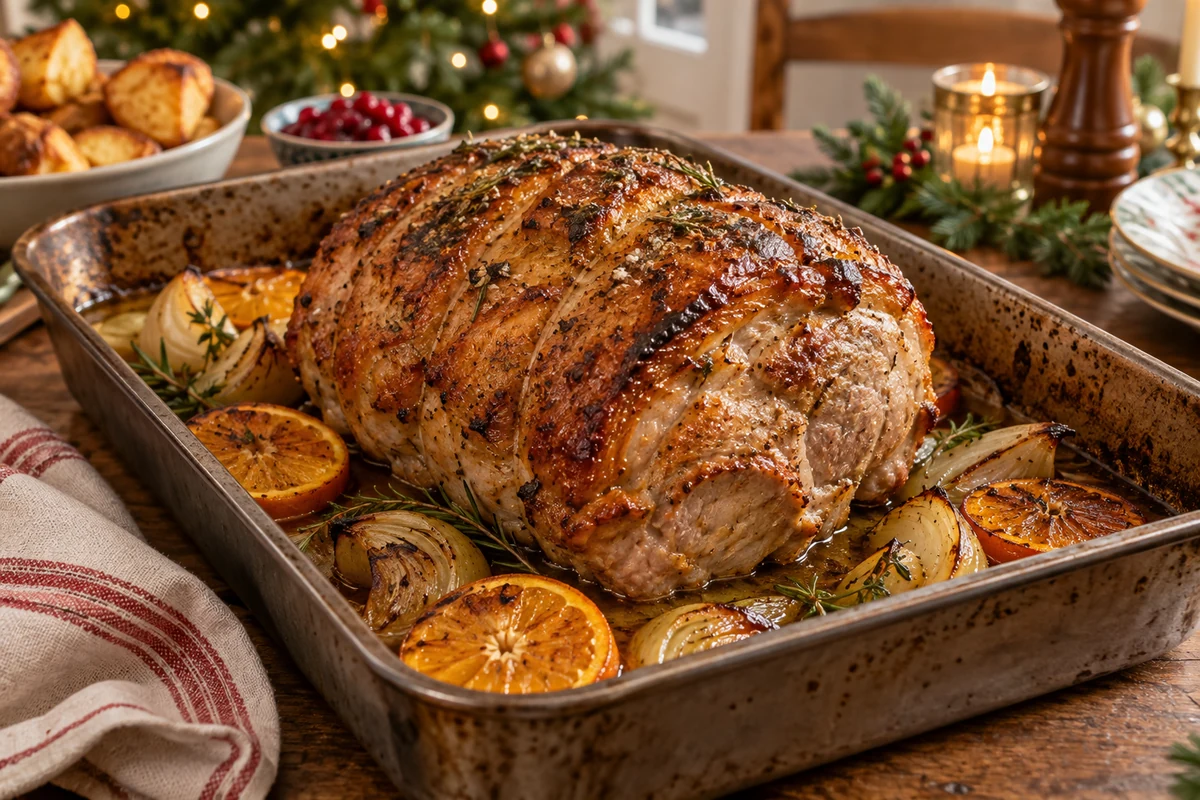
- Prepare the pork: do not wash raw meat. Trim excess skin or fat if needed, leave a thin layer of fat, pat dry with kitchen paper and make shallow scores in the surface. Clean hands, equipment and worktops afterwards.
- Mix the marinade: combine the garlic, onion, orange and lemon juices, oil, brown sugar, paprika, optional cumin, soy sauce, salt and pepper. Blend into a paste if preferred.
- Coat the joint: rub the marinade over the surface and shallow scores, add the rosemary, thyme and bay leaves, and stud with the optional cloves. Place in a covered, food-safe container.
- Refrigerate: marinate for 12–24 hours if time allows, turning once with clean utensils. Keep covered on the lowest shelf so raw juices cannot drip onto other food.
- Preheat the oven: keep the pork refrigerated until you are ready to prepare it for roasting. Preheat to 160°C conventional/140°C fan, unless the joint’s instructions specify otherwise.
- Prepare the tin: tie the joint evenly with kitchen string if necessary and set it on a rack in a roasting tin. Add the 240 ml stock and 120 ml wine or extra stock underneath. Brush with the optional butter or oil. Discard the used raw marinade.
- Roast: at this oven temperature, allow roughly 45–60 minutes per kg as a planning estimate: approximately 2 hours 40 minutes to 4 hours for a 3.5–4 kg joint. Its shape and your oven affect the timing; the thermometer, not this estimate, determines when it is ready.
- Check the roasting liquid: every 30–40 minutes, check briefly and add fresh stock or water if the tin is drying out. Do not baste with marinade that has touched raw pork.
- Finish the colour: loosely cover with foil if the surface is browning too quickly. If needed, increase to 200°C conventional/180°C fan for the final 20–30 minutes and brush on the optional honey. Watch closely because sugar burns easily.
- Check the centre: probe the thickest part of the rolled joint in more than one place. It must reach 75°C for 30 seconds, or 70°C for two minutes. Do not remove undercooked pork expecting the resting period to make it safe.
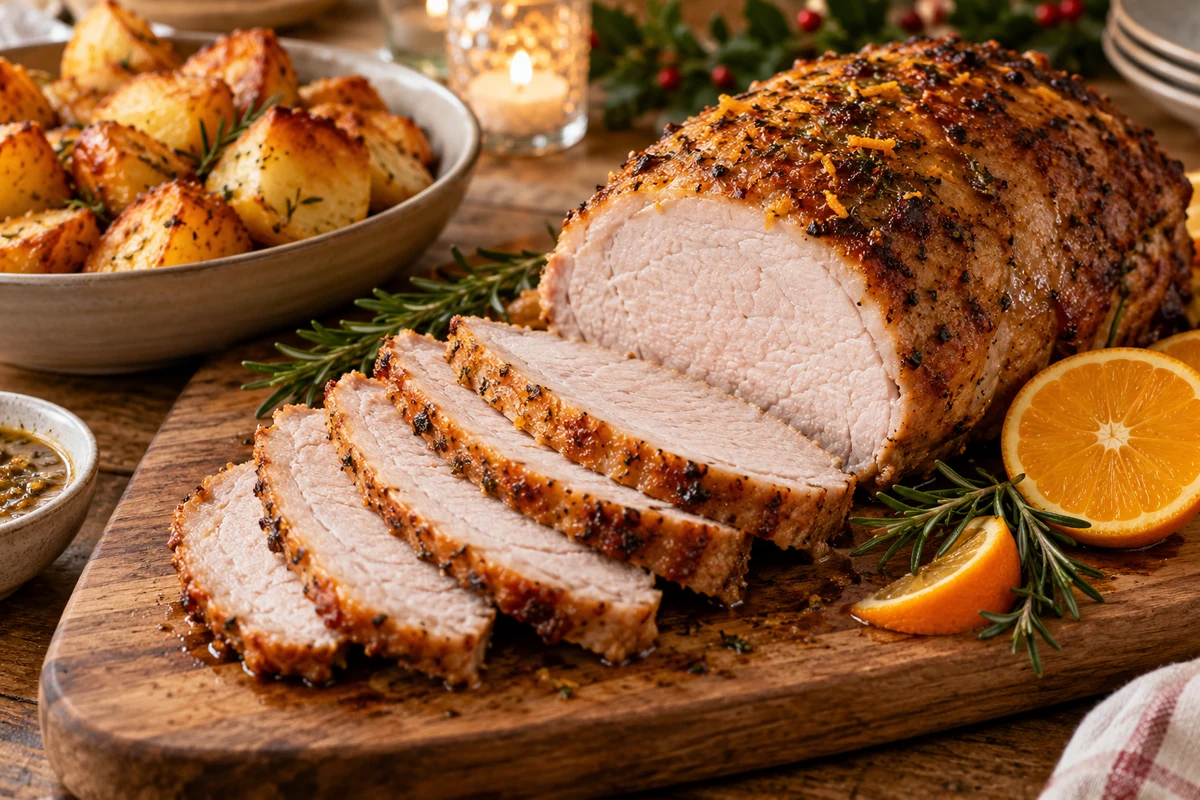
- Rest and carve: once fully cooked, cover loosely and rest for 20–30 minutes. Remove all cloves, bay leaves and string, then carve thinly across the grain.
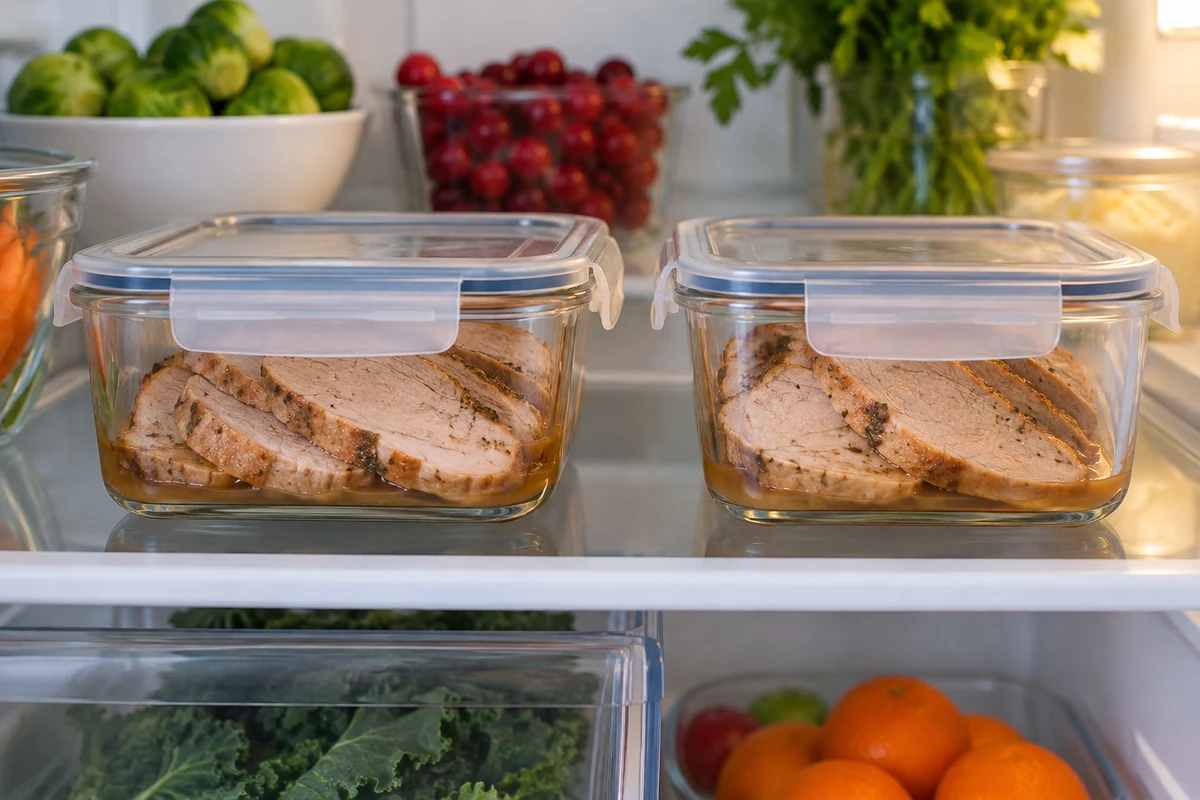
- Store leftovers: divide into smaller portions, cool and refrigerate within one to two hours. Eat within 48 hours or freeze. Reheat only once, until steaming hot throughout, with a little stock to prevent drying.
Practical cooking tips
- Use a thermometer: cooking time and surface colour alone cannot confirm that a large rolled joint is cooked through.
- Allow flexibility: 45–60 minutes per kg is only a planning estimate at the temperature above. Follow product instructions where available.
- Marinate ahead: an overnight rest in the fridge is convenient, but a shorter marination does not prevent you from cooking the pork safely.
- Change the flavour: use apple or pasteurised pineapple juice instead of orange juice, or honey instead of brown sugar. These are alternatives, not extra ingredients to add together.
- Avoid a dry tin: maintain some roasting liquid and avoid unnecessary overcooking. Do use a thermometer to check the centre; checking the temperature matters more than avoiding every puncture.
Citrus marinade and seasoning tips
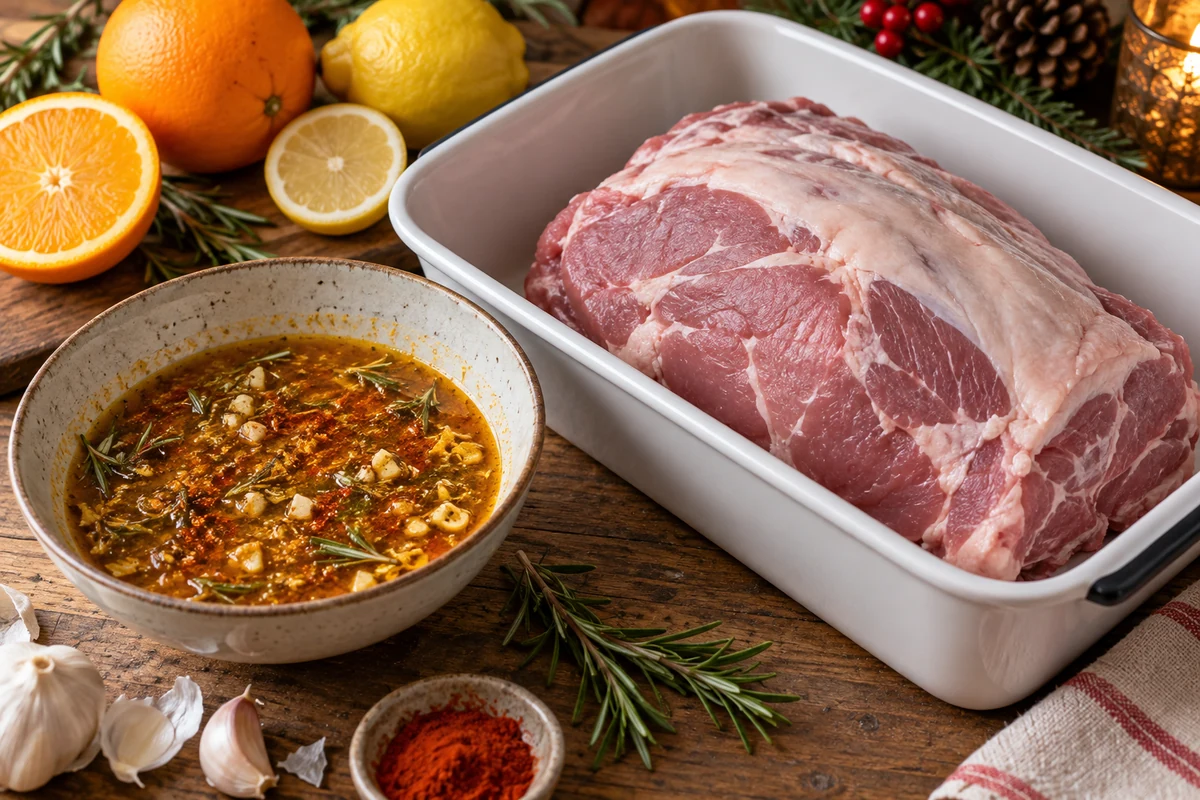
This section summarises the same marinade for the pork leg. Make it once using the quantities below; they are not additions to the main ingredients list.
Marinade ingredients at a glance
- 240 ml orange juice – or apple or pasteurised pineapple juice for a different flavour.
- 120 ml lemon juice – or 60 ml cider vinegar.
- 80 ml olive oil – vegetable oil is an alternative.
- 10 crushed garlic cloves – or about 2 tbsp garlic paste, allowing for any added salt.
- 1 large onion, grated or chopped – or 2 medium onions.
- 3 tbsp light brown sugar – honey or maple syrup can replace it.
- 60 ml soy sauce – or 2 tbsp Worcestershire sauce, checking its fish and other allergens.
- 1 tbsp smoked paprika – or sweet paprika.
- 1 tsp ground cumin – optional.
- Salt, to taste – use sparingly alongside the soy sauce.
- 1 tsp ground black pepper – adjust to taste.
- 2 rosemary sprigs – strip and chop the leaves.
- 2 bay leaves and 2 thyme sprigs – remove the bay leaves and woody stems before serving.
- 120 ml dry white wine or stock, reserved for the tin – this is separate from the marinade and accompanies the main recipe’s 240 ml stock.
- 2 tbsp honey, optional – reserve for brushing on near the end rather than adding to the marinade.
Mixing and applying the marinade
- Combine the liquids: mix the orange juice, lemon juice and olive oil in a large bowl. Keep the wine or extra stock for the roasting tin.
- Add the seasoning: stir in the garlic, onion, soy sauce, sugar, paprika, optional cumin, salt and pepper until combined.
- Add the herbs: include the rosemary and thyme leaves and the bay leaves.
- Blend if preferred: blending produces a smoother coating; it does not guarantee that seasoning reaches the centre of a large joint.
- Prepare the surface: pat the pork dry with kitchen paper and score the fat shallowly. Do not wash it or cut deep pockets into the joint.
- Coat evenly: rub the marinade over the pork and into the shallow scores, then transfer to a covered, food-safe container.
- Keep chilled: refrigerate for 12–24 hours if time allows, turning once with clean utensils and respecting the use-by date.
- Discard used marinade: any liquid that has touched raw pork must not be used as a finishing sauce. Use fresh stock for topping up the roasting tin.
- Prepare for roasting: keep the joint refrigerated until the oven and tin are ready. There is no need to leave a large joint at room temperature for an hour.
Seasoning and finishing tips
- Balance the acidity: if you prefer a milder marinade, use half the lemon juice and replace the rest with orange juice.
- Add the glaze late: brush honey on in the final 20–30 minutes and check frequently to prevent burning.
- Season carefully: taste the marinade only before it touches raw meat. Start with little salt, then adjust the finished sauce after it has cooked thoroughly.
- Choose pineapple carefully: fresh pineapple contains enzymes that can make the surface mushy during a long marinade. Prefer pasteurised juice for this overnight version.
- Use fresh liquid: check the tin every 30–40 minutes and top up with stock or water as needed, never with used raw marinade.
- Remove whole spices: whole cloves give a strong aroma. Count those added and remove all of them before carving; do not leave them hidden in slices.
- Check the centre: use a clean thermometer and the time–temperature guidance above, rather than judging by the glaze.
Flavour variations and alternative cooking methods
These ideas offer different ways to season boneless Christmas pork leg. Treat them as separate variations. Pressure-cooker, smoker and slow-cooker suggestions are not complete, tested cooking schedules for a 4 kg joint.
Honey and clove glaze
For a sweeter finish, use the following glaze instead of the main recipe’s finishing honey. Do not add another set of whole cloves if they are already in the joint.
- 60 ml honey
- 2 tbsp light brown sugar
- 8 whole cloves, only if not already used – remove before carving.
- 1 tbsp Dijon mustard – optional; check allergens.
Brush on for the final 20–30 minutes at 200°C conventional/180°C fan if additional browning is needed. Watch closely and cover if the glaze darkens too quickly.
Smoked flavour
Use a purpose-built food smoker and a tested recipe suitable for the joint’s weight. Do not improvise indoor smoking equipment.
- Food-smoking wood chips suitable for your appliance – use the type and quantity specified by its manufacturer.
- 2 rosemary sprigs – use the leaves to season the meat, not as improvised fuel near heating elements.
Follow the smoker’s ventilation, placement and cooking instructions. A generic one- or two-hour smoking stage cannot establish whether a large pork joint is safely cooked; check the centre as well.
Pineapple variation
Pineapple gives a sweeter, fruity flavour. Replace the corresponding ingredients in the main marinade rather than adding another batch.
- 240 ml pasteurised pineapple juice – instead of orange juice.
- 80 g canned pineapple pieces, drained – optional, for a cooked accompaniment.
- 2 tbsp light brown sugar – instead of the main marinade’s 3 tbsp.
Apple juice is another option. Avoid leaving the meat overnight in fresh pineapple juice, which can give the surface an unpleasantly soft texture.
Using a pressure cooker
A pressure cooker may suit a smaller joint, but use its manufacturer’s recipe for the particular weight and cut. The full-size joint may not fit safely.
- Brown if instructed: if the appliance supports browning and the joint fits, use about 1 tbsp oil as directed by its recipe.
- Use sufficient liquid: stock and citrus juice can provide flavour, but the manufacturer’s minimum liquid quantity and maximum fill level take priority.
- Follow the appliance recipe: use its specified cooking and pressure-release method. Do not assume one fixed time covers every 2–3 kg joint; check the centre after opening safely.
- Brown separately if needed: once the pork is fully cooked, a short oven finish at 200°C conventional/180°C fan can add colour. Monitor the glaze rather than relying on a fixed finishing time.
Using a slow cooker
Choose a tested slow-cooker recipe and a joint that fits within your appliance’s capacity. This is an alternative method, not an instruction to put a 4 kg joint into any cooker.
- Stock in the quantity your appliance recipe specifies – the roasting recipe’s 240 ml is not a universal slow-cooker requirement.
- Fresh citrus seasoning, if the recipe calls for it – do not use marinade retained after contact with raw pork as a finishing sauce.
Follow the recipe’s joint size, liquid level and heat setting, and the appliance’s safety instructions. Confirm that the pork is cooked through; a generic low/high timetable is not enough for every joint.
Dairy-free adjustments
You can omit the optional butter and check the remaining ingredients for milk. These changes do not automatically make the meal lower in calories.
- Use olive oil instead of butter, or omit the extra brushing fat.
- Use apricot jam instead of honey if you prefer its flavour – both add sugar.
- Vegetable stock can replace meat stock – check its ingredients; the pork dish itself is not vegetarian.
Trim excess fat if preferred, but avoid overcooking. Keep some liquid in the tin and use a thermometer to judge doneness.
Preparation, cooking and safe storage
Use these timings to plan your meal, while checking the joint’s instructions and its internal temperature for a properly cooked Christmas roast.
Preparation and marinating
- Hands-on preparation: allow about 30–45 minutes for trimming, scoring, mixing and applying the marinade, and cleaning up.
- Marinating: allow 12–24 hours in the fridge if convenient and within the pork’s use-by date; it is not a safety requirement to marinate for a minimum time.
- Before roasting: keep the pork chilled until the oven and tin are ready, rather than leaving it out for an hour.
Oven temperature and cooking time
- Roasting stage: use 160°C conventional/140°C fan unless product instructions differ. Allow approximately 45–60 minutes per kg as a planning guide, then verify doneness with a thermometer.
- Browning stage: if needed, increase to 200°C conventional/180°C fan for the final 20–30 minutes and brush on the glaze, watching for burning.
- Safe centre temperature: the thickest part must reach 75°C for 30 seconds, or 70°C for two minutes. Resting afterwards does not replace this cooking step.
Resting and carving
- Rest: after cooking fully, cover loosely with foil and rest for 20–30 minutes before carving.
- Carve: remove string, bay leaves and all cloves, then cut thinly across the grain.
Refrigerating leftovers
- Cool promptly: divide the leftovers into smaller portions and refrigerate in a fridge kept at 0–5°C within one to two hours. Do not leave a whole large joint cooling on the worktop for hours.
- Use refrigerated leftovers: keep covered and eat within 48 hours, or freeze promptly.
- Prevent cross-contamination: keep raw meat and its juices away from cooked food, and use clean boards, utensils and containers.
Freezing and defrosting
- Freeze in portions: cool promptly, pack in freezer-safe containers, label and freeze. Aim to use within two to three months for best quality; this is a quality guide rather than a guarantee about mishandled food.
- Defrost safely: thaw covered in the fridge. Large pieces may need more than 24–48 hours, so follow the product guidance and check they are fully thawed. Use within 24 hours of complete defrosting.
Reheating
- In the oven: heat at 160°C conventional/140°C fan in a covered dish with a little stock until steaming hot throughout, for example 75°C for 30 seconds at the centre. Thickness affects the time needed.
- For slices: reheat in a covered pan or microwave-safe dish, checking several places until steaming hot throughout, for example 75°C for 30 seconds. Follow microwave instructions and allow for uneven heating.
- Reheat only once: take out just the portion you need rather than repeatedly warming the whole batch.
Quick safety reminders
- Clean the probe: measure the thickest parts without touching the tin or rack, and clean the thermometer between checks.
- Discard doubtful food: an unusual smell, colour or texture is a reason to discard it. A normal appearance does not prove that food kept too long or too warm is safe.
- Label portions: record the cooking and freezing dates so you can keep track of storage times.
Side dishes and arranging the Christmas table
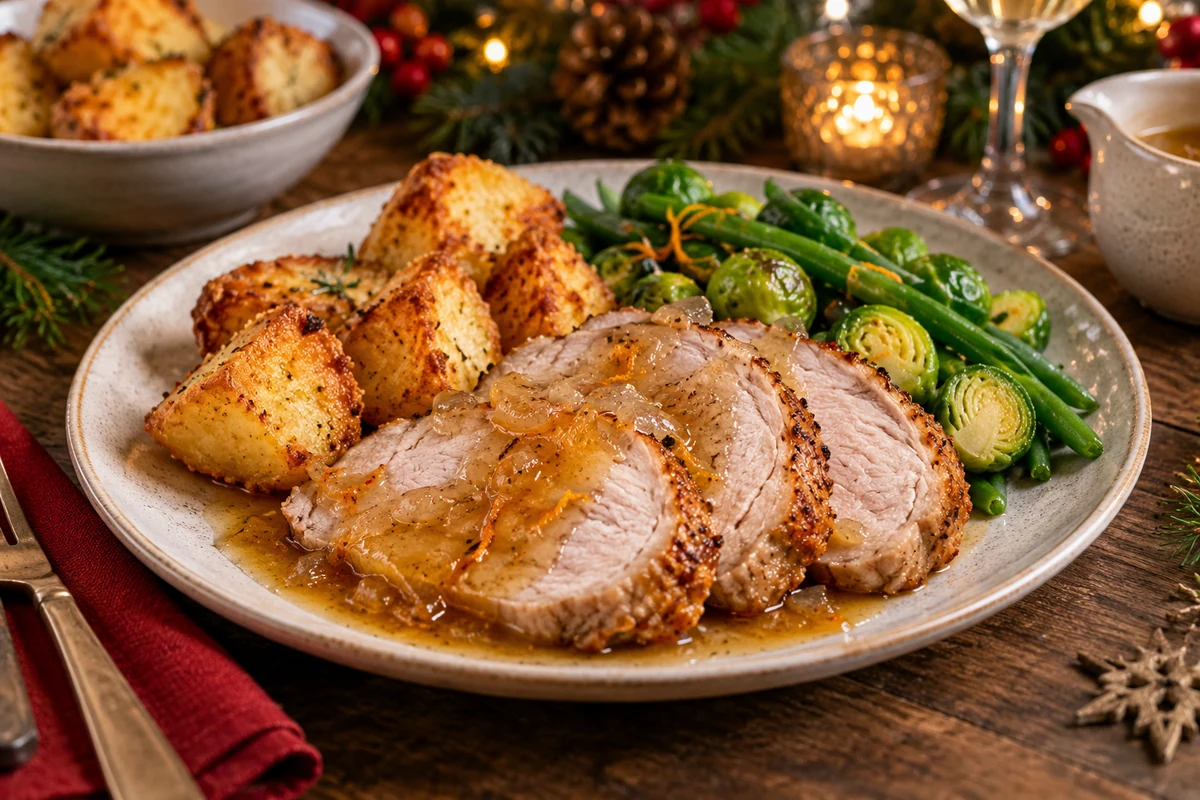
- Brazilian-style rice with vegetables – often called arroz à grega, with peas, carrots and optional raisins. Cool leftover rice within one hour, refrigerate and use within 24 hours; reheat only once until steaming hot.
- Crunchy farofa – coarse toasted cassava flour with onion and optional bacon or nuts. Use flour sold for farofa, not tapioca starch, and check allergens.
- Roast potato wedges – seasoned with rosemary and olive oil and cooked until tender and golden.
- Potato salad – potatoes, carrots and peas with shop-bought mayonnaise or a suitable pasteurised-egg version. Keep chilled until serving.
- Citrus sauce – a separately prepared orange sauce with zest and optional honey, using ingredients that have not touched raw pork.
- Grilled vegetables – courgettes, aubergines and peppers with oil and herbs.
- Fresh bread or baguette – to serve with the sauce or make sandwiches from properly chilled leftovers.
Arranging a practical buffet
- Group dishes sensibly: place the roast and hot sides together, with chilled salads brought out just before the meal.
- Carve before serving: use a clean board and transfer slices to a warm serving platter.
- Offer accompaniments separately: small bowls of farofa, citrus sauce and mustard let guests choose their own combinations.
- Serve promptly: use smaller platters and replenish as needed. Keep cold dishes refrigerated until serving and use suitable equipment if holding food hot for an extended period.
- Make plates easy to reach: put plates at the start of the table and spare cutlery nearby, with room for serving utensils.
- Leave space to move: arrange the table so guests do not have to crowd around the carving board.
Presentation and portions
- Slice across the grain and arrange the pork in a fan on a clean platter with washed herbs.
- Add colour: orange slices, cranberries and rosemary can brighten the presentation. Keep woody stems and whole spices out of individual portions.
- Plan portions: as a rough shopping guide, allow 250–300 g raw boneless pork per adult with side dishes, or 150–200 g when serving several main courses. Appetite, cooking losses and desired leftovers will vary.
- Label allergens accurately: check every ingredient before making free-from claims. Soy sauce may contain wheat, Worcestershire sauce may contain fish, and butter contains milk; prevent cross-contact too.
Serving and using leftovers
- Offer help where needed: assist guests who would find carrying plates or using serving utensils difficult.
- Start with modest portions: make seconds available to reduce food left on plates.
- Plan the next meal: properly chilled pork can go into sandwiches or salads within 48 hours. If reheating, do so only once and heat thoroughly.
A little planning makes Christmas roast pork leg easier to serve: choose the joint, prepare the marinade, check doneness carefully and have your side dishes ready.
Try the flavour combination that suits your household and tell us how it turned out. For more Christmas cooking ideas, follow our latest articles and social updates.
Thank you for reading. Visit the I Love Christmas blog for more recipes and ideas for the festive season.
Christmas roast pork leg: frequently asked questions
How long should I marinate the pork?
Allow 12–24 hours in the fridge if time permits, within the joint’s use-by date. A shorter marination is possible; keeping the meat chilled and cooking it thoroughly matter more than reaching a minimum marinating time.
What centre temperature should I check?
Check the thickest parts with a clean thermometer: 75°C for 30 seconds or 70°C for two minutes. Do not rely on resting to finish cooking an undercooked rolled joint.
Can I replace the orange juice?
Apple juice or pasteurised pineapple juice can replace it. Avoid a long marinade with fresh pineapple juice, which can make the surface mushy.
How can I brown the surface without burning it?
Roast at the lower temperature first, then use 200°C conventional/180°C fan for the final 20–30 minutes if needed. Apply the glaze late and watch closely; a browned surface does not confirm that the centre is cooked.
How should I store leftovers?
Divide into smaller portions, cool and refrigerate within one to two hours, then eat within 48 hours or freeze. Use frozen portions within two to three months for best quality, thaw in the fridge and reheat only once if serving hot.
Can I cook it more quickly in a pressure cooker?
Possibly, using a smaller joint and a tested recipe for your appliance. Follow its capacity, minimum liquid, cooking and pressure-release instructions; there is no single safe timetable for every size of pork leg.
Sources and Further Reading
- Food Standards Agency: Cooking Your Food
- Food Standards Agency: Chilling, Freezing and Defrosting Food