
Christmas music has several intertwined histories: Christian worship, medieval festive songs, oral traditions, manuscripts and printed collections. Later recordings, broadcasting and cinema brought particular songs to wider audiences, while translations and new arrangements helped communities make the repertoire their own.
The origins of Christmas songs bring together faith, history and personal memories. Why do certain melodies feel inseparable from December? Looking at how they were written, performed and shared reveals a varied story rather than a single starting point.
Illustrations in this article are conceptual images, not documentary photographs or evidence of a particular historical event, destination, venue or access route.
Religious music and early Christmas songs
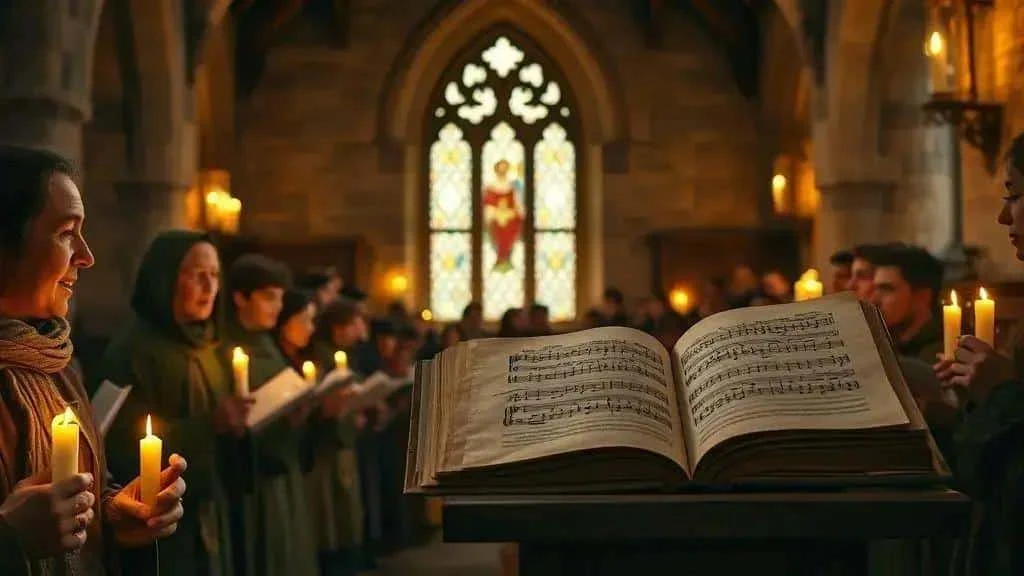
The history of Christmas music includes Christian hymns and liturgical chants that predate the medieval carol. During the Middle Ages, religious singing and popular festive music developed in overlapping but distinct settings.
From liturgical chant to medieval carols
Gregorian chant belongs to the tradition of unaccompanied liturgical singing. Medieval carols also drew on vernacular song and dance traditions; they should not all be described as direct descendants of a single chant form. Some celebrated Christmas, while others addressed different seasons or subjects.
Worship and community
Within worship, chants and hymns served particular liturgical purposes. Beyond it, songs could accompany gatherings, seasonal customs and performances. Music moved between settings, but a church chant and a popular carol were not necessarily the same melody or type of song.
Themes and structure
Christmas carols often tell of the Nativity, angels, shepherds or the Magi. Repeated refrains can invite participation, although surviving medieval pieces vary in complexity and include music for more than one voice.
Instruments and notation
Singing could be unaccompanied or supported by instruments, depending on the place and occasion. Oral transmission mattered, but written musical notation and surviving polyphonic manuscripts were already part of medieval musical life; they did not begin only in the Renaissance.
Sharing and changing the music
Manuscripts, printed collections, choirs and later recordings helped preserve particular versions. Editors and performers also adapted melodies and harmonies, so a familiar arrangement may be much later than the song on which it is based.
- Different forms: liturgical chants, hymns and carols, with distinct purposes and histories.
- Community settings: gatherings, seasonal performances and shared singing.
- Musical variety: single-line melodies, refrains and more complex multi-voice compositions.
- Transmission: oral tradition, manuscripts and, later, printed music.
English carols from the Middle Ages to the nineteenth century
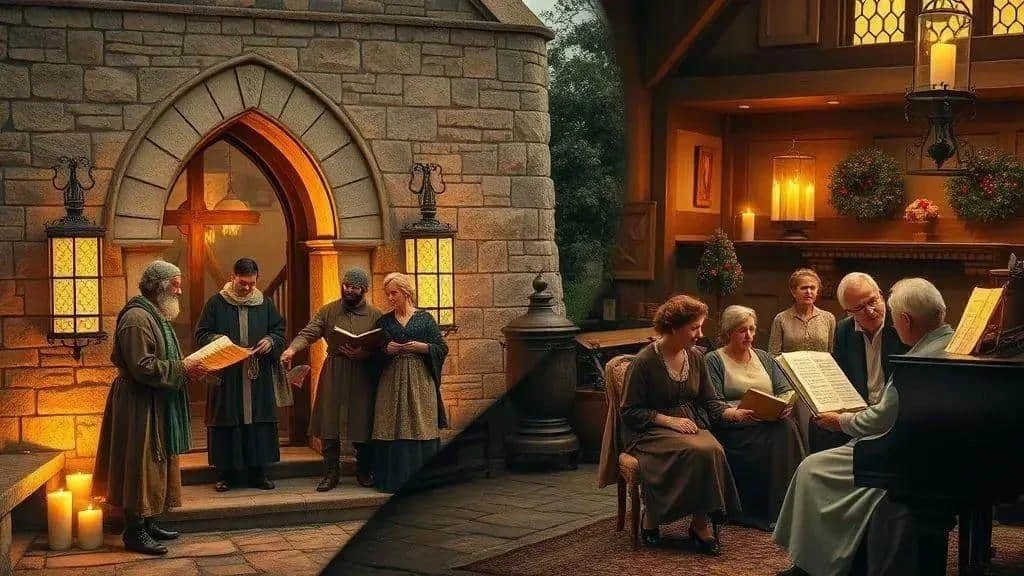
Medieval English carols combined verses and refrains in forms associated with festive and devotional life. Their origins connect with song and dance, and Christmas was one of several subjects before it became the word’s strongest modern association. Source: English Heritage: the history of carols
Festivity beyond church
Carols were not confined to formal worship. Singing could form part of social occasions and performances, sometimes bringing devotional themes into everyday community life. The setting and purpose varied with the particular work.
Oral and written traditions
Melodies could change as people learned them by ear. Alongside oral transmission, manuscripts preserved written versions, and later printed collections made particular texts and arrangements more widely available.
Religious change and restrictions
In seventeenth-century England, Puritan opposition to Christmas festivities and restrictions during the parliamentary period affected public celebration. This is a particular historical context, not evidence that every carol disappeared everywhere or that all Christian traditions rejected Christmas music.
Nineteenth-century collections and renewed interest
Collectors and editors took a renewed interest in traditional songs during the nineteenth century. Published carol collections and new arrangements helped shape the repertoire familiar in churches, concert halls and homes today.
Musical features
Carols often alternate verses with a recurring refrain, but their musical language varies. Older modal melodies, later tonal harmonies and modern arrangements can all sit within a Christmas programme. Simplicity is common in singalong versions, not a rule for every carol.
An evolving legacy
Today’s repertoire brings together songs from different periods. A text, tune and harmonisation may each have a separate history, making a recording’s notes or a reliable music collection useful when tracing a familiar carol.
- Social role: community participation, devotion and seasonal celebration.
- Transmission: oral learning, manuscripts and printed collections.
- Transformation: new harmonisations and the influence of Victorian publishing.
- Present-day settings: choirs, churches, homes and Christmas playlists.
The stories behind Silent Night, Jingle Bells and White Christmas
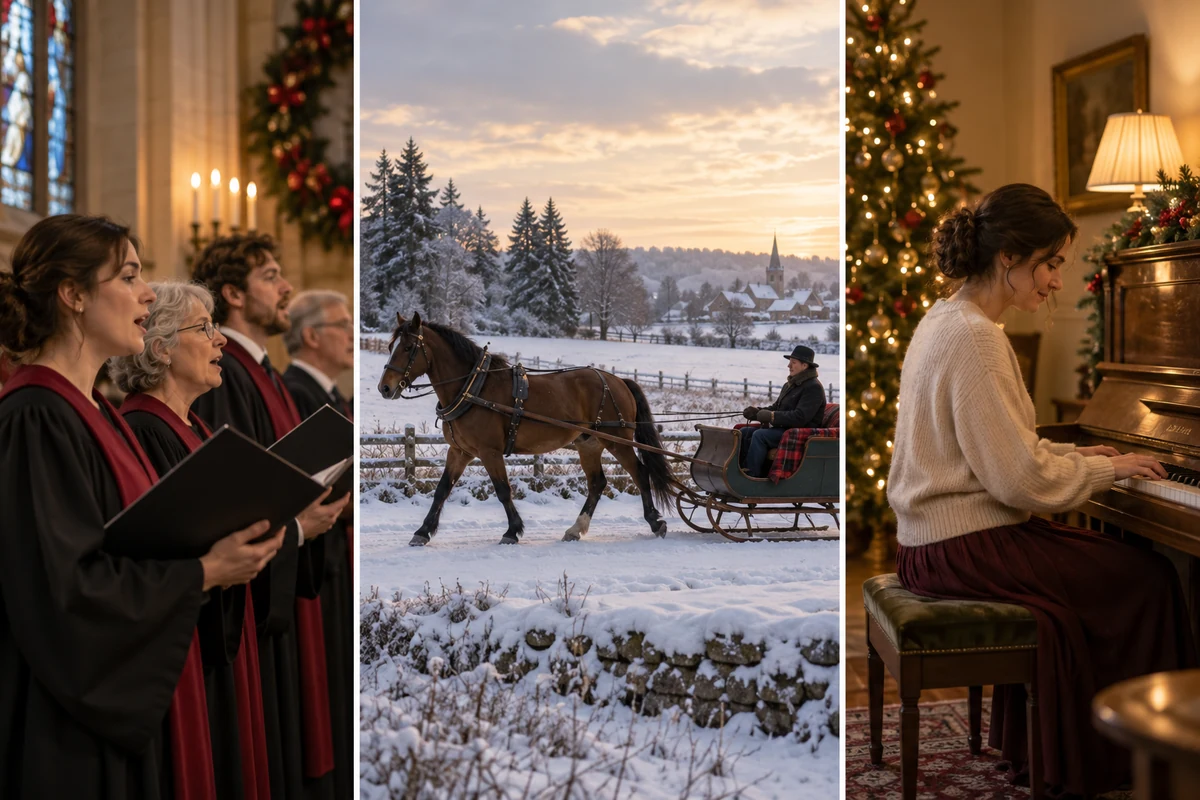
Silent Night originated in Austria. The priest Joseph Mohr wrote the poem in 1816, and Franz Xaver Gruber composed its music in 1818. It was first performed in Oberndorf on Christmas Eve that year with guitar accompaniment. The often-repeated broken-organ explanation is not needed to establish those documented details and should not be presented as a settled fact. Source: Silent Night Association: history
Jingle Bells: a song about a sleigh ride
Jingle Bells was published under the name of James Lord Pierpont in 1857 as One Horse Open Sleigh. The original publication describes a secular winter outing rather than the Nativity. Its later place in the Christmas repertoire illustrates how a song’s seasonal associations can change; specific stories about the occasion that inspired it should be checked rather than repeated as certainty. Source: Library of Congress: The One Horse Open Sleigh, 1857
White Christmas: song, film and recording
White Christmas was written by Irving Berlin and became closely associated with Bing Crosby through his 1942 recording and its appearance in Holiday Inn. Its nostalgic imagery resonated during the Second World War and beyond. Later recordings helped maintain its place in the seasonal repertoire. Source: Library of Congress: White Christmas
Translations and new arrangements
These songs have travelled through translations and new performances. Silent Night is sung in many languages; Jingle Bells appears in playful and formal arrangements; and White Christmas has been recorded by artists with different styles. Comparing versions shows how a familiar melody can acquire a different atmosphere.
- Different beginnings: a Christmas Eve performance, a published sleighing song and a film-era standard did not follow the same path.
- Stories to check: colourful accounts about a broken organ or a particular sleigh race may go beyond what the available record establishes.
- Historical context: the wartime reception of White Christmas is part of its story, alongside its musical and cinematic history.
- Continuing presence: choirs, films, broadcasts and recordings introduce these songs to new listeners.
Their subjects differ, from the Nativity to winter recreation and longing for home. Shared emotional associations and repeated performances help explain their familiarity without making their histories identical.
How recording and cinema broadened the audience

Recording, broadcasting and cinema allowed particular performances to reach people far beyond the places where a song began. They also created strong associations between music and scenes of Christmas celebration.
The recording industry
Record companies released seasonal singles and albums featuring established performers and new interpretations. Successive recording formats brought these performances into homes and shops, where repeated listening made some arrangements especially familiar.
Film and soundtracks
A song heard during a memorable film scene can take on associations beyond its lyrics. Soundtracks help connect a particular performance with characters, settings and emotions, which may influence how later audiences hear it.
Radio, television and streaming
Seasonal broadcasts and television specials brought Christmas music to large audiences. Streaming services now offer another route through playlists, recommendations and individual searches, alongside live performance and personal collections.
Advertising and seasonal associations
Advertisers use familiar Christmas music to establish a seasonal atmosphere. Repetition can strengthen an association with presents, family gatherings or nostalgia, even when that was not the original purpose of the song.
Production and arrangement
Studio performances may add strings, choirs, percussion or a small acoustic ensemble. Arrangers and producers make choices about tempo, texture and harmony that can substantially change the character of a familiar tune.
Cultural effects
Wide distribution can make a relatively small set of songs especially prominent. At the same time, local performers and new arrangements offer different ways to interpret the material rather than simply reproducing one international version.
- Reach: recordings and screen appearances introduce music to wider audiences.
- Memory: a scene or family occasion may become closely associated with a song.
- Commercial use: advertising and seasonal releases contribute to repeated exposure.
- Adaptation: different performers bring their own musical choices to the repertoire.
Christmas music in Brazil
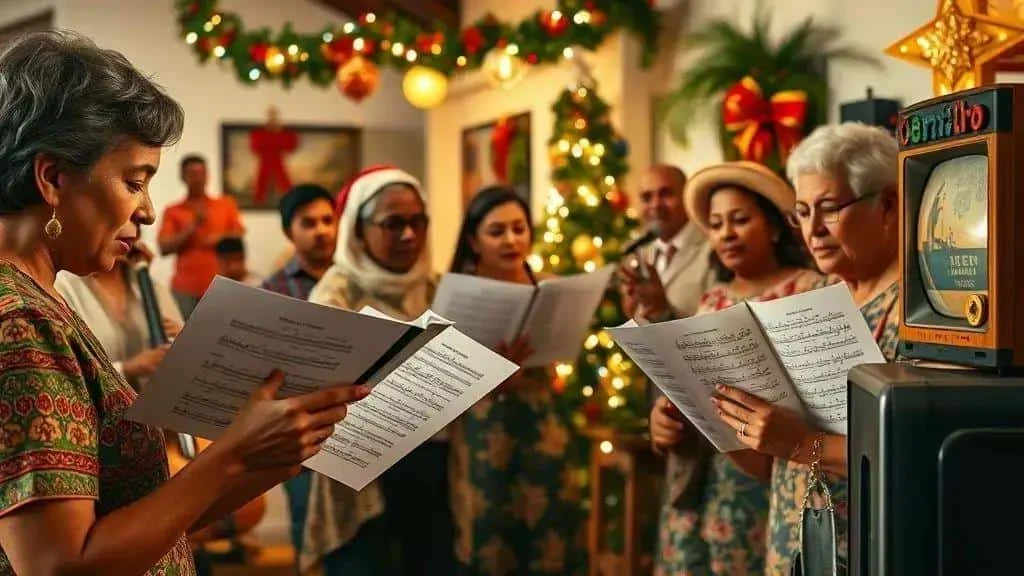
Brazil’s Christmas repertoire includes Christian music connected with Portuguese religious traditions, translated international songs and Brazilian compositions. Its development varies by community and period; it should not be reduced to an immediate or uniform blending of all the country’s cultural traditions.
Religious and community settings
Churches, schools and community gatherings provide settings for sharing the repertoire. Hymns and Christmas choral works may be performed in Portuguese, while translated lyrics can make an existing melody accessible to a different audience.
Rhythm and regional interpretation
When comparing Brazilian arrangements, listen for choices associated with samba, forró, baião, maracatu or bossa nova where the particular recording uses them. Instruments such as the pandeiro, zabumba, accordion and guitar offer different textures. These are possibilities to explore, not features shared by every Brazilian Christmas song.
- Language and imagery: an adaptation may change the wording or setting, while another may retain winter imagery despite Brazil’s summer Christmas.
- Rhythm: compare the actual recording’s groove and tempo rather than assuming a style from the performer’s nationality.
- Instruments: listen for how percussion, accordion, guitar or orchestral instruments shape the arrangement.
- Circulation: choirs, broadcasting, recordings and streaming all offer ways to encounter different versions.
Familiar Portuguese versions
Silent Night is familiar in Portuguese as Noite Feliz, while Jingle Bells has Portuguese adaptations known as Bate o Sino. Brazilian Christmas compositions also sit alongside translated repertoire; a shared melody does not mean every version has identical words.
Broadcasting and commercial recordings
Radio, television and seasonal recordings helped particular performances become familiar to Brazilian audiences. Advertising added further associations, while community and church performances continued to provide their own settings for the music.
Continuity and change
New recordings can introduce different voices and instrumental approaches without replacing earlier versions. A family’s favourite performance may coexist with a choir’s arrangement or a contemporary interpretation.
To explore that variety, compare named performers, local choirs and regional arrangements. Check recording credits when tracing a song’s history rather than relying only on a playlist title.
Lyrics, melodies and regional traditions
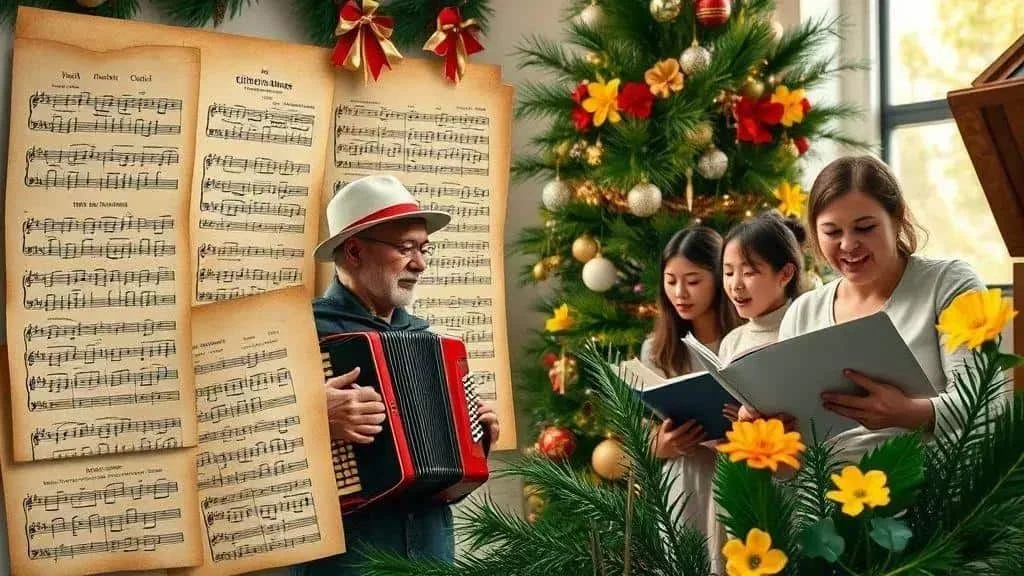
Comparing lyrics and melodies helps reveal how performers and translators adapt a song for different audiences and settings.
Features worth listening for
Some adaptations change imagery or rewrite lines to fit a language’s rhythm. Others preserve references to snow and winter even where Christmas falls in summer. The choice depends on the particular version, not simply the country’s climate.
- Imagery: notice whether a translation preserves the original landscape or introduces another setting.
- Call and response: a leader and group may alternate musical phrases. This technique appears in many traditions and should not be assigned a single origin without evidence for the specific work.
- Modes and harmony: older melodic patterns and later harmonisations can give two versions noticeably different colours.
- Recurring refrains: repetition can make a song easier for a group to learn and join.
Comparing different settings
A folk arrangement, a church choir and a commercial recording can offer very different experiences of the same tune. Rather than assuming a whole region shares one style, choose identifiable recordings and listen to their individual choices.
Context matters too. A secular winter song may become part of a Christmas gathering, while a devotional carol may be heard in a concert or advertisement. Its use in that setting does not erase its original history.
Musical and textual details
Listen for changes in harmony, tempo, phrasing and the number of verses. Their emotional effect depends on the whole arrangement; a major chord does not automatically make a performance festive, nor does a long verse belong only in church.
- Instrumentation: percussion or a solo instrument can change the energy and texture.
- Words: a translator may adjust imagery, phrasing or the amount of detail.
- Rhythm: tempo and metre influence how a familiar melody feels.
- Purpose: worship, social singing, a concert and advertising create different listening contexts.
Finding these variations
Look for local choir recordings, library collections and releases by identifiable regional artists. Recording notes and archive descriptions can clarify dates and credits. Streaming can be a convenient starting point, but a playlist label alone is not historical evidence.
Choosing Christmas music for home, worship and gatherings
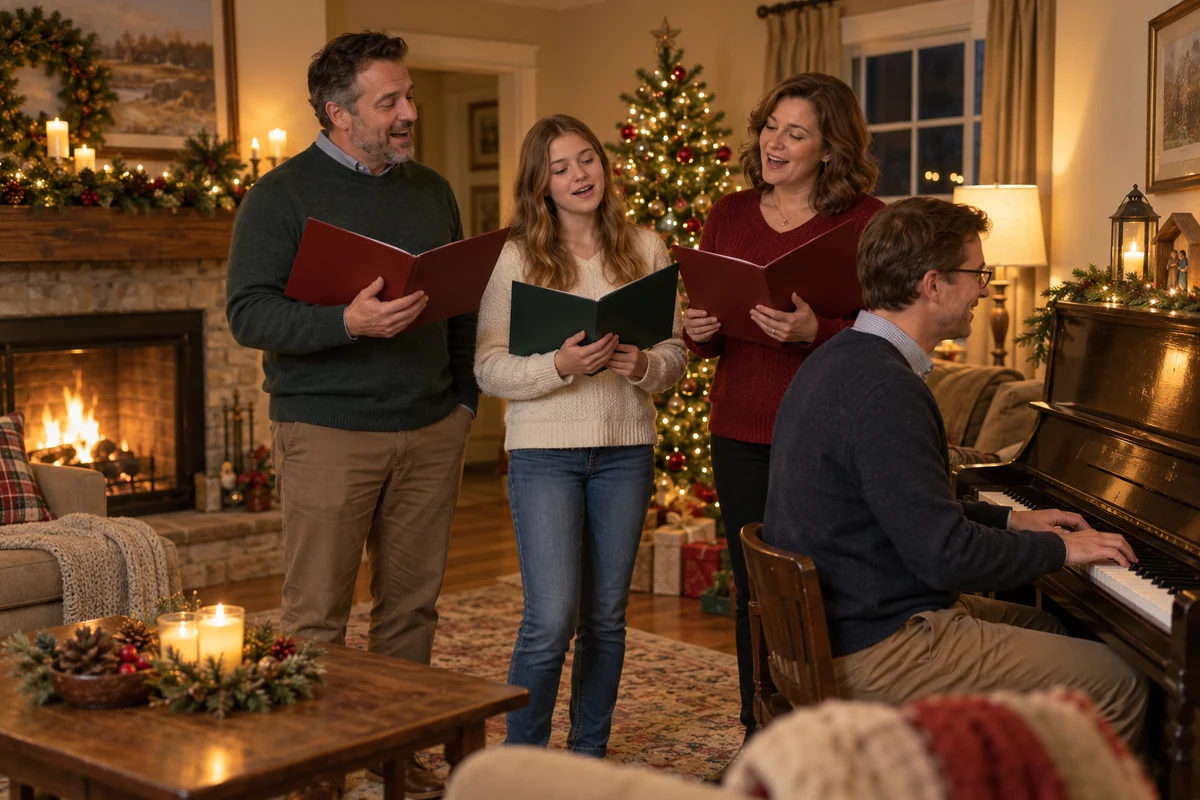
Start with the audience and setting. Music for a family meal has a different role from music selected for a church service. For public events, check the relevant permissions and venue arrangements rather than assuming a personal streaming subscription covers them. Source: GOV.UK: licences to play live or recorded music
Family listening
- Begin gently: acoustic or choral arrangements can provide a calm welcome without overwhelming conversation.
- Add livelier moments: include upbeat tracks if your group enjoys dancing, games or an energetic gift exchange.
- Vary the performers: combine religious, traditional and popular music according to the family’s preferences.
- Plan the duration: for example, a two-to-four-hour gathering needs enough music for the meal and conversation, with a few extra tracks if plans run late.
Music for Mass or another service
- Work with the church: the community’s liturgical requirements and music leader determine what is appropriate; a personal playlist is not a replacement for that planning.
- Follow the service structure: agree where music belongs within the particular celebration.
- Support participation: choose arrangements suited to the singers and congregation where communal singing is intended.
- Confirm practical details: agree texts, keys, performers and any permissions with the responsible person.
Social gatherings
- Match the atmosphere: begin with welcoming music, add energy where appropriate and finish at a comfortable pace.
- Use themed sections: acoustic songs, familiar classics and dance tracks can help organise the flow.
- Ask about preferences: age alone does not tell you what guests will enjoy.
- Include a different version: an unexpected arrangement of a familiar song can make an enjoyable talking point.
Order and transitions
Think about the overall flow: a gentle opening, any planned livelier section and a warm ending. Where your player supports them, volume normalisation or a modest crossfade may help transitions; avoid cutting off a choral piece’s ending unnecessarily.
Duration and volume
- Volume: keep conversation comfortable during a meal and be considerate of neighbours and anyone sensitive to sound.
- Length: add spare tracks so the music need not stop abruptly if the gathering lasts longer than expected.
- Repetition: vary performances if the playlist will run for several hours.
Languages and variety
Include Portuguese, English and other languages when they suit the group. Combining musical styles can introduce guests to something new while leaving room for familiar favourites.
Practical tools
- Separate selections: keep music for a meal, dancing and an agreed service programme distinct.
- Player settings: test available volume and transition options before guests arrive.
- Suggestions: invite guests to propose a few favourites in advance.
- Offline availability: where your service and permissions allow it, prepare for a connection failure. Public performance and recording rights may require separate arrangements.
A repertoire with many histories
Christmas music brings together religious practice, seasonal celebration and individual creativity. Songs have travelled through manuscripts, performances, recordings and translations, acquiring new associations along the way.
Compare an older recording with a recent interpretation and listen for what changes. The words, instruments and setting can reveal as much about a community’s celebration as the melody itself.
Thanks for reading. Explore the I Love Christmas blog for more stories about Christmas customs, music and seasonal celebrations.
Frequently Asked Questions
Where did Christmas music begin?
There is no single origin for the whole repertoire. Christian hymns and liturgical chants predate medieval carols, while later popular songs, recordings and film music followed different paths into Christmas celebrations.
How does a carol differ from a hymn?
The terms overlap in modern use. Carols have historical connections with festive verse-and-refrain songs, while hymns are songs of religious praise. A Christmas carol can also be used as a hymn, so form and setting matter more than a strict popular-versus-formal division.
How has Christmas music been adapted in Brazil?
Brazil’s repertoire includes Portuguese versions of international songs, religious and community performances, local compositions and varied instrumental arrangements. Listen to specific recordings rather than assuming every song uses the same regional style.
Why are some Christmas songs recognised so widely?
Repeated performance, memorable melodies and emotional associations all play a part. Recordings, radio, television and cinema have brought particular songs and arrangements to much larger audiences.
Where can I find historical or regional versions?
Try library and sound-archive collections, choir recordings and releases with clear performer credits and notes. Specialist playlists can help you discover music, but verify historical claims against the underlying sources.
Sources and Further Reading
- English Heritage: the history of carols
- Silent Night Association: history
- Library of Congress: The One Horse Open Sleigh, 1857
- Library of Congress: White Christmas
- GOV.UK: licences to play live or recorded music