
Christmas karaoke can bring a festive gathering together. Choose a compatible sound system or simply sing along without amplification, prepare suitable backing tracks and clear lyrics, test everything beforehand and offer relaxed ways to join in. A Bluetooth speaker alone does not necessarily accept a live microphone.
Christmas karaoke can turn the time around dinner into a cheerful musical gathering. If you would like to involve children, relatives and friends, start with a manageable setup, familiar songs and a welcoming atmosphere rather than complicated equipment.
Illustrations in this article are conceptual images, not documentary photographs or evidence of a particular historical event, destination, venue or access route.
Why add Christmas karaoke to your party?

A Christmas karaoke session gives guests something to enjoy together and can help break the ice. Participation should always be optional: listening and cheering are welcome contributions too.
What it can bring to the evening
- Time together: shared songs can connect generations and become happy memories.
- A festive atmosphere: familiar music helps set the mood, especially when the technical arrangements are ready beforehand.
- A modest budget: you can begin with a phone or television playing backing tracks and sing without a microphone. Amplification requires a compatible signal path.
- Variety: adapt the selection to your guests, mixing carols, festive pop and other favourites.
- Different ways to join in: offer solos, duets, group singing and the option to watch.
Practical planning tips
- Balance the playlist: mix familiar easy songs with more demanding choices, including duets and slower versions.
- Use a simple running order: a short sign-up list or relaxed rotation helps avoid confusion.
- Test the sound first: check microphones, playback and levels before guests arrive.
- Make a comfortable singing area: use gentle lighting and nearby seating; a raised stage is unnecessary.
- Offer light-hearted activities: themed rounds and small optional prizes can encourage participation without turning it into a demanding competition.
- Allow for comfort: provide water, seats and breaks between performances.
Inclusion and accessibility
Use readable lyrics and ask guests about their preferences rather than assuming what they enjoy because of their age. Offer duets to anyone who would rather not sing alone, and provide quieter songs or seated performances where helpful.
Safety and practical arrangements
- Keep cables and equipment out of walkways and secure stands against accidental knocks.
- A suitable wireless microphone can reduce trailing cables, but check its receiver, batteries and compatibility beforehand.
- Have a backup playlist available through a service’s authorised offline feature, or another lawful source, in case the internet fails.
Essential equipment and affordable alternatives
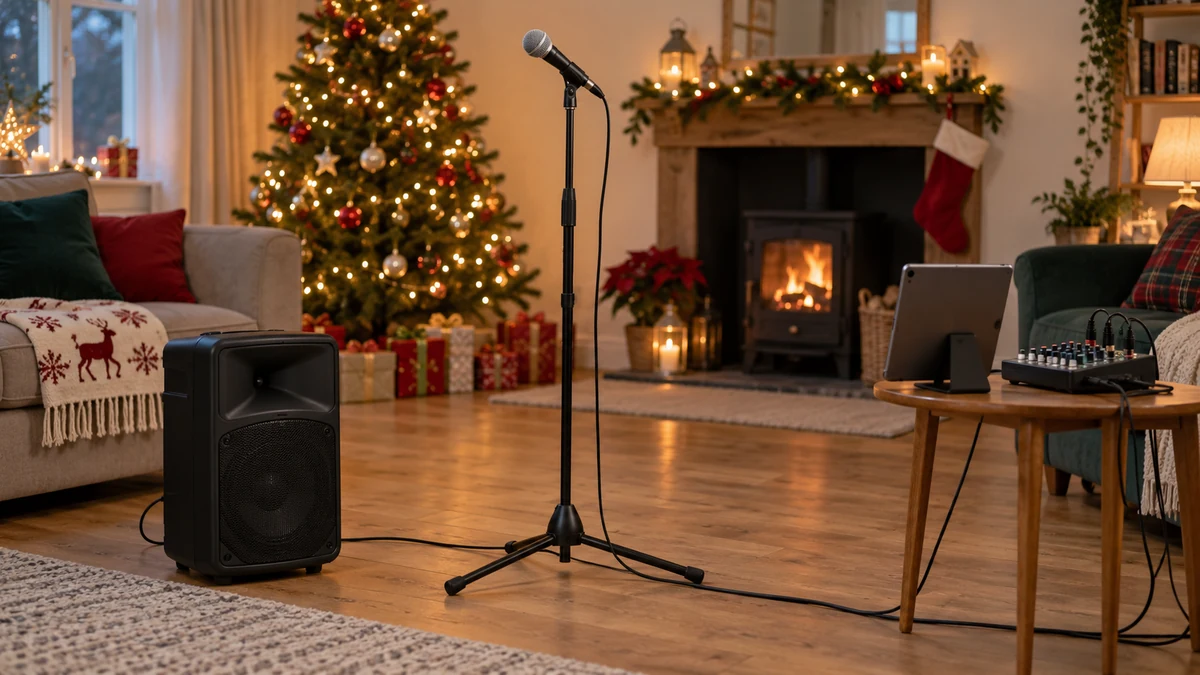
Concentrate on clear sound, compatible connections and a setup you can operate confidently. More equipment is not automatically better for a small room.
What you may need
- Microphone: a dynamic handheld microphone is a common practical choice, but an XLR microphone still needs a suitable microphone input and preamp, such as those in a mixer or compatible PA. A simple plug adaptor does not provide these. USB microphones require a compatible device and suitable audio routing.
- Loudspeaker: choose a system that accepts your microphone and playback source. A domestic Bluetooth speaker may only accept music playback. Judge suitability by the room, inputs and clear sound at a comfortable level rather than a universal wattage figure.
- Playback and lyrics: a television, tablet, phone or laptop can display a compatible karaoke service. Check its audio output separately from the screen connection. Bluetooth can introduce delay and is generally a poor choice for the live microphone path.
- Mixer or interface: you may need one to combine music and microphones or route computer audio. Two microphones require enough suitable inputs; an interface does not automatically provide an easy standalone karaoke mix.
- Cables and adaptors: use the types specified by your equipment, such as XLR or appropriate line-level cables. Check connector wiring and signal level, not just whether a plug fits.
- Stands and accessories: a stable microphone stand, tablet holder, suitable cable covers and spare batteries can help. Use electrical accessories within their ratings and avoid improvised power connections.
- Lighting: gentle LED lighting can add atmosphere without shining into singers’ eyes or obscuring walkways.
Lower-cost options
- Phone and Bluetooth speaker: use this for backing music and sing unamplified. Adding a USB or headset microphone will not automatically make your voice come through the speaker.
- Compact karaoke PA: a portable system with compatible microphone inputs and a separate music input can provide a simpler all-in-one arrangement. Check the manual before buying or borrowing.
- USB microphone and laptop: this can work with appropriate software, monitoring and output routing. Test the full setup for delay; merely connecting a USB microphone and opening a music video does not amplify your voice through the speakers.
- Borrowing or hiring: a basic PA package with setup advice may suit a larger gathering. Confirm which microphones, cables and instructions are included.
- Using what you already own: a headset or home speaker is useful only if its connections and functions suit the task. Check the manufacturer’s instructions rather than improvising adaptors or modifying equipment.
Setup tips
- Positioning: aim speakers towards listeners and keep them forward of the singing area where practical. Sing towards the microphone and keep it away from the speakers’ direct sound to reduce feedback. Source: Shure: microphone placement
- Soundcheck: begin at a low level, check the microphone input and increase gradually while someone listens from the audience area.
- Room sound: ordinary curtains and rugs can reduce reflections. Lower the level if the room sounds harsh or reverberant rather than adding more effects.
- Cables and power: use suitable cable covers or appropriate securing tape, without creating raised trip hazards. Do not overload sockets or connect extension leads in a chain.
- Backup: prepare lawful offline tracks where available and spare batteries or a compatible microphone if you have one.
Apps and connectivity
Choose a karaoke service with clear synchronised lyrics and suitable backing tracks, checking its device support and terms. Test the app beforehand and silence notifications so calls and alerts do not interrupt the music.
Building a Christmas karaoke playlist
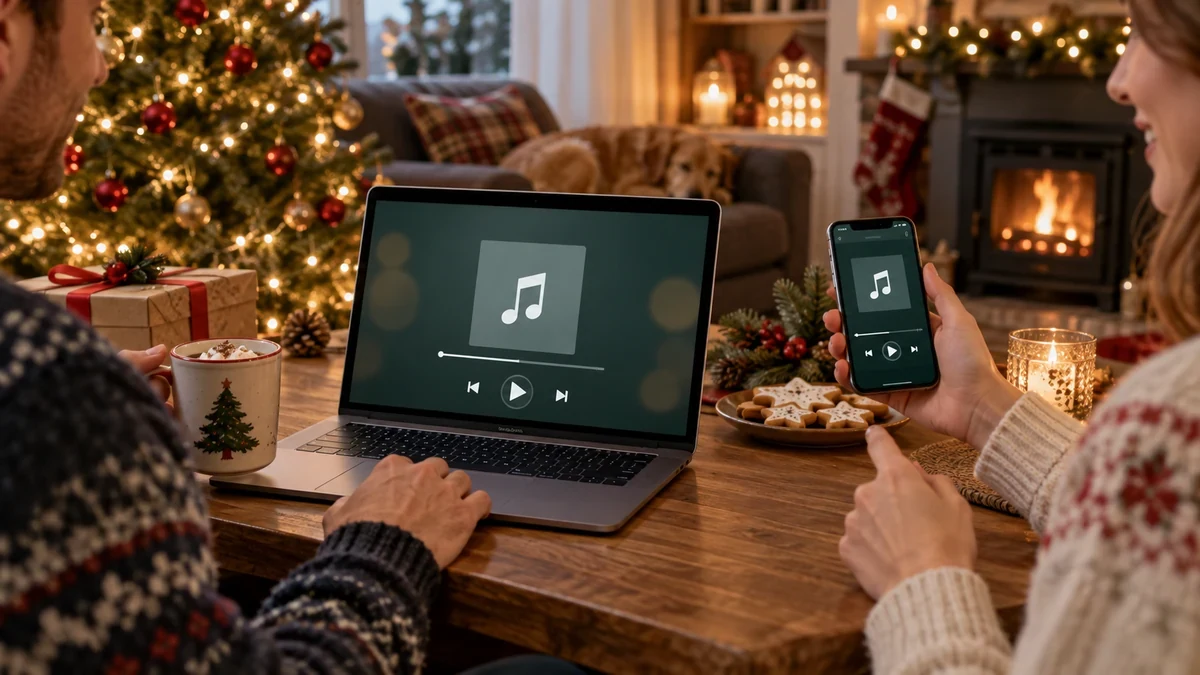
A useful Christmas karaoke playlist matches the people in the room and the time available. Choose clear backing tracks and versions in a comfortable vocal range.
Balancing the selection
- Vary the pace: alternate gentle, lively and moderate songs rather than keeping the volume and energy high throughout.
- Mix familiar and newer songs: ask guests what they know instead of assuming that different generations have fixed musical tastes.
- Include different interests: offer carols, pop, group songs and other requested favourites.
- Choose suitable backing tracks: a clear instrumental version makes it easier to hear the singer.
- Keep turns manageable: songs around two and a half to four and a half minutes can work well, but let the running order remain flexible.
Christmas song suggestions by category
Familiar English-language choices
- Jingle Bells — a familiar traditional or instrumental arrangement.
- White Christmas — associated with Bing Crosby; choose a suitable karaoke arrangement.
- Last Christmas — Wham!, with pop or acoustic-style backing tracks to explore.
- All I Want for Christmas Is You — Mariah Carey; a lively but vocally demanding choice.
- Silent Night — a gentle option for a group or a solo voice.
Portuguese-language Christmas favourites
- Noite Feliz — the Portuguese version of Silent Night, suitable for a group familiar with it.
- Bate o Sino — a familiar Portuguese-language festive singalong.
- Então É Natal — associated with Simone in Brazil; choose it if your guests know the Portuguese version.
- Boas Festas — a Brazilian Christmas song by Assis Valente.
Festive pop and lively choices
- Feliz Navidad — José Feliciano, often enjoyable as a group song.
- Santa Tell Me — Ariana Grande.
- Wonderful Christmastime — Paul McCartney.
- Mistletoe — Justin Bieber, for a gentler pop moment.
Songs to share between singers
- The Little Drummer Boy — try sharing parts with a small group.
- Underneath the Tree — guests can take turns if they prefer; this is a party arrangement, not a claim that the original is a duet.
- Então É Natal — Portuguese-speaking guests can divide sections between voices.
Group choices for children who know them
- Jingle Bells — choose a straightforward arrangement.
- Rudolph the Red-Nosed Reindeer — a familiar storytelling song.
- We Wish You a Merry Christmas — a short option for singing together.
Arranging the running order
- An easy opening: start with a familiar song to help the first volunteers feel comfortable.
- A livelier section: place two or three upbeat songs together when the group is ready for them.
- Quieter moments: follow an energetic run with a gentler choice or a break.
- A shared finish: end with a song that everyone who wants to can join.
Practical playlist tips
- Offline preparation: use an authorised download or offline feature where the service permits it. Check that the tracks actually play without a connection.
- Favourites: keep requested songs in a short queue so you can find them easily.
- Clear transitions: leave a pause between ordinary karaoke turns so the next singer can get ready. Automatic crossfades can cut off introductions and confuse lyric cues.
- Alternative versions: keep a gentler or lower-key arrangement where helpful.
- Requests: invite each guest to suggest one or two songs before the gathering.
Medleys and variations
- For a short private singalong, you might rehearse a transition between Jingle Bells and Feliz Navidad using appropriate backing material.
- A Portuguese-language sequence such as Noite Feliz followed by Então É Natal may suit guests who know those songs.
- Share sections between singers or generations without putting anyone under pressure to perform alone.
Finding suitable versions
- Look for authorised karaoke or instrumental recordings on video platforms, checking the uploader and usage terms.
- Dedicated karaoke services may provide synchronised lyrics and backing tracks; check compatibility and available songs.
- A streaming subscription or offline feature does not automatically cover public karaoke use. For a public or commercial event, check the music, recording and lyric permissions required with the venue, supplier and relevant licensing bodies. Source: GOV.UK: licences for live or recorded music
Setting the scene

A welcoming Christmas karaoke space can be created with ordinary furniture, gentle lighting and a few decorations. Keep the layout practical before adding extras.
Lighting and atmosphere
Use warm, indirect lighting if you like a cosy setting, with enough brightness to read lyrics and move safely. Avoid glare and ask guests about flashing-light or sensory sensitivities.
- Position suitable decorative lights away from cables and performance equipment.
- Lamps with adjustable brightness can make it easier to change the mood between singing and conversation.
- LED candles avoid an open flame, but still need safe handling; keep loose batteries and unsecured battery compartments away from children.
The singing area and seating
Set aside a clear corner rather than constructing a stage. A stable stand and accessible chair may be all you need.
- A small marked area of about 1 m × 1.5 m is only a starting idea, not an accessibility standard. Increase the space to suit movement, mobility aids and safe access.
- Place speakers securely, directed towards listeners and away from microphones as far as practical; do not balance them on unstable surfaces.
- Keep a clear route to and from the singing area.
Simple decoration ideas
Combine a few seasonal touches with things you already own.
- Use lightweight wreaths or ribbons securely fixed away from electrical equipment.
- Paper decorations and pine cones can add interest where they will not create an obstruction or small-parts hazard.
- Cushions and blankets in festive colours can make the seating area inviting.
Useful finishing touches
A few practical details help the evening run smoothly.
- A stable side table can hold the tablet, remote control and running order.
- Offer simple hats or paper photo props if guests enjoy them, with suitable choices for children.
- Keep food and drinks nearby but separate from electrical equipment.
Reuse and safety
Reuse decorations where possible and inspect lights and cables before setting up.
- Choose suitable LED lighting and use it according to the manufacturer’s instructions.
- Route cables safely, use suitable protection where needed and keep sockets accessible without overloading them.
- Keep paper, fabric and other decorations clear of heat sources and equipment ventilation openings.
Final setup checks
- Arrange the room before guests arrive and test lighting while the lyrics are on screen.
- A simple photo backdrop can be placed away from the performance area.
- Ask someone to check sightlines, seating and routes through the room.
Games and activities for the whole group

Light-hearted activities can keep Christmas karaoke varied, but nobody should feel obliged to sing or compete.
Simple games
- Themed rounds: try a familiar-classics round, a pop round or duets, keeping turns short and flexible.
- Karaoke bingo: make cards with features such as a duet, a solo or a group chorus. Mark them as they occur, without encouraging louder singing as a challenge.
- Christmas charades: act out a song title or festive character for the group to guess.
- Name that tune: play a short instrumental introduction for teams to identify. A short clip is not automatically copyright-free; use material appropriate to your private gathering and check permissions for public events.
Collaborative activities
- A family medley: share short sections of several songs among willing singers and rehearse the handovers beforehand.
- Duets across generations: pair guests who would enjoy singing together, rather than assigning partners solely by age.
- A request playlist: ask each household for a couple of suggestions so different tastes are represented.
Organising a turn-taking game
- Agree the order: use a simple list of volunteers and allow anyone to pass.
- Manage the time: short turns of around two to four minutes can keep the pace comfortable.
- Keep track: a small board or list can show who is next.
- Welcome duets: let anyone join a willing partner instead of singing alone.
Materials for the games
- Simple printed or digital bingo cards.
- Cards with themes or charade ideas.
- A clock or timer, used flexibly.
- Suitable photo props and small optional prizes.
Making participation accessible
- Offer larger, high-contrast lyrics and slower arrangements to anyone who finds them helpful, regardless of age.
- Provide a stable seated option and a suitable microphone stand or lightweight microphone where needed.
- Offer pairs or small groups for guests who prefer company while singing.
Keeping the evening comfortable
- Alternate music with conversation or a short game rather than keeping the sound going continuously.
- Choose small suitable prizes, taking allergies and children’s ages into account.
- Allow breaks for water, snacks and rest, and stop if singing becomes uncomfortable.
Setting up and testing the sound before dinner
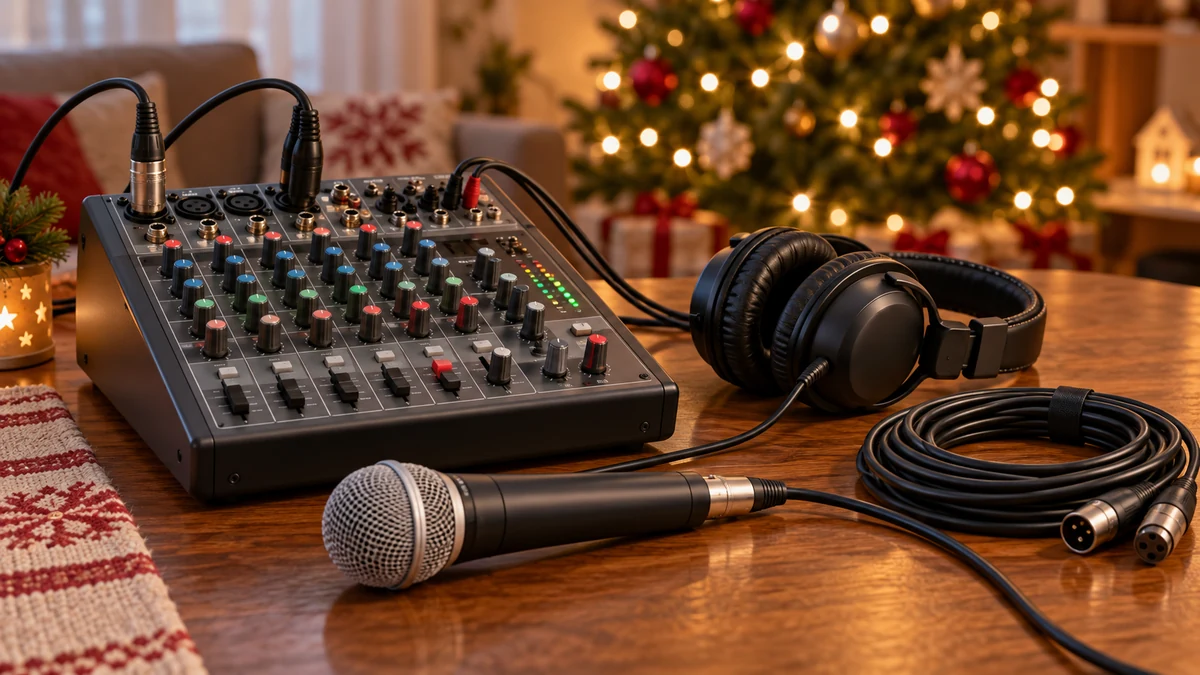
A soundcheck helps reveal connection problems before the Christmas karaoke begins. Keep adjustments simple and follow the instructions for your particular equipment.
Equipment checklist
- Microphones: check cables or batteries and have a compatible spare if available.
- Speakers: confirm that the selected inputs accept the signals you intend to use.
- Playback device: prepare the playlist and any authorised offline tracks.
- Mixer or interface: confirm the input, monitoring and output routes before raising levels.
- Cables: inspect the required audio and display leads and use appropriate electrical extensions safely.
- Stands and cable protection: secure the setup without obstructing walkways.
A straightforward soundcheck
- Position equipment: place speakers towards the audience, keep microphones out of their direct sound and put the playback device within easy reach.
- Power up carefully: make connections with equipment off and controls low. Normally switch on sources and mixer before powered speakers or amplifiers, following the manuals. Reverse that order when switching off.
- Check inputs: verify that the microphone and music source reach the intended channels and are not muted.
- Set input gain: ask a singer to use their normal performance level and adjust within the equipment’s guidance, leaving room below clipping.
- Test the voice: speak and sing gently from the intended position to check clarity and a comfortable microphone distance.
- Add backing music: bring it up gradually and balance it below the voice without making the overall level excessive.
- Start with neutral equalisation: adjust only when a specific problem is audible. Small reductions may help; indiscriminate treble boosts can make feedback more likely.
- Listen for feedback safely: test from the planned singing positions at a low level. Do not deliberately approach a speaker with a live microphone. If ringing begins, lower or mute the channel promptly and reposition the setup. Source: Shure: solving feedback problems
- Try a duet: check both microphones together, keeping unused microphones muted.
- Ask another listener: have someone listen from different seats and comment on clarity. If making a short test recording, obtain the participants’ permission.
- Finish the setup: secure cables, check power arrangements and put any spare batteries or microphone somewhere accessible.
Simple gain and tone adjustments
- Low-frequency rumble: a microphone channel’s high-pass filter may help if available and appropriate. Follow its instructions; a fixed 80 Hz setting is not a universal cure.
- Vocal clarity: first check microphone position and reduce overpowering backing music. Do not automatically boost 2–5 kHz, which may increase harshness or feedback.
- Clipping: reduce the relevant input gain if the channel clips; lowering only the final speaker volume will not fix an overloaded input.
- Music and voice balance: keep the voice understandable while the backing remains comfortable and audible.
Common problems
- Feedback: lower or mute the affected channel, improve microphone and speaker positioning and use less gain. Use a notch filter only if you understand the system and the problem frequency.
- Distortion: check which stage is overloaded and reduce its level. Inspect connections and cables with equipment safely powered down where necessary.
- No microphone sound: check battery, cable, mute switch, selected input and compatibility before raising the volume.
- Buzzing or crackling: check signal leads and connections using the manufacturer’s guidance. Never remove a mains earth connection or open powered electrical equipment; seek qualified help for electrical faults.
- Bluetooth delay: use a suitable wired path for live vocals. Offline music may prevent buffering, but does not remove Bluetooth latency or automatically correct lyric synchronisation.
When to test
- Connect and inspect the equipment while it is off, then perform the first powered soundcheck about 60 minutes before dinner, if that fits your plans.
- Make any final adjustments around 30 minutes beforehand with a representative backing track.
- Recheck connections around 10 minutes before the session, keeping levels low while doing so.
Versions, medleys and variations

Acoustic arrangements, pop backing tracks and group songs can suit different moments. Choose variations around your guests’ voices and preferences, using material you are entitled to play and adapt.
Choosing suitable arrangements
- A comfortable key: where the service allows it, try a modest pitch adjustment before the performance. There is no single key that suits every singer.
- A manageable pace: a slower version may help some singers, but test that the accompaniment and lyrics remain synchronised.
- A clear arrangement: a less busy backing track can make a gentle song easier to follow.
- Clean backing audio: use a suitable instrumental or karaoke track rather than competing with a loud lead vocal.
- Rehearsed transitions: if using a medley, check each handover and lyric cue. A deliberate pause is often clearer than an automatic crossfade.
Medley ideas
- A lively sequence, around 3–4 minutes: selected sections of Jingle Bells, Feliz Navidad and All I Want for Christmas Is You. Choose keys and tempos that suit the actual singers rather than imposing one setting on all three songs.
- A gentler sequence, around 4–5 minutes: Silent Night or Noite Feliz followed by Happy Xmas (War Is Over), or its Portuguese adaptation Então É Natal. Use a comfortable range and a gentle arrangement, with the correct title for the version being sung.
- A short children’s sequence, around 2–3 minutes: familiar sections of Jingle Bells, Rudolph the Red-Nosed Reindeer and We Wish You a Merry Christmas, if the children enjoy those songs.
- A bilingual sequence: alternate familiar English and Portuguese songs to include guests who use both languages.
- A changing mood: begin gently, move towards a livelier song and finish with a shared chorus.
Preparing a medley
- Choose three or four songs with sections your singers know and can manage comfortably.
- Check the keys and use suitable authorised arrangements or permitted transposition where needed.
- Plan transitions at natural musical stopping points, with clear cues.
- Test every handover rather than applying a fixed crossfade to all tracks. Keep introductions and lyric timing intact; a short pause may be the better choice.
- Rehearse together before the party to agree entries, handovers and the ending.
Other ways to vary the session
- An acoustic singalong with guitar or keyboard, if someone wants to play.
- A suitable pop arrangement for guests who enjoy dancing.
- Group singing so people can join without taking a solo.
- Duets and shared turns for anyone who prefers company.
- Slower backing tracks for any guest who finds that pace more comfortable.
Final karaoke tips
- Offer alternatives: keep a gentler version or another familiar song ready.
- Test pitch and tempo controls: agree changes with the singer beforehand rather than altering them unexpectedly mid-song.
- Label the medley clearly: make its start and finish obvious in the running order.
- Keep it manageable: a short three-to-five-minute medley can be enough; adapt to the group’s energy and interest.
Bringing the evening together
A relaxed Christmas karaoke session is about shared songs and enjoyable company. Choose equipment you understand, prepare the playlist and give everyone a comfortable way to take part—or simply listen.
Thank you for reading. Follow us for more seasonal ideas and visit the I Love Christmas blog for further inspiration.
Enjoy the music, and have a happy Christmas!
FAQ: Christmas karaoke at home
What basic equipment do I need?
For an unamplified singalong, a device playing suitable backing tracks may be enough. To amplify voices, use a compatible microphone input and preamp, music input, mixer or karaoke PA, and speakers. Check the entire signal path; a Bluetooth speaker alone may not accept a live microphone.
How can I build a playlist guests will enjoy?
Ask for requests, mix familiar festive songs and different styles, and choose readable lyrics and comfortable vocal ranges. Keep turns manageable, include group songs and allow pauses between performances.
What should I do about feedback or distortion?
Lower or mute the affected channel first. Check microphone and speaker positioning, input gain and whether any stage is clipping. Avoid indiscriminate EQ boosts, and follow the equipment manual before trying more advanced adjustments.
How can I include guests without making them feel embarrassed?
Offer duets, group singing, seated performances and larger lyrics where helpful. Let guests choose songs and decline a turn without pressure. Ask about preferences instead of assuming them from age.
What works on a small budget?
Play backing tracks through equipment you already own and sing without amplification, or borrow a compatible karaoke PA. A USB microphone and laptop require tested audio routing and monitoring; they are not automatically a complete karaoke system.
Sources and Further Reading
- Shure: microphone placement
- Shure: solving feedback problems
- GOV.UK: licences for live or recorded music