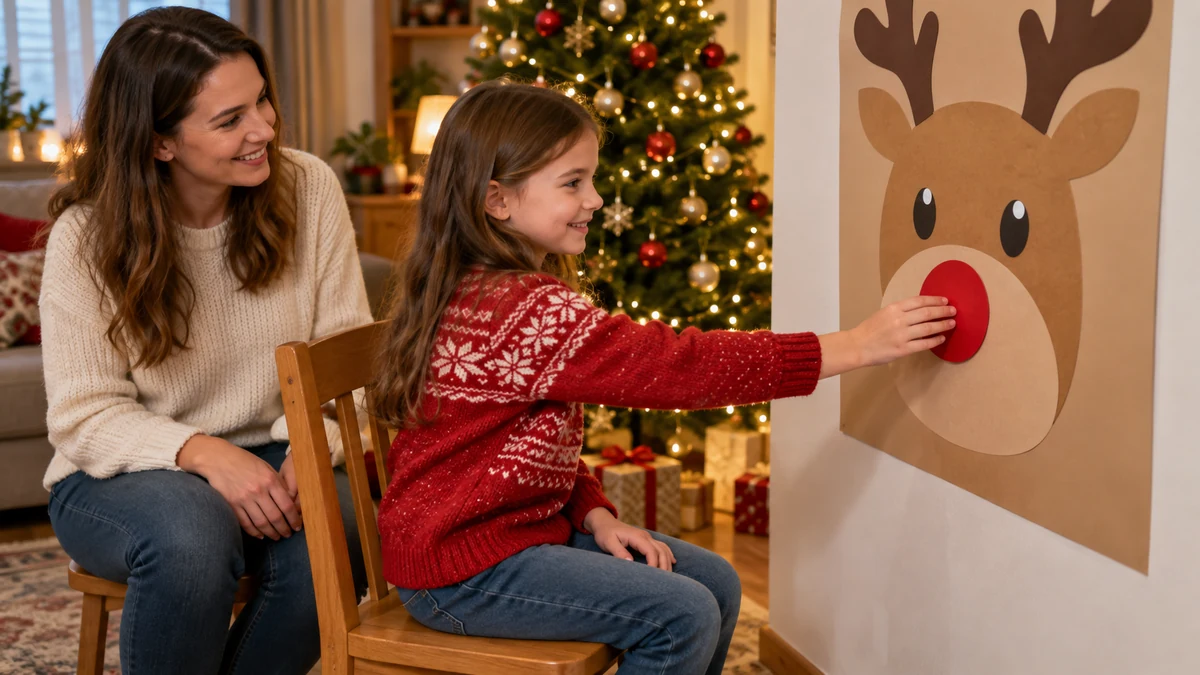
Pin the nose on the reindeer is a Christmas party game in which players try to place a red nose on a reindeer picture. Use removable tape rather than actual pins, offer an eyes-open version and, if a player chooses a blindfold, let them place the nose from a stationary position within easy reach. Adapt the materials, scoring and support to the group.
Pin the nose on the reindeer can be a light-hearted addition to a Christmas gathering. Here are simple ways to make the game, involve children and adapt it for your family, with ideas for homemade prizes.
Illustrations in this article are conceptual images, not documentary photographs or evidence of a particular historical event, destination, venue or access route.
The game pictures illustrate the equipment and an eyes-open variation; they are not printable templates.
How the reindeer nose game works
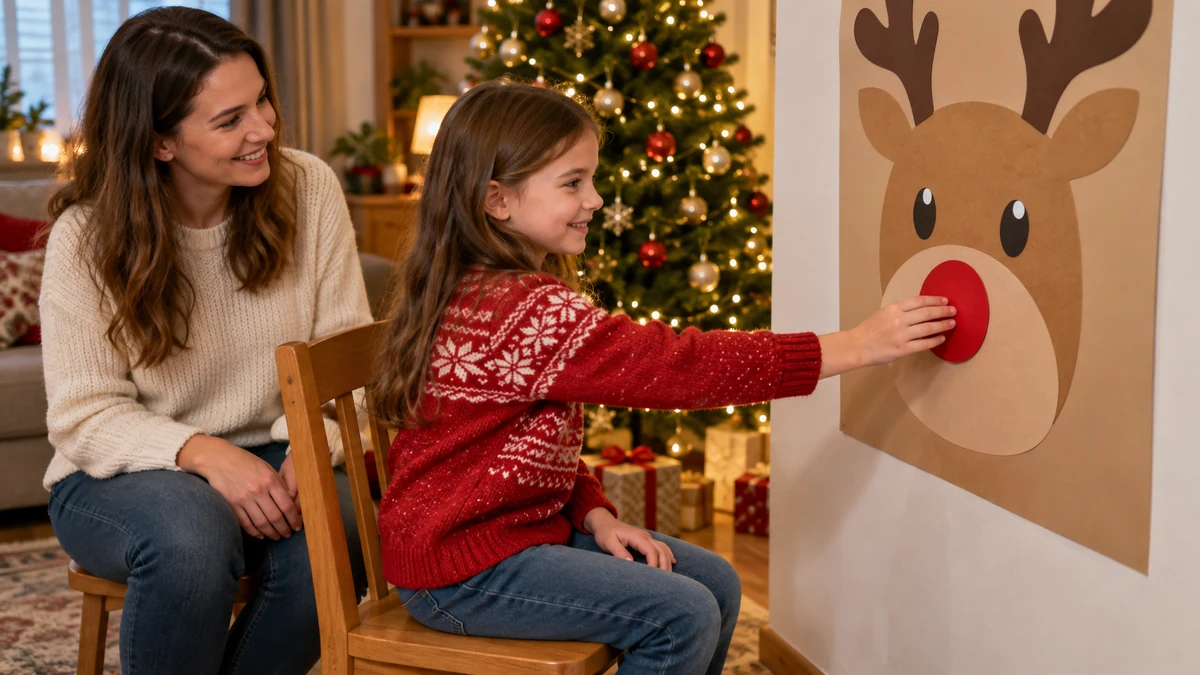
Players take turns placing a red nose on the correct spot on a reindeer picture. A blindfold is optional: position the player within easy reach first, keep them still and do not spin them or ask them to walk without seeing.
Materials and preparation
- Reindeer picture: draw a face on card or a poster and fix it securely at a height the player can reach comfortably.
- Red noses: use large, flat paper or felt circles with removable adhesive. Avoid small loose pompoms or other pieces a child could put in their mouth.
- Optional blindfold: a clean, comfortable eye covering for a willing player; it must not cover the nose or mouth.
- Removable tape: secure the picture and attach the noses without pins or sharp fixings.
- Position marker: a flat strip of suitable tape can mark a comfortable stationary position within reach of the picture.
- Optional timer: useful for keeping turns similar, but never a reason to rush someone.
How to play, step by step
- Set up: attach the reindeer picture to a clear wall or stable board, with enough unobstructed space for the player and a supervising adult.
- Decide the order: take turns by agreement or draw names.
- Prepare the player: help them settle within easy reach of the target and hand them a nose. Offer an eyes-open turn or, if appropriate and wanted, an optional blindfold.
- Allow time: around 20–30 seconds can be a loose guide, with extra time or no timer where helpful.
- Place the nose: the player stays seated or standing in the same place and reaches towards the picture. No running, spinning or blindfolded walking.
- Check the result: remove any blindfold before the player moves and look at how close the nose is to the target.
- Take turns: continue until everyone who wants to play has had a go, then add the scores if you are keeping them.
Simple rules and scoring
- Basic scoring: award three points for the central area, two for the surrounding area and one for taking a turn outside those zones. Agree the boundaries beforehand.
- Touching the picture: in the standard challenge, place the nose without feeling for the target first. Allow tactile exploration when it is part of an agreed accessible version.
- A tie: share the result, offer another unhurried turn or measure the distance from the centre.
- Adaptations: offer spoken directions, tactile features or an eyes-open turn according to the player’s preferences.
Ways to make it enjoyable
- Play quiet Christmas music if everyone is comfortable with it, keeping instructions easy to hear.
- Offer simple recognition, such as a homemade certificate or an age-appropriate sticker.
- Adjust the target size or nose design rather than adding heavy or small loose pieces.
- Play in teams if the group enjoys a friendly shared challenge.
Safety and inclusion
Keep the play area clear of trip hazards and spectators. Ask each player what support would help; a tactile board, clear spoken instructions or a seated, eyes-open version may work better than a blindfold.
Materials and low-cost alternatives
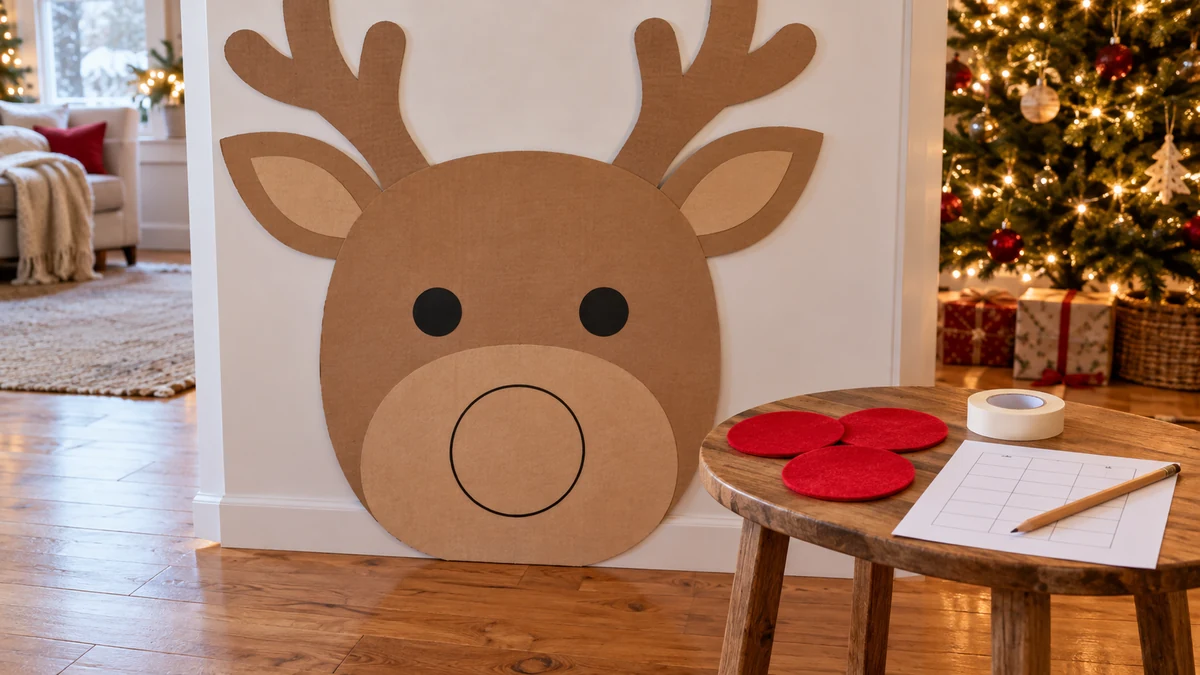
Gather the basic equipment before the game and choose reusable or inexpensive materials suited to the players.
Essential equipment
- Reindeer picture: one large sheet of card, roughly A2 or larger, or a clean cardboard panel that can be fixed securely.
- Red noses: five to ten large, flat paper or felt circles. Around 6 cm may be manageable for older players, but size alone does not make a loose item suitable for a young child.
- Optional eye coverings: one to three clean, comfortable fabric blindfolds, used only by players who want them and can remove them readily.
- Removable adhesive: tape suitable for the wall or board, with small loops prepared on the backs of the noses by an adult.
- Scissors and craft glue: for preparing the picture and pieces. Adults should handle difficult cutting; hot glue is not needed for this game.
- Black marker: draw the face and clearly mark the nose position.
- Floor tape: if useful, mark a stationary position within comfortable reach. Do not stretch string across the floor or create a blindfolded walking route.
- Timer or phone: optional; 20–30 seconds is a flexible guide for a turn, not a speed target.
Budget-friendly substitutions
- An alternative board: use a clean, sturdy cardboard box lid with all staples and sharp edges removed.
- Low-cost noses: cut large circles from red paper or card. Avoid bottle tops, loose magnets and small pompoms.
- No special blindfold needed: simply offer an eyes-open game. If using a fabric eye covering, it should fit comfortably and never obstruct breathing.
- Fixing the picture: use suitable removable tape or a stable board. Do not substitute pins, drawing pins or dangling cords.
Making a quick homemade set
- Draw the reindeer: sketch the face on card and mark the eyes and target nose area clearly.
- Cut out the shape: an adult should handle stiff cardboard and any cutting unsuitable for the children involved.
- Make the noses: cut large red paper or felt circles and prepare removable tape on the back. Choose materials around the youngest participant’s needs.
- Secure the picture: attach it to a suitable wall or stable board, checking that it will not fall or shift during a turn.
- Mark the position: place a flat tape marker within easy reach, adjusting it for each player’s height and reach rather than using a fixed walking distance.
Keeping costs down
- Reuse clean card and craft materials already at home.
- Store a sturdy board and suitable noses for another gathering.
- Choose simple homemade certificates or other inexpensive, age-appropriate prizes.
- Adjust the target, reach and level of support to the player rather than making the game harder through movement or speed.
Before you begin
Check the setup for loose parts, slipping surfaces and an unstable board. Keep small parts away from young children, especially those under three; supervise throughout. This homemade activity is not a safety-tested toy.
Organising a round: rules and timing
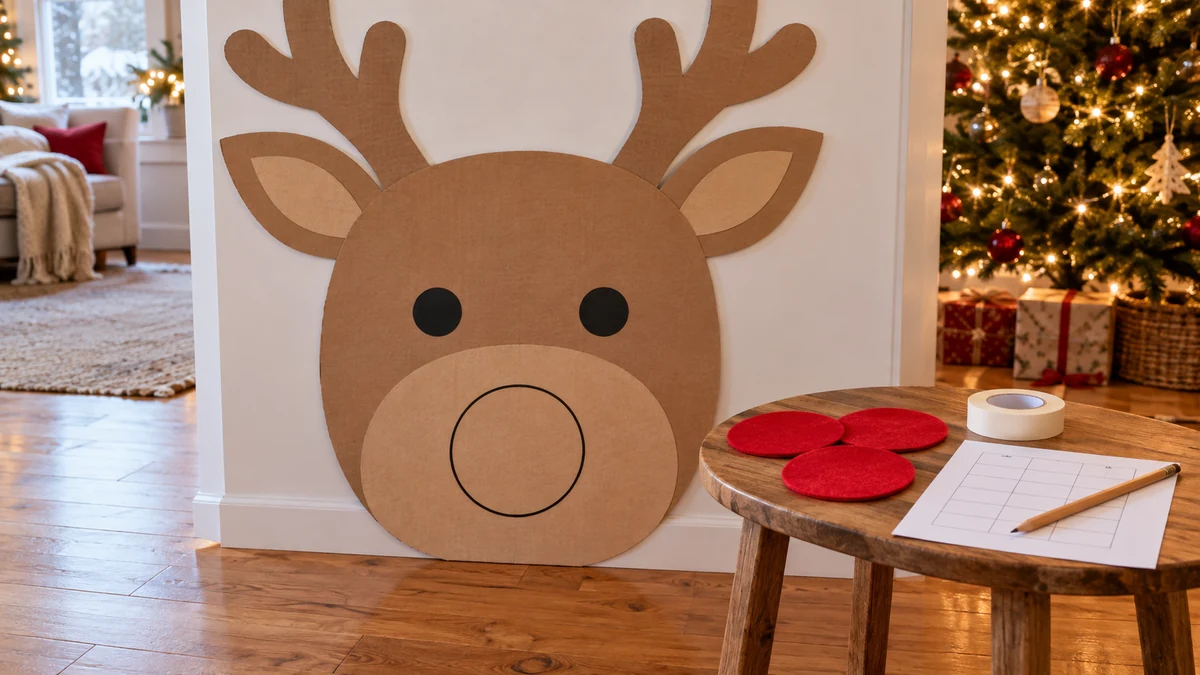
Explain the turn order and scoring before starting. A predictable routine can help the group enjoy the game without confusion.
Preparing the round
- Choose the order: agree a sequence, draw names or alternate between teams.
- Set up the board: secure the reindeer picture at a comfortable height and keep the surrounding floor clear.
- Have materials ready: keep noses, any optional blindfold and the timer together, away from young children between turns.
- Choose the number of rounds: one to three attempts per player may be enough; stop earlier if the group loses interest.
- Explain clearly: describe or demonstrate how to place the nose, score a turn and ask for help.
Clear, flexible rules
- Do not push the board: use a light touch to attach the nose. Allow feeling the target when agreed as an accessibility adaptation.
- Flexible timing: allow roughly 20–30 seconds if using a timer, with extra time or no limit when needed.
- Optional challenge: a willing player can try placing the nose with one hand, but do not restrict a hand they need for support.
- Keep movement controlled: no running or spinning; remove any blindfold before moving away and check the floor between turns.
Timing for different groups
- Younger children, around three to six: try short, eyes-open turns with an adult nearby and no pressure from a timer. Suitability depends on the child and materials, not age alone.
- Older children and teenagers: offer a 20–30-second turn if wanted, keeping guidance available for anyone who needs it.
- Adults and mixed-age groups: use a similarly relaxed time allowance, with music only if it does not interfere with communication.
- Team version: add the points from two or three team members, with only one player at the board at a time.
- Overall length: 15–30 minutes may suit some gatherings; take breaks or finish sooner as needed.
Scores and ties
- Scoring: three points in the central zone, two in the surrounding zone and one for another completed attempt.
- Recording: write down each result on paper or a phone after the turn.
- A tie: share the win or give each tied player another equally supported, unhurried attempt. Measure distance only if that rule was agreed beforehand.
Keeping the game moving
- Ask a volunteer to explain turns, manage any timer and record scores.
- Use a clear spoken signal to begin and end a turn; music can be an optional background rather than the only cue.
- Recognise participation with age-appropriate prizes or certificates if wanted.
- Alternate individual and team rounds if the group would enjoy a change.
Versions for children, teenagers and adults
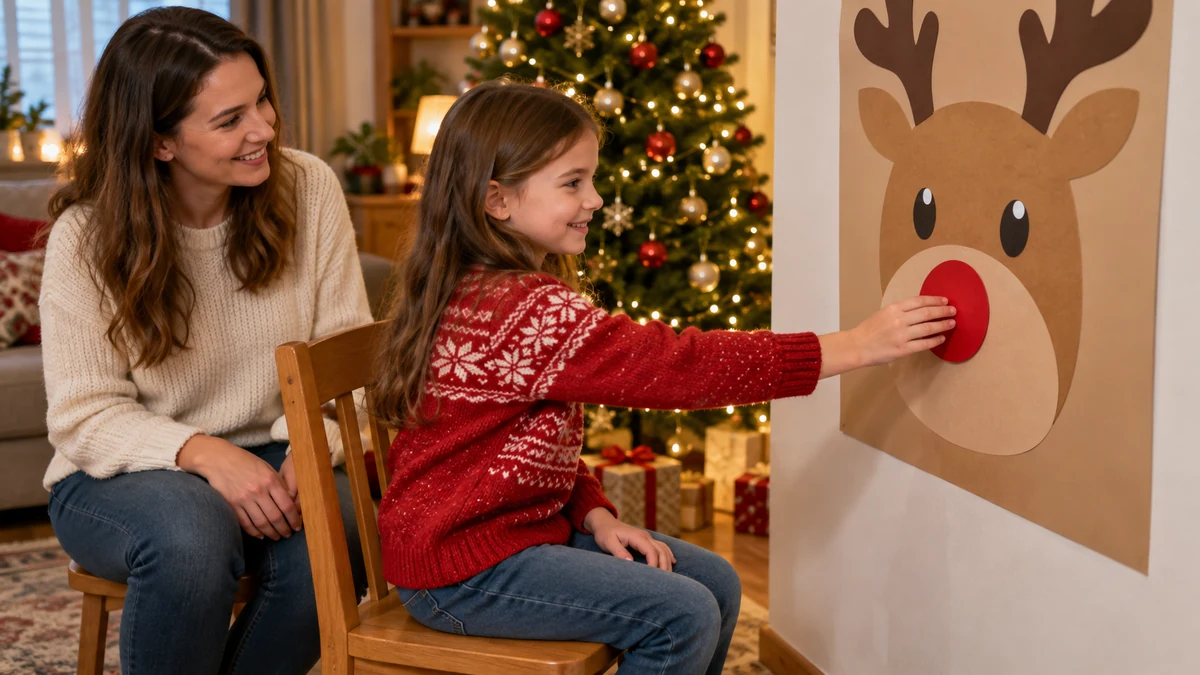
Adapt the target, timing and support to the players. Greater difficulty should come from the puzzle of placing the nose, not from running, obstacles or moving while blindfolded.
Younger children, around three to six
- Easy reach: place the board close enough for a comfortable stationary turn, preferably with eyes open.
- Unhurried turns: offer encouragement and simple directions without a strict countdown.
- Large, flat noses: choose pieces that are easy to handle and suitable for the child; a large pompom is not automatically free of choking hazards.
- Support when welcome: an adult can explain the task or offer agreed assistance, without forcing a child’s hand or covering their eyes against their wishes.
Older children, around seven to twelve
- A moderate challenge: use a smaller scoring zone or an optional stationary blindfolded turn, with an adult beside the player.
- Scoring zones: draw clear areas on the picture and explain what each is worth.
- Co-operative play: one child gives directions while the other places the nose from a fixed position. An adult remains responsible for supervision.
Teenagers
- An agreed challenge: use a smaller target or one-handed placement if comfortable, while keeping the player still and within reach.
- A musical variation: use music between turns, then pause it for instructions and placement so everyone can hear.
- Creative scoring: award points for accuracy or an imaginative reindeer design, rather than speed or mocking a player’s mistakes.
Adults
- Team play: form pairs or trios and add each person’s score.
- Themed rounds: change the reindeer picture or use different large, flat nose shapes. Keep the playing area free of obstacles.
- Shorter rounds: reduce waiting time by limiting the number of attempts, not by rushing someone who cannot see.
A turn-taking team relay
- Make teams: divide willing players into reasonably balanced groups.
- Prepare one player: they approach with eyes open, settle within reach and choose their preferred version of the game.
- Take the turn: place the nose without moving from the playing position. Remove any blindfold before stepping away; the next player then approaches with eyes open. This is a turn-taking relay, not a race.
- Set a round length: choose the same number of turns for each team, allowing needed time and assistance.
- Choose the result: add points rather than using speed to decide the winner, or work towards a shared score.
Accessible versions
- For blind or partially sighted players: ask what would help, such as a tactile target, clear spoken descriptions or an accessible eyes-open version using remaining vision.
- For players with limited mobility: adjust the board to a comfortable seated reach and provide enough space for the person’s usual mobility equipment.
- For younger children: remove small loose components, use an appropriate eyes-open version and supervise closely.
Prizes and encouragement
- Simple prizes: homemade certificates, suitable craft decorations or biscuits that meet the recipient’s dietary needs.
- Recognition for everyone: a small keepsake can acknowledge participation, without requiring anyone to compete.
- Different achievements: recognise creativity, accuracy or helpful encouragement according to the group.
Helping children take part
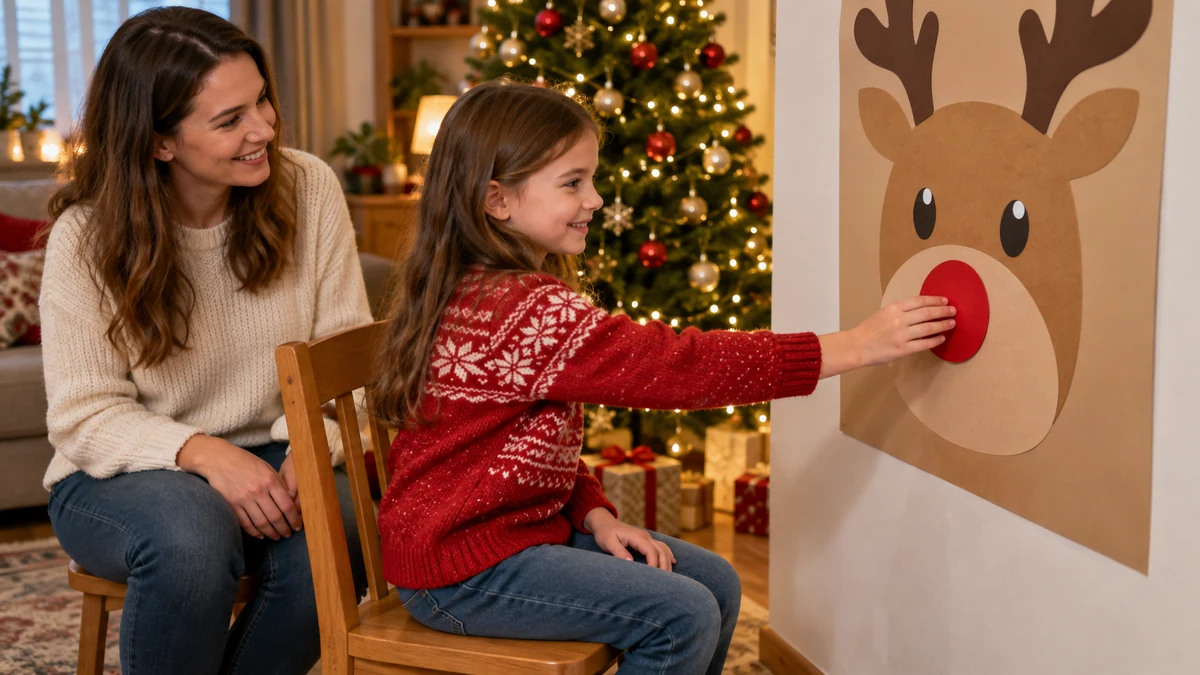
Invite children to help with appropriate preparation tasks and explain the rules simply. Offer choices rather than assuming everyone wants to wear a blindfold or play competitively.
Making the game more accessible
- Use easy-to-hold noses made from large, flat card or felt, chosen for the players’ needs.
- Add tactile features with firmly attached felt or raised lines, if the player would find them useful.
- Offer clear spoken cues rather than relying on a bell or sudden noise; ask which kind of guidance is helpful.
- Adjust reach and time for each player, keeping the board within comfortable reach and allowing an unhurried turn.
Roles for different ages
- Helpers: children can hand out suitable noses under supervision. An adult should check any optional blindfold and the player’s comfort.
- Creative judges: older children can recognise imaginative designs or friendly teamwork, without making fun of players.
- Scorekeepers: recording scores or announcing turns offers another way to join in.
- Mixed-age teams: pair willing children and adults so they can support each other.
Adaptations for sight loss
- A tactile picture: attach raised shapes securely and allow the player to explore the board before placing the nose.
- Easy attachment: use suitable firmly attached hook-and-loop patches or removable tape. Do not use loose magnets.
- Agreed assistance: ask before touching or guiding someone and follow their preferred approach. RNIB guidance emphasises asking how a person would like to be helped. Source: RNIB: asking how a person would like to be guided
- Useful directions: agree clear words such as “a little higher” or “to your left”, rather than using vague pointing or unexpected sounds.
Adaptations for mobility needs
- Adjust the height: position the board for the person’s comfortable reach, with space for their chair or mobility aid.
- Seated play: use a stable tabletop or low board so the player can place the nose themselves, with assistance only if requested.
- Extra time: allow an unhurried turn or remove the timer altogether.
Comfort and practical checks
- Keep small parts away from young children, especially under-threes, and supervise throughout. UK product-safety guidance highlights hazards from small objects, magnets and drawing pins. Source: UK Office for Product Safety and Standards: small objects magnets and drawing pins
- Clear space: remove loose objects and keep the floor dry and unobstructed.
- Check before each round: make sure the board remains secure and any eye covering is clean, comfortable and easily removed.
Encouragement without pressure
- Praise effort: recognise trying, helping and taking turns, not just accurate placement.
- Acknowledge participation: a simple certificate or keepsake can be offered to everyone who wants one.
- Offer real choices: anyone can play without a blindfold, choose another role or watch without being pressured.
Prizes, scoring and keeping things tidy
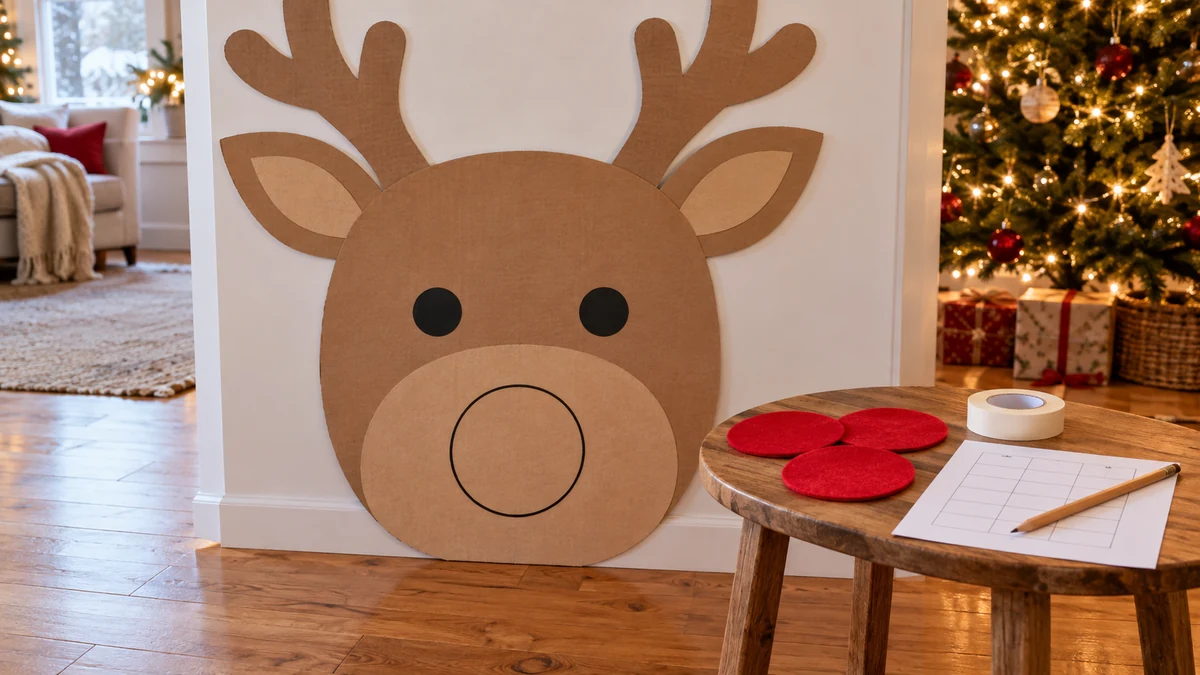
A simple scoring system and an organised set of materials can keep the activity manageable from the first turn to tidying up.
Prizes and recognition
- Low-cost prizes: paper certificates or age-appropriate stickers can be enough.
- Edible prizes: check allergies and dietary requirements, and choose foods suitable for the child’s age. Individual wrapping does not remove those considerations.
- Something for everyone: optional participation tokens can make the activity feel less focused on a single winner.
- Creative awards: recognise a thoughtful design, accuracy or supportive teamwork with a simple homemade certificate.
Keeping score
- Agree the scale: three points for the central zone, two for nearby and one for another completed attempt.
- Write it down: record each result on paper or a phone to avoid confusion.
- Add the rounds: allow one to three turns per player and total the points at the end.
- Ties: share the win, measure distance or offer another unhurried turn using the same agreed rules.
- Team scoring: add members’ points, with equal numbers of turns, or set a co-operative group target.
Keeping the area tidy
- Keep the floor clear: do not lay loose newspaper, plastic sheeting or an unsecured rug in the playing area, as these can slip or trip players.
- Use tidy materials: large card or felt circles are easy to collect. Avoid loose glitter, bottle tops and small detachable decorations.
- Prepare adhesive beforehand: use removable tape or suitable hook-and-loop patches during the game; keep liquid glue and hot-glue tools out of the play area.
- Collect pieces promptly: large, flat noses are easier to retrieve, but still need supervision around young children.
- Separate players and spectators: keep waiting guests outside the clear playing space, without creating a cord barrier.
- Have cleaning supplies nearby: deal with spills promptly and ensure the floor is dry before play resumes.
Practical organising tips
- Collect after each round: put used noses back in a box, removing damaged pieces.
- Share the tidy-up: give willing participants age-appropriate jobs, with an adult checking for loose parts.
- Keep food elsewhere: serve snacks away from the play area to avoid spills and distractions.
- Store for reuse: keep the board and suitable components in a labelled box out of young children’s reach, and check their condition before playing again.
A simple Christmas party activity
The reindeer nose game can bring different ages together with a few homemade materials and flexible rules. Keep it unhurried, make blindfolds optional and adapt the activity to the people taking part.
Thank you for reading. Follow our social channels for more Christmas ideas and visit the I Love Christmas blog for further inspiration. Only share photographs of participants with appropriate permission.
Reindeer nose game: frequently asked questions
What do I need to make the game?
A securely fixed reindeer picture, large flat red paper or felt circles and removable adhesive are the basics. Scissors and glue are for preparation; a timer and a comfortable blindfold are optional. Do not use actual pins.
What age is the game suitable for?
Suitability depends on the child, materials and supervision. Younger children may enjoy an eyes-open version within easy reach, without a timer. Avoid small loose parts, never force a blindfold and do not ask anyone to walk or run while unable to see.
How can players with sight loss or mobility needs take part?
Ask about their preferences. A tactile or high-contrast board, clear spoken guidance, easy attachment and a comfortable seated reach may help. Do not use loose magnets, and ask before offering physical assistance.
How can we score and settle a tie?
Agree zones worth three, two and one point. For a tie, share the result, measure the distance from the target or offer another equally supported turn. Avoid speed-based tie-breaks.
How can I keep the game area tidy and reduce risks?
Secure the board, keep the floor dry and clear, collect pieces between turns and avoid loose floor coverings, sharp fixings and small components. Players should be stationary and within reach before any optional blindfold is used.
Which prizes work well?
Simple certificates or age-appropriate stickers can recognise participation. If offering biscuits or other food, check allergies and suitability first. Prizes are optional; friendly encouragement and a choice of roles matter too.
Sources and Further Reading
- RNIB: asking how a person would like to be guided
- UK Office for Product Safety and Standards: small objects magnets and drawing pins