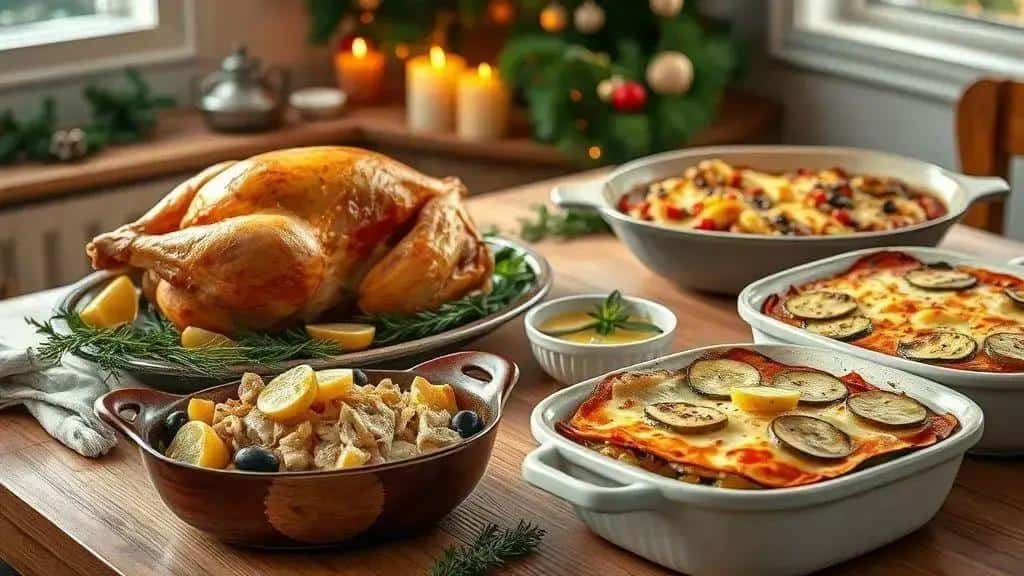
Planning Christmas dinner for ten starts with how many people will actually eat each dish. The options below are not an instruction to serve three full main meals: choose a base and scale alternatives to your guests, including anyone who does not eat meat or fish.
As a planning estimate, allow 150–200g cooked boneless protein per adult, 200–300g of sides in total and 120–150g dessert. Appetites, children and other dishes change the calculation. Raw whole-turkey weight is not cooked-meat weight. A bird of around 4kg with sides may suit ten; check the supplier’s yield guidance.
One simple example is bruschetta, turkey, rice and salad, followed by chocolate biscuit dessert. Salt cod can replace the turkey. Lasagne can be the vegetarian main or an option for some guests. Scale recipes proportionately when splitting the group; do not automatically add together all the main-course quantities.
A schedule that includes fridge and oven time
- A week ahead: confirm guests, allergies, budget, menu and available help. Check poultry thawing time, which can take several days.
- A few days ahead: buy shelf-stable ingredients, check roasting dishes and reserve fridge space. Buy fresh foods according to use-by dates.
- The day before: make dessert, prepare vegetables that will be used soon and set the table. Do not keep prepared perishable food for a week.
- On the day: start the roast with a margin, schedule one oven dish at a time where necessary and cook rice near serving time.
- At service: replenish small dishes, keep drinks accessible and ask for help refrigerating leftovers promptly.
Bruschetta: 20 small pieces
Use 400g baguette cut into 20 slices, 500g chopped drained tomato, 2 small chopped garlic cloves, 45ml olive oil, 10 basil leaves, salt and pepper. Mix the tomato with garlic, oil and basil. Toast the bread at 200°C conventional or 180°C fan for 6–8 minutes. Top shortly before serving: two pieces per person.
Roast turkey: approximately 8–10 portions with sides
- 1 raw unseasoned turkey of approximately 4kg, fully thawed and unstuffed
- 150g unsalted butter, 4 crushed garlic cloves, 1 tablespoon chopped rosemary and 1 tablespoon thyme
- 30ml lemon juice, 2 teaspoons zest, 15g fine salt and pepper to taste
- 200g onion wedges and 300ml unsalted stock; up to 200ml extra hot water if the tin dries out
Remove giblets and internal packaging and do not wash the bird. Mix butter, garlic, herbs, zest, salt and pepper; spread half beneath the breast skin and half outside. Put the onion in the tin, set the turkey over it and pour stock and lemon juice into the base. Roast according to the packaging; without instructions, allow about 3 hours 20 minutes at 180°C conventional or 160°C fan for this weight. Cover loosely with foil if it browns early and use extra water only if needed.
Timing is an estimate: check 75°C for 30 seconds in the thickest breast and thigh without touching bone. Rest for 20–30 minutes. For a pre-seasoned bird, omit additional salt and follow its packaging. The Food Standards Agency provides planning guidance.
Salt cod and potatoes in the style of Gomes de Sá: 10 moderate portions
- 1.5kg desalted salt cod, weighed without skin or bones and still uncooked
- 1.5kg potatoes, 600g sliced onions and 4 sliced garlic cloves
- 150ml olive oil, divided into 100ml for cooking and 50ml for finishing
- 100g pitted olives, 4 hard-boiled eggs and 20g chopped parsley; pepper and salt only after tasting
- Buy ready-desalted salt cod or desalt it in the fridge for the time directed by the supplier. Desalting does not cook fish.
- Cook potatoes until tender but not falling apart; drain, peel when cool enough to handle and slice.
- Poach the cod in gently simmering water for approximately 8–12 minutes depending on thickness, until opaque, hot throughout and flaking. Drain and check again for bones.
- Soften the onions in 100ml oil and add the garlic for 1 minute. Gently fold in fish and potatoes.
- Transfer to a large baking dish, drizzle with the remaining 50ml oil and bake at 180°C conventional or 160°C fan for about 15–20 minutes until piping hot. Finish with sliced eggs, olives and parsley.
Vegetable lasagne: 10 moderate portions
- 300g dried lasagne sheets, precooked according to their packet and drained
- 500g courgettes, 500g aubergines and 200g grated carrots
- 800g tomato sauce, 400g ricotta and 250g grated mozzarella, made with vegetarian rennet where required
- 45ml olive oil, 1 teaspoon oregano, salt and pepper; a dish approximately 30 × 22cm and at least 7cm deep
- Slice the courgettes and aubergines. Use 30ml oil to griddle them in batches until tender. Soften the carrot in the remaining 15ml oil for 4–5 minutes. Season the vegetables.
- Divide the pasta, vegetables and ricotta into three portions. Spread 150g sauce over the base; add one layer of pasta, vegetables and ricotta and cover with 200g sauce. Repeat with the second portion and another 200g sauce.
- Add the third portion, cover with the remaining 250g sauce and the mozzarella. Leave approximately 2cm clear below the dish rim.
- Bake at 180°C conventional or 160°C fan for about 35–45 minutes until bubbling and piping hot at the centre. Rest for 10 minutes before cutting.
Chocolate biscuit dessert: 10–12 portions
- 300g plain sweet biscuits
- 600ml milk for the cream and a separate 60ml for moistening biscuits
- 395g sweetened condensed milk, 200g single cream and 150g chopped dark chocolate
- 40g cornflour; optional 20g grated chocolate for finishing; a dish about 25 × 18cm and 6cm deep
- Dissolve the cornflour in 150ml cold milk taken from the 600ml. In a saucepan, combine with the remaining 450ml and condensed milk.
- Cook over medium-low heat, stirring until thick and bubbling; cook for another 2 minutes while stirring. Remove from the heat, melt the chocolate into the custard and stir in the cream.
- Cool promptly in a shallow container, stirring occasionally. Make three biscuit layers, briefly moistening them with the separate 60ml milk, and alternate with the chocolate cream. Finish with cream.
- Cover and refrigerate for at least 6 hours. Finish with optional grated chocolate. This is a spoon dessert; serve chilled and eat within 48 hours of preparation.
Shopping, table and clearing away
Once you choose the dishes, add their recipe ingredients rather than using a generic menu’s shopping list. For rice as one of several sides, about 400–500g uncooked for ten is a starting point, adjusted to appetite; 1kg uncooked alongside many sides may leave substantial leftovers. Set aside enough water, drinks suited to the group, serving utensils and containers for leftovers.
Use low centrepieces, LED lighting and clear walkways. Identify allergens and do not label a dish free from an ingredient without checking every product and utensil. Cool hot food promptly and refrigerate within 2 hours at 0–5°C. Use within 48 hours and reheat only once; cool rice ideally within 1 hour and use within 24 hours. Prepare separate portions for dietary needs without sharing contaminated utensils.
AI-generated illustration; choose dishes to suit your group rather than making them all.