
Wearing white on New Year’s Eve is a familiar Brazilian custom associated with peace, renewal and hope. Its Afro-Brazilian religious roots are important, although people today also wear white for cultural, social or personal reasons. The meanings of rituals and colours vary; they are expressions of belief rather than guarantees of good fortune.
Wondering why Brazilians wear white on New Year’s Eve? The choice can involve faith, family tradition or simply joining in with a celebration. Here is a closer look at its roots and present-day meanings.
Illustrations in this article are conceptual images, not documentary photographs or evidence of a particular historical event, destination, venue or access route.
The tradition’s history and roots

The custom of wearing white clothes for Brazil’s Réveillon, or New Year’s Eve celebrations, should not be reduced to a universal colour symbol. Its relationship with Afro-Brazilian religious traditions deserves particular recognition.
Brazil’s cultural history includes African, European and Indigenous traditions, but that broad history does not establish a single, documented origin for every New Year custom. It is more accurate to identify the relevant religious and cultural connections than to invent one moment when the practice began.
Afro-Brazilian religious influence
Brazilian cultural accounts connect the wearing of white at New Year with religions including Umbanda and Candomblé. These are distinct traditions, with differences between communities and houses of worship. White clothing and coastal celebrations associated with Iemanjá helped make this heritage visible beyond religious settings. Source: MultiRio: origins of New Year’s Eve customs
Other participants may understand white as a wish for peace or as a familiar festive dress code. Sharing a clothing colour does not mean everyone follows the same religion or takes part in the same rituals.
Public celebrations, tourism, media coverage and clothing campaigns have helped reinforce the image of people dressed in white at the turn of the year. That wider popularity should not erase the communities behind the tradition.
Today, one person may wear white as a religious expression, another to follow a family custom, and another because they enjoy the look. Accessories, rituals and local expectations can differ.
Understanding these layers makes the custom more meaningful: it can be a personal choice, a shared celebration and a reminder of Brazil’s religious and cultural history.
White does not mean the same thing everywhere
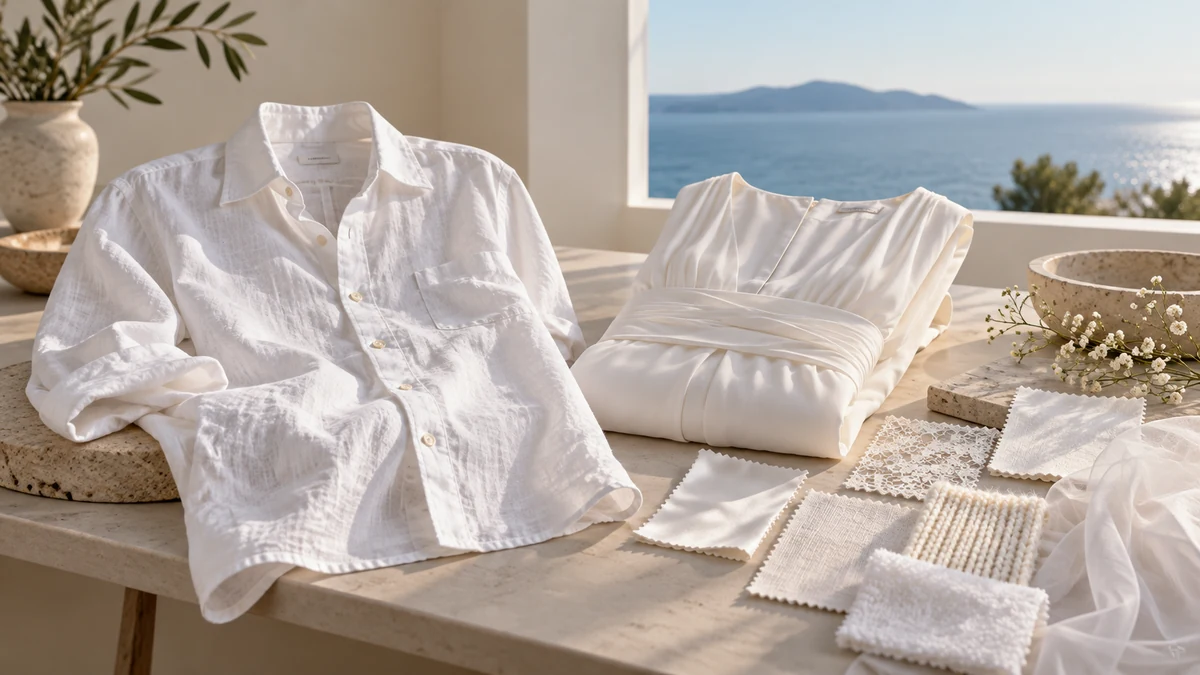
Colours take their meaning from particular communities, occasions and beliefs. White is not a universal shorthand for one idea, and similarities between customs do not prove that one caused another.
In some Christian traditions, white is used for important celebrations. For example, the Church of England prescribes white for Christmas and Easter festal periods and certain other occasions. This offers a comparison, not proof that Brazilian New Year clothing originated in Christian liturgy. Source: Church of England: liturgical colours
In Afro-Brazilian religious settings, white clothing can have ceremonial significance. The precise meaning and dress requirements depend on the community; visitors should learn from their hosts rather than treat ritual clothing as a generic costume.
Looking beyond one cultural interpretation
In other settings, white may be associated with mourning, simplicity or ceremonial dress rather than a New Year celebration. It is misleading to assign one meaning to all of Asia, a whole country or an entire religion without identifying the specific practice.
The same care applies to Indigenous peoples of the Americas, whose traditions are diverse. Broad claims that white universally represents the wind, moon or water should not be used to explain Brazil’s New Year custom without evidence from the relevant community.
In contemporary Brazilian celebrations, white can express a wish for peace, a personal style or a sense of joining the occasion. These present-day interpretations sit alongside, rather than replace, the tradition’s religious connections.
Common personal interpretations
- Peace and renewal: a symbolic wish for a calmer year and a fresh start.
- Spiritual protection: a meaning some people attach to white within their beliefs, rather than a demonstrated effect of the colour.
- Respect and remembrance: meanings that may apply in particular ceremonies, without being universal New Year associations.
- Purification: a religious or symbolic interpretation in some traditions, whose practices should be understood in their own context.
If you choose white for New Year’s Eve, consider the setting and what it means to you. A coloured accessory can express a personal wish, but colour meanings are not fixed rules.
The symbolism of white depends on history, belief and context. Recognising that variety is more useful than presenting one explanation as universal.
How the custom became familiar in Brazil
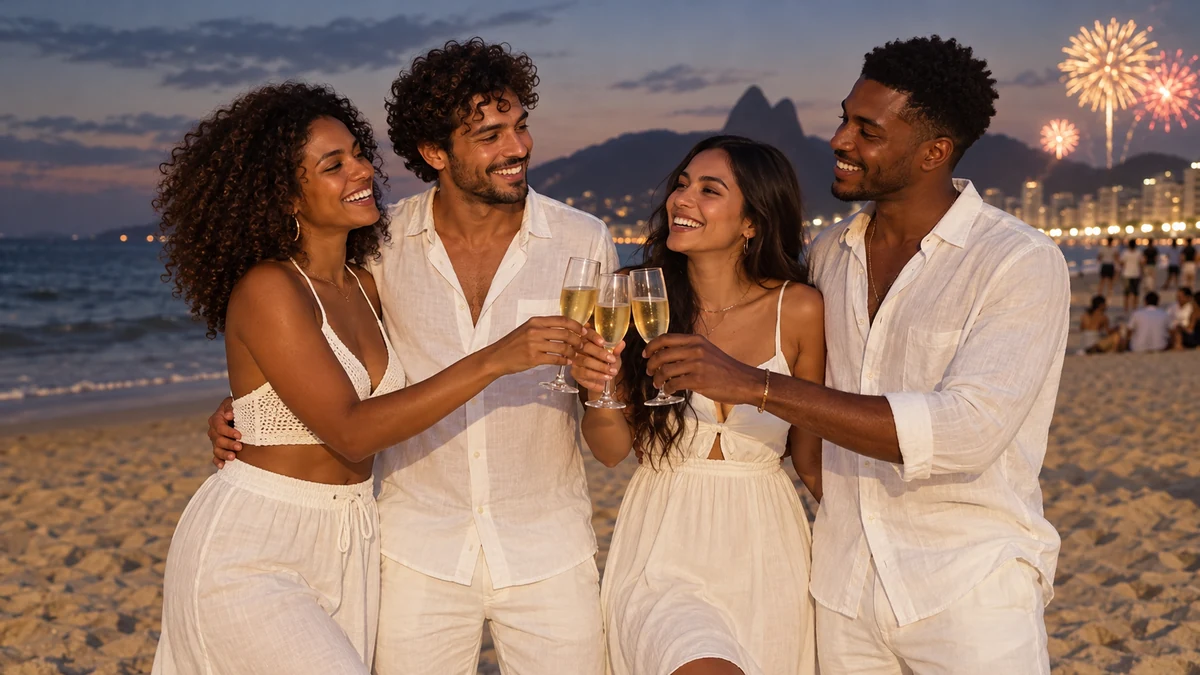
The popular New Year custom did not arrive in Brazil as a single clearly documented imported fashion. Describing it as a colonial European practice overlooks its Afro-Brazilian connections and claims a chronology the available evidence does not establish.
Afro-Brazilian traditions and coastal celebrations
Religions shaped within Brazil through African diasporic histories gave white important ceremonial roles. Their public presence, including coastal gatherings, is relevant to understanding the clothing seen at modern New Year celebrations.
Iemanjá is honoured in different communities and on different occasions. New Year’s Eve observances should not be confused with every festival dedicated to her; Salvador’s well-known celebration on 2 February, for instance, has its own date and history.
Religious heritage and public festivities
Beach celebrations helped bring religious observances and wider public festivities into shared spaces. Participation became broader, but Umbanda and Candomblé should not be treated as interchangeable, nor should their traditions be reduced to party folklore.
Media, tourism and fashion
Images of large coastal celebrations, particularly in Rio de Janeiro, have made white clothing a recognisable feature of Brazilian Réveillon. Fashion and tourism reinforce that image without explaining every participant’s personal motivation.
The custom still varies. Some people follow religious guidance, some dress for a family celebration and others follow an event’s suggested colours. A religious house may have specific expectations that do not apply to a secular party.
Environmental care is another consideration at coastal celebrations. Seek guidance from local organisers and prefer a symbolic gesture that leaves nothing behind rather than assuming any item described as natural or biodegradable is harmless in the sea.
Beliefs, rituals and local variations
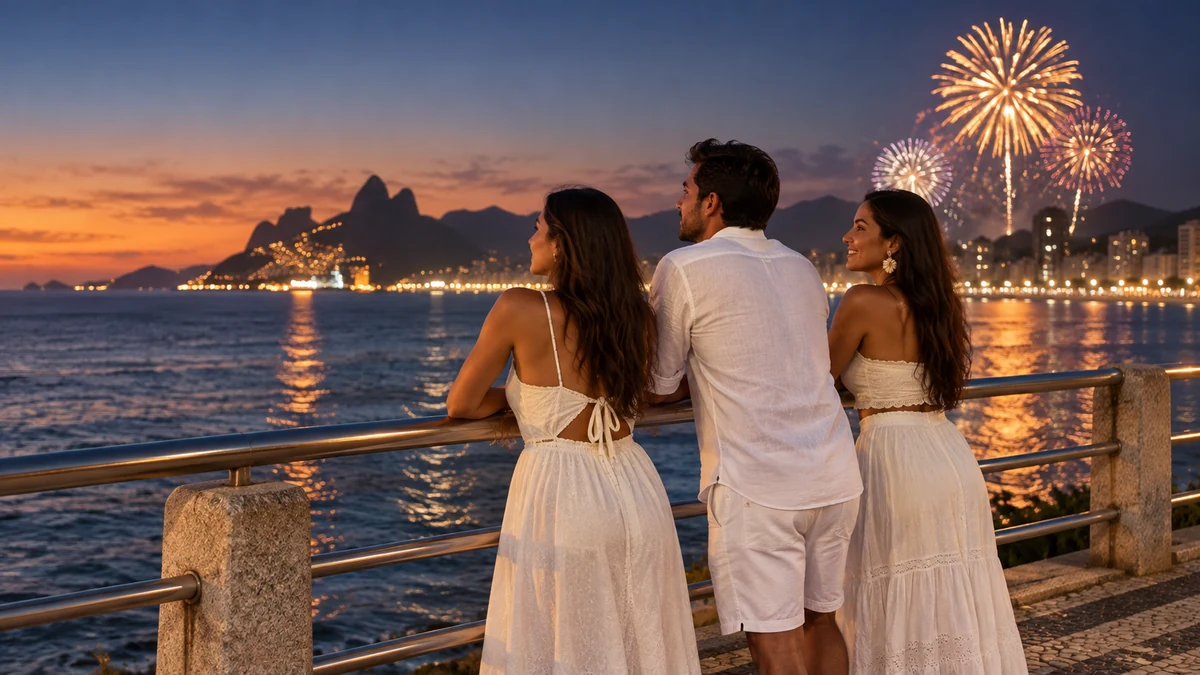
Some people associate white clothes with protection, peace or luck at the turn of the year. These are beliefs and symbolic intentions, not predictions or proven effects.
Customs you may encounter
- Jumping seven waves: a custom associated with wishes or thanks in some coastal celebrations. This is a cultural description, not advice to enter the sea at night or in unsafe conditions; observing from the shore is an alternative.
- Offerings associated with the sea: some religious observances include offerings to Iemanjá. Visitors should respect the community’s guidance and local environmental rules rather than improvise by throwing objects into the water.
- Ritual bathing: some people practise cleansing rituals within their beliefs. These are not medical treatments, and this article does not prescribe herbal or salt mixtures for skin use.
- Coloured accessories: popular associations include yellow for prosperity, red for love and green for health or hope. Interpretations vary and do not guarantee those outcomes.
- Symbolic foods: lentils, grapes and other foods can carry festive meanings for particular families and communities. They need not all belong to the same religious tradition.
Differences between celebrations
Coastal cities such as Salvador and Rio de Janeiro host religious and secular festivities, but each gathering has its own context. Do not assume everyone on a beach is practising the same ritual, or that all celebrations honour Iemanjá in the same way.
Elsewhere, New Year may centre on a family meal, a religious service, a community event or a party. These choices vary within every region; a coastal-versus-inland divide cannot describe every Brazilian household.
Environmental responsibility matters alongside respect for religious practice. Coastal clean-up and education initiatives in Bahia highlight the problem of discarded waste. Keep packaging and personal belongings out of the sea and follow the event’s arrangements.
Participating respectfully
Ask hosts or organisers about local customs, avoid interrupting ceremonies and seek permission before photographing people. A private wish or other gesture that leaves no litter can express your intention without adding objects to the beach or water. Source: Bahia Environment Secretariat: waste prevention during celebrations
Choosing a white New Year’s Eve outfit today
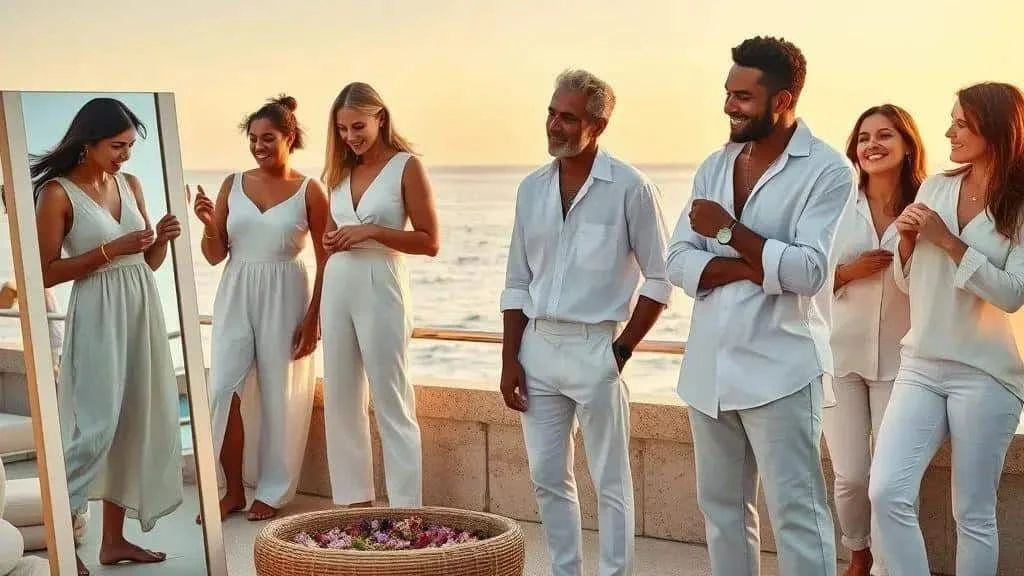
Choosing white clothes is mainly about comfort, occasion and personal meaning. Brazil’s December weather differs from a British winter, so an outfit suitable for a warm beach is not automatically suitable for a UK outdoor celebration.
Match the outfit to the setting
For a warm-weather beach event, light fabrics may be comfortable. For a formal party, consider the host’s dress code. For winter celebrations, prioritise warmth, weather protection and practical footwear over matching the colour from head to toe.
- Warm-weather beach party: breathable cotton or linen and comfortable, loose-fitting clothes can suit the setting.
- At home: choose relaxed pieces that allow you to sit, move and enjoy the evening comfortably.
- Formal occasion: a suit, coordinated separates, jumpsuit or dress can work according to your style and the event’s expectations.
Fabric, opacity and comfort
Try the outfit in the lighting you expect, as some pale fabrics become more transparent than anticipated. A lining or suitable underlayer can help. Choose a comfortable fit for walking, sitting or dancing, without using clothing as a reason to attempt unsafe water activities.
Coloured accessories and personal wishes
Adding coloured accessories can be a simple way to express a personal wish. Yellow, red and green are popularly linked with prosperity, love and health or hope, but these are symbolic associations rather than promises.
- A yellow bracelet can represent a wish for prosperity.
- A red necklace can symbolise love, without being expected to bring it about.
- Green jewellery can express hope or a wish for wellbeing; it is not a health intervention.
Personal style
Lace, clean lines, embroidery or layered textures can all work. Shirts, trousers, dresses and other pieces are choices for anyone who enjoys them; there is no need to assign an outfit to a particular gender.
Reuse and respect
Consider wearing something you already own, borrowing or buying second-hand. If attending a religious or coastal celebration, follow the organisers’ guidance and keep accessories and packaging out of the environment.
Before you leave
- Try sitting and walking in the outfit, and check its fit and opacity.
- Carry a useful extra layer or spare item if the weather and occasion call for it.
- Follow the garment’s care instructions and carry a small cloth for spills if helpful. Test any stain-removal product on a hidden area first.
- Choose footwear for the actual surface and weather, especially if you will walk or stand for a long time.
The right white outfit is one that suits the occasion, respects any relevant customs and feels comfortable for you. Wearing white is optional, not a condition for a happy New Year.
Final thoughts
Wearing white for Brazilian Réveillon brings together religious heritage, personal wishes and social celebration. Recognising its Afro-Brazilian connections adds depth to a custom that people now interpret in many ways.
Thank you for reading. Explore the I Love Christmas blog for more festive traditions, seasonal ideas and cultural guides.
Wishing you an enjoyable and thoughtful start to the New Year.
FAQ: wearing white on New Year’s Eve in Brazil
Why do many Brazilians wear white on New Year’s Eve?
White is commonly associated with peace, renewal and hope in this setting. The custom has important Afro-Brazilian religious connections, while many people now also follow it as a cultural, family or social tradition.
Is the custom connected with a particular religion?
Its connections with Umbanda and Candomblé are important and should be recognised. These are distinct religious traditions. Wearing white at a secular New Year party does not necessarily mean someone follows either religion.
What do coloured accessories mean?
Popular associations include yellow for prosperity, red for love and green for hope or health. Meanings differ between people and communities; they express wishes rather than guaranteeing results.
Does everyone in Brazil celebrate in the same way?
No. Clothing, religious observance, beach activities and family customs vary within regions and communities. Ask about the specific event rather than assuming a single national ritual.
How can I celebrate respectfully without leaving litter?
Follow local organisers’ and religious hosts’ guidance, keep packaging and objects out of the sea and consider a symbolic gesture that leaves nothing behind. Natural or biodegradable does not automatically mean appropriate to discard in a particular place.
Sources and Further Reading
- MultiRio: origins of New Year’s Eve customs
- Rio de Janeiro Tourism: Réveillon
- Church of England: liturgical colours
- Bahia Environment Secretariat: waste prevention during celebrations