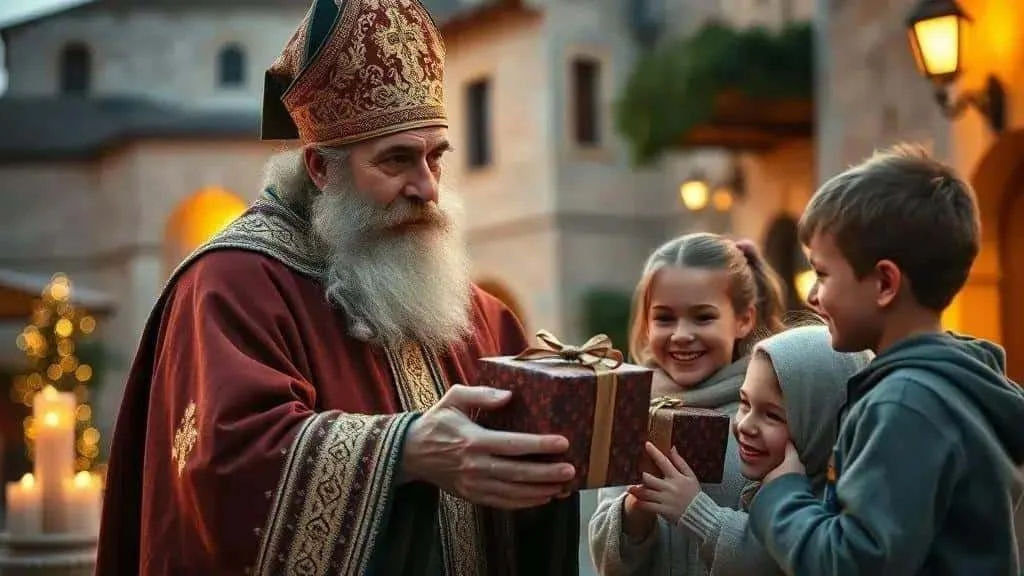
The legend of St Nicholas centres on the bishop associated with Myra, remembered in Christian tradition for secret gifts and miracles. Medieval devotion, the movement of relics and later literary and artistic interpretations helped shape Christmas gift-giving figures, including Santa Claus. Much of his biography survives as religious tradition rather than securely documented history.
The legend of St Nicholas invites an affectionate question: who was the bishop behind so many Christmas stories? Explore the traditions, the miracles attributed to him and ways to tell these stories thoughtfully at home.
Illustrations in this article are conceptual images, not documentary photographs or evidence of a particular historical event, destination, venue or access route.
St Nicholas: historical background and religious tradition
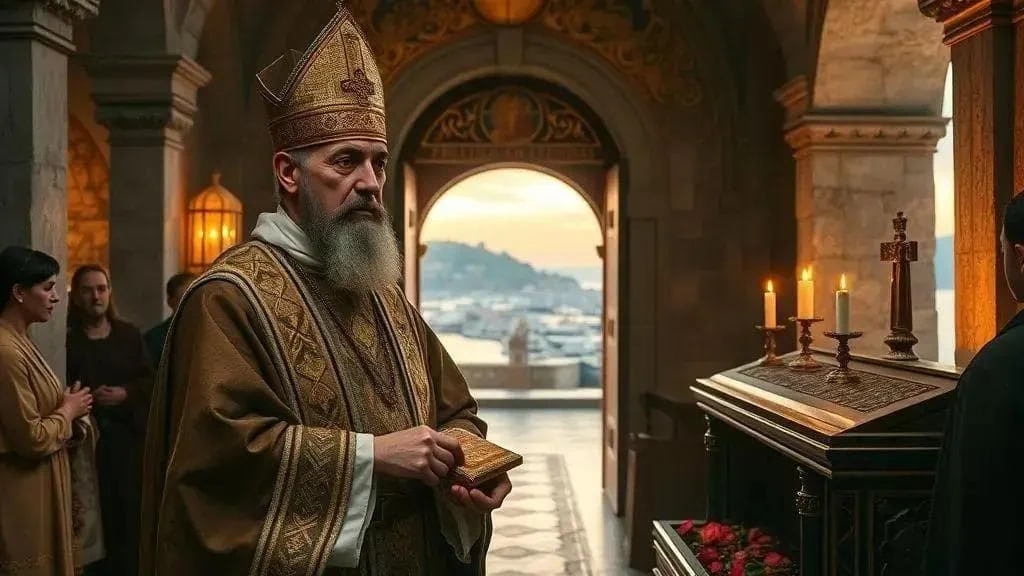
St Nicholas is traditionally associated with Patara and with the bishopric of Myra, in what is now Türkiye, around the late third and fourth centuries. Contemporary evidence about his life is limited. Later devotional biographies describe generosity towards poor families, children and travellers; these accounts should not be treated as a complete, independently verified biography. Source: St Nicholas Center — Historical background
Religious context
As a bishop in Christian tradition, St Nicholas belongs to the world of the early Church. Devotion to him grew through worship, art and storytelling. 6 December became his widely observed feast day, marked in many communities by services and charitable activities. Particular stories about his participation in church disputes require their own historical assessment.
The veneration of relics helped spread his cult. Relics attributed to Nicholas were taken to Bari, Italy, in 1087, and the shrine became a pilgrimage destination. Eastern and Western Christian communities developed different artistic and devotional representations of the saint. Source: St Nicholas Center — Historical background
Secret giving, help for sailors and protection of people in danger became recurring themes. These religious and folkloric narratives later contributed to seasonal gift-giving characters, although the modern Santa Claus did not emerge through one simple, continuous transformation.
Stories and miracles attributed to St Nicholas
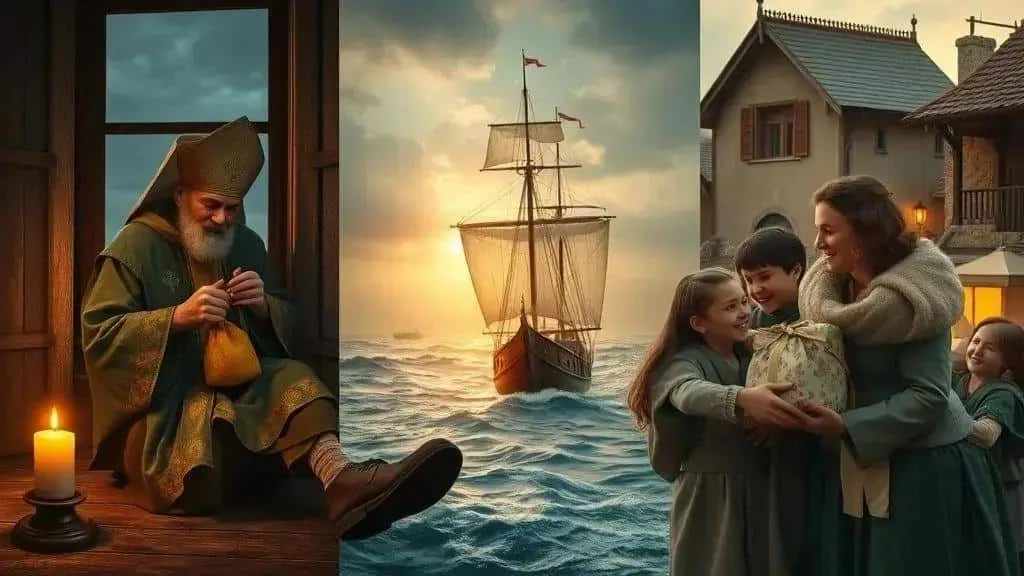
Stories about St Nicholas emphasise generosity and care for vulnerable people. They describe private acts of charity, rescue at sea and help in moments of danger. They can be shared as devotional stories and legends without presenting supernatural events as established historical facts.
Well-known stories and miracles
- The secret dowry: a familiar legend tells of Nicholas secretly giving gold to help three sisters whose family could not provide dowries. Later versions connect the gifts with shoes or stockings. Details vary between retellings.
- Protection of sailors: seafaring traditions attribute rescues during storms to Nicholas. Stories describe his intervention bringing ships and their crews safely through danger.
- Help for children: popular legends include miraculous protection and restoration. For young listeners, choose a gentle version and omit disturbing details rather than assuming every traditional account is suitable.
- Defending the innocent: some narratives show Nicholas intervening to prevent injustice. Their themes are courage, compassion and pastoral responsibility.
How the stories spread
Storytelling, devotional biographies, worship and pilgrimage carried these accounts between communities. The shrine at Bari helped widen their reach. Retellings developed local details over the centuries, while generosity and concern for others remained central themes. The survival of a story does not by itself establish that every described event happened.
The stories’ legacy
These narratives helped inspire celebrations around 6 December and customs involving gifts and quiet acts of kindness. Their value for many families lies in the ethical questions they raise, alongside their place in religious tradition.
From saint to Santa Claus: a changing cultural figure
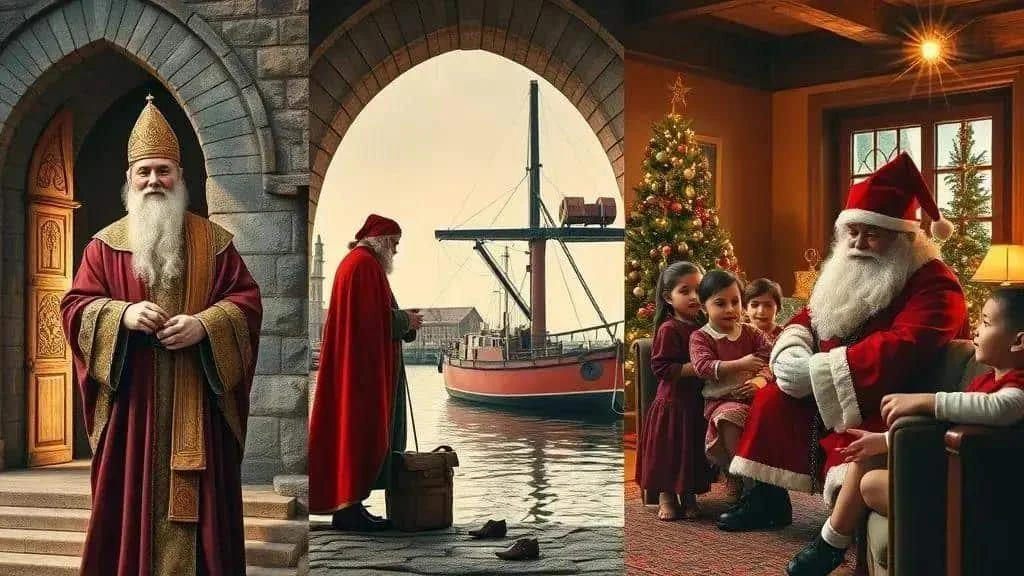
The image of St Nicholas has taken many forms. European gift-giving customs, literature and popular illustration all contributed to later Christmas characters. These figures sometimes merged, while older religious observances continued alongside them.
Stages in the changing tradition
- Medieval devotion: communities honoured Nicholas through worship, local festivities and charitable giving associated with his feast day.
- Sinterklaas in the Netherlands: Dutch traditions retained the bishop’s dress and a distinct gift-giving celebration. The name and imagery became part of the cultural background of the American Santa Claus, rather than evidence of a single unchanged colonial custom.
- Literature and poetry: nineteenth-century writing helped popularise the night-time visitor bringing presents to children.
- Illustration and print: nineteenth- and twentieth-century artists developed recognisable features such as a white beard, festive clothes and a friendly expression.
- Twentieth-century media: advertising, films and photography spread familiar versions of Santa. In Britain, the older Father Christmas tradition had also merged with the gift-bearing Santa figure; the two had not always been identical.
Details that changed
Among the changing details were the clothes, from episcopal robes to a festive suit; the date, with Christmas Eve replacing the saint’s feast in some gift-giving customs; the companions, including different regional helpers and later elves; and the transport, from horses and processions to the familiar reindeer-drawn sleigh.
Cultural significance
The modern figure belongs to family celebrations and commercial culture, while religious communities also maintain devotion to Nicholas as a saint. Looking at both helps distinguish related traditions without assuming that one replaced every other version.
St Nicholas and Christmas traditions in Brazil

In Brazil, the legend of St Nicholas can be connected with Christmas themes of generosity and giving. Religious observances, family customs and imported popular imagery have developed together, but a thematic resemblance does not prove that every Brazilian custom originated with Nicholas.
Connections with Brazil
European religious traditions and later international media helped shape Brazilian Christmas celebrations. The Dutch Sinterklaas belongs to the wider story of Santa Claus, known in Brazil as Papai Noel. It would be misleading to claim, without specific evidence, that Sinterklaas directly introduced all these customs to Brazil.
Familiar customs and shared themes
- Papai Noel and Christmas presents: family and commercial gift-giving can echo the generosity associated with Nicholas, although modern practices have many influences.
- Amigo secreto: Brazil’s Secret Santa exchanges provide a useful comparison with discreet giving. This similarity is not proof of a direct historical origin in the saint’s legend.
- Missa do Galo and charitable work: Christmas Mass and seasonal collections express broader Christian beliefs and community responsibilities, rather than being customs established by Nicholas himself.
- Decorations and nativity scenes: these can express the Christian story of Christmas alongside popular seasonal figures. Nativity scenes have their own history and should not be attributed to the Nicholas legends.
Local and family variations
Practices differ between families, churches and communities. Some emphasise a religious observance, others the familiar red-suited Papai Noel, and many combine several elements. Avoid assuming that a region, city or immigrant community follows one uniform version.
What the stories can mean today
Stories of Nicholas can offer a starting point for discussing generosity, charitable collections and community support. With children, focus on empathy and practical kindness, respecting each family’s beliefs and circumstances.
Sharing the legend through family activities and decorations
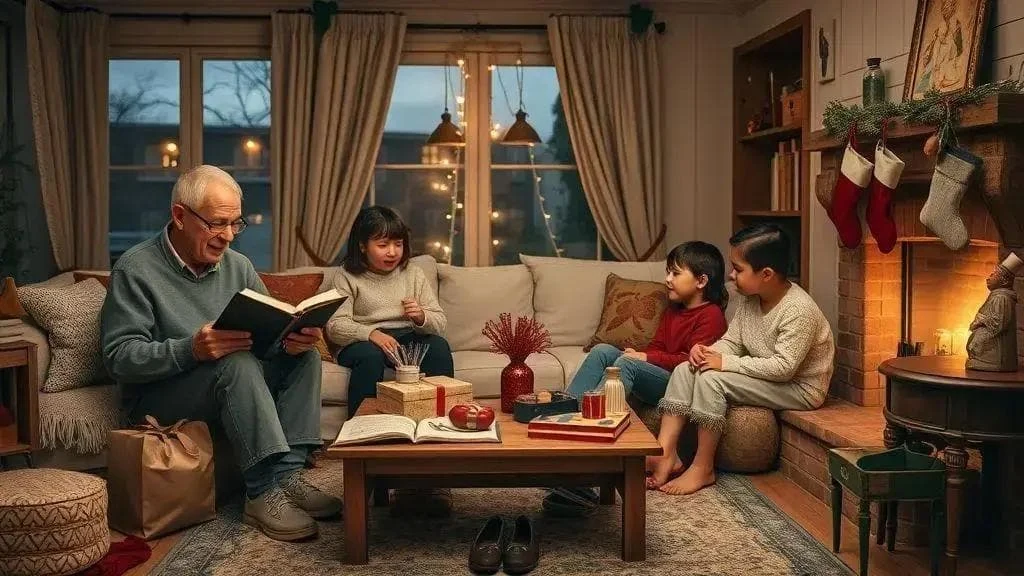
A story, a simple craft and a thoughtful act can bring the tradition into family life without an elaborate celebration or expensive purchases.
Storytelling activities
Choose a short book or retelling, invite questions and offer optional character roles. Children might leave a pair of shoes in a safe place near the door for a small surprise, as in some St Nicholas traditions. Keep exits clear and choose gifts appropriate to the child’s age.
Simple decorative crafts
- Decorated stockings: use fabric scraps and suitable craft glue. Adults should handle hot glue or sharp tools; avoid loose buttons and small decorations for children who might put them in their mouths.
- A paper-coin garland: cut large golden paper circles, add messages about kindness and make a garland with adult help where needed.
- Symbolic gift boxes: decorate cardboard boxes to represent secret giving. These are craft objects, not religious relics.
A themed evening, step by step
- Prepare the room: choose gentle lighting and comfortable seating. Use suitable battery candles with secure compartments instead of flames near children and fabric.
- Choose a story: find a short version suitable for the listeners’ ages and beliefs.
- Offer roles: children can take a character part or make a sound such as wind, footsteps or a boat on the water. Listening quietly is also a valid choice.
- Act and reflect: discuss generosity afterwards and suggest small, realistic ways to help someone.
- Finish with a gesture: leave a kind note or a suitable symbolic gift, keeping the arrangement simple and safe.
Turning a story into action
Ask a local organisation what donations it actually needs, arrange a voluntary gift exchange or join an existing community collection. Involve children in choosing a manageable contribution without pressuring them to give away treasured belongings.
Practical, affordable ideas
- Reuse clean, suitable materials for decorations and homemade gifts.
- Adapt activities to individual abilities: simple tasks for younger children and optional organising roles for older ones.
- Keep participation accessible. A small act of kindness can be meaningful without comparing the size or price of gifts.
- Save notes or photographs, with permission, to remember the occasion in later years.
Conclusion
The stories of St Nicholas invite us to consider how modest acts of generosity can strengthen family and community life.
Thank you for reading. Follow our social channels for more seasonal stories, decoration ideas and thoughtful activities.
Visit the I Love Christmas blog for further articles and practical festive inspiration.
FAQ — The Legend of St Nicholas
What is the legend of St Nicholas?
It is a collection of traditions about the bishop associated with Myra, especially his generosity and the miracles attributed to him. These stories helped shape later gift-giving customs, although many biographical details are uncertain.
When is St Nicholas celebrated?
His widely observed feast day is 6 December. Some customs take place on the evening before, while later Christmas gift-giving traditions have their own dates.
How did St Nicholas become connected with Santa Claus?
Religious traditions, regional gift-giving figures, literature and illustration contributed over time. Sinterklaas, the American Santa and Britain’s Father Christmas have connected but distinct histories.
How can I explain the legend simply to children?
Tell a short, age-appropriate story about kindness, explain that it is a traditional account and offer a simple activity, such as decorating a stocking or making a kind note.
How can our family connect the story with helping others?
Combine storytelling with a voluntary collection, a suitable craft or a small act of support. Ask organisations what is useful and keep the activity within the family’s means.