
A Christmas quiz brings guests together through questions about festive songs, films, traditions and food. Use printed sheets, picture cards or a host-led game, adapting the pace and difficulty so different ages can take part.
A Christmas quiz is a simple way to add laughter and shared memories to a family gathering. Ready for a little friendly competition around the table?
Why include a Christmas quiz at your party?

A Christmas quiz gives guests a shared activity without requiring elaborate planning. It can help people get to know one another, start conversations and recall favourite festive memories.
Main benefits
- Bringing generations together: adaptable questions let children, teenagers and older relatives contribute.
- Inclusive teamwork: mixed teams can balance different interests and prevent one confident player from dominating.
- Shared memories: questions about songs, films and traditions often lead to family stories.
- Simple preparation: printed questions or slides are enough; expensive equipment is unnecessary.
- A flexible format: choose a theme such as music or food, or mix categories to suit your guests.
Practical party ideas
- Vary the difficulty: combine straightforward questions with a few challenges.
- Mix the teams: bring together different ages and interests so everyone has something to offer.
- Keep rounds short: five questions per round works neatly for the 20-question quiz below.
- Choose small prizes: homemade biscuits, little gifts or choosing the next song can be enough to make the game feel special.
- Adapt the pace: for younger children, use fewer questions at a time and include pictures.
Run the quiz as the main activity or fit it between the meal and present-opening. A relaxed host and a little humour matter more than an elaborate scoring system.
How to organise your Christmas quiz: materials and rules

Gather a few basic materials and explain the rules before starting. Clear arrangements help everyone concentrate on enjoying the game.
What you will need
- Printed questions or slides: 20 questions divided into rounds, with an answer key and suggested difficulty levels.
- Answer cards or sheets: one per team; different colours can help keep them organised.
- Pens or pencils: enough for the players, plus a few spares.
- A timer: use a phone or kitchen timer if timed answers suit your group.
- A score sheet: a large sheet of paper or whiteboard makes the totals easy to follow.
- Small prizes: chocolates, little keepsakes or homemade vouchers, chosen with guests’ needs in mind.
- Optional pictures or audio: use material you have permission to use for any multimedia questions.
- A prepared host: someone to read the questions, keep time and settle queries fairly.
Rules and structure
- Teams: aim for three to five people per team, mixing ages where practical.
- Rounds: divide these 20 questions into four rounds of five.
- Answer time: try 30–45 seconds for open questions and 15–20 seconds for multiple choice, allowing extra time when needed.
- Scoring: award one point per correct answer. Announce any two-point bonus questions before the round starts.
- Devices: agree that players will not search for answers unless a round is specifically designed for research. Keep accessibility aids available.
- A tie: use a prepared extra question or another agreed tie-breaker.
- Participation: recognise teamwork and give quieter players space to contribute, without changing the scoring rules halfway through.
Tips for the host
- Read clearly: speak at a comfortable pace and repeat a question when needed.
- Prepare the answers: reveal them after each round to make marking straightforward.
- Use accessible language: explain unfamiliar words, especially in mixed-age groups.
- Offer different formats: combine spoken and written questions, with optional visual or audio rounds.
- Watch the overall length: allow around 20–40 minutes, depending on discussion, team numbers and breaks.
Accessibility and inclusion
- Picture questions: simple illustrations can help children or players who find reading difficult; describe the images aloud too.
- Read questions aloud: provide both spoken and written versions where useful.
- Flexible timing: offer extra time according to individual needs rather than assuming ability from age.
The 20 Christmas quiz questions, with categories and answers

- Question 1 — Music — Easy
Which José Feliciano Christmas song has a Spanish title meaning Happy Christmas?
Answer: Feliz Navidad. - Question 2 — Traditions — Easy
On which date is Christmas Day celebrated in the UK?
Answer: 25 December. - Question 3 — World traditions — Medium
Which country is associated with Sinterklaas gift-giving on the evening of 5 December?
Answer: The Netherlands. - Question 4 — Food — Medium
What is the name of the hook-shaped sweet often decorated with red and white stripes at Christmas?
Answer: A candy cane. - Question 5 — Films — Easy
In which Christmas film is Kevin McCallister accidentally left at home by his family?
Answer: Home Alone. - Question 6 — History — Medium
Which country is particularly associated with the development of the decorated indoor Christmas tree tradition?
Answer: Germany. - Question 7 — Plants — Easy
Which popular Christmas houseplant often has bright red bracts surrounding its small flowers?
Answer: The poinsettia. - Question 8 — Music — Medium
Which singer released the Christmas hit All I Want for Christmas Is You in 1994?
Answer: Mariah Carey. - Question 9 — Literature — Medium
Who wrote A Christmas Carol, the story featuring Ebenezer Scrooge?
Answer: Charles Dickens. - Question 10 — Traditions — Easy
What name is commonly used in Britain for the festive figure who brings children presents at Christmas?
Answer: Father Christmas. Accept Santa Claus too. - Question 11 — Music — Medium
Which Christmas carol is known in German as Stille Nacht?
Answer: Silent Night. - Question 12 — Festive trivia — Hard
How many reindeer pull the sleigh in the poem commonly known as The Night Before Christmas, before the later addition of Rudolph?
Answer: Eight. Including Rudolph gives the familiar later total of nine. - Question 13 — Food and drink — Medium
What is the name of the creamy festive drink traditionally made with eggs, milk or cream, sugar and spices?
Answer: Eggnog. - Question 14 — Films and stories — Medium
What does the Grinch learn about Christmas after taking the presents and decorations?
Answer: That Christmas means more than material things. Accept answers about love, community or being together. - Question 15 — Traditions — Medium
What is the name of a display of figures showing the birth of Jesus, often placed in homes or churches?
Answer: A Nativity scene. Accept crib. - Question 16 — Symbols — Easy
What colour is Rudolph’s famous nose?
Answer: Red. - Question 17 — History — Medium
Which saint, traditionally remembered as a generous bishop of Myra, helped inspire the figure of Santa Claus?
Answer: Saint Nicholas. - Question 18 — Party traditions — Easy
What is the name of the gift exchange in which each person is secretly assigned someone to buy a present for?
Answer: Secret Santa. - Question 19 — World traditions — Hard
In which country does La Befana traditionally bring gifts around Epiphany in January?
Answer: Italy. - Question 20 — Festive sounds — Easy
What small ringing objects are associated with sleighs and many Christmas songs?
Answer: Bells or sleigh bells.
Accepting equivalent answers
Accept clear equivalents, translated titles and recognisable spelling variations where the meaning is correct. Announce this approach in advance. If a question proves ambiguous, acknowledge the problem and accept reasonable answers or remove it from everyone’s score.
A quick note: the difficulty labels are suggestions. Adapt them to your guests’ knowledge and explain unfamiliar cultural references without giving away the answer.
Adapting questions for children, teenagers and adults

Choose questions around the group’s interests, attention span and access needs. Age can offer a starting point, but individual preferences matter more.
Possible starting points by age
- Younger children: try short questions, pictures and two or three answer choices. Fifteen to twenty seconds may suit some questions, but allow longer when helpful.
- Teenagers: mix music, films and quick challenges with written or multimedia questions. Try 20–30 seconds as a starting point.
- Adults: include history, traditions and open questions at varied difficulty levels, perhaps allowing 30–45 seconds.
Format and wording
- Use pictures thoughtfully: clear illustrated cards can make a question easier to understand; offer a spoken alternative as well.
- Avoid jargon: choose familiar words when different ages are playing together.
- Try multiple choice or true-or-false: these formats can make a round more approachable.
Practical examples
- For younger children: what colour is Father Christmas’s hat in the usual modern red outfit? Offer red, blue or green; the answer is red.
- For music fans: who released All I Want for Christmas Is You? Answer: Mariah Carey.
- For a history round: which country is strongly associated with the decorated indoor Christmas tree tradition? Answer: Germany.
Difficulty and scoring adjustments
- Separate or mixed rounds: use age-focused rounds if guests prefer them, or balance the difficulty within mixed teams.
- A teamwork bonus: include an announced collaborative question that encourages players to pool their knowledge.
- Different kinds of recognition: celebrate a creative answer or supportive team as well as the highest score.
Useful materials
- Coloured cards: distinguish categories with colours and written labels, rather than colour alone.
- Audio and video: optional clips can add variety, with equivalent alternatives for anyone unable to hear or see them.
- Simple digital tools: a timer or score sheet can help the host. Check any automatically generated questions and answers before using them.
Inclusion and accessibility
- Spoken questions: read clearly and provide written copies for anyone who needs them.
- Extra time: offer it without making players feel singled out.
- Readable materials: use large type and good contrast when helpful. Large print is not a substitute for a tactile or spoken format when those are needed.
Small changes to wording, presentation and timing can make the quiz more welcoming without making it complicated.
Scoring and creative prizes

Explain the scoring before the first round and choose prizes that keep the game friendly. The aim is shared enjoyment, not a high-pressure competition.
A suggested scoring system
- Correct answer: one point.
- Bonus question: two points where announced in advance.
- Optional speed bonus: one extra point for a correct answer within ten seconds, but leave this out if it would disadvantage players who need more time.
- Participation: an optional half-point per round for every team that attempts an answer, if this rule is agreed from the beginning.
- No deductions: avoiding penalties for wrong answers can keep the atmosphere relaxed.
Tie-breakers
- An extra question: give tied teams the same question and equal thinking time.
- Name that tune: use a short permitted clip if an audio challenge is accessible to everyone involved.
- A creative challenge: invite other teams to vote for a playful response, excluding their own team’s answer.
Inexpensive prize ideas
- Edible treats: homemade biscuits, mini panettone or Brazilian brigadeiro sweets. Check allergies and storage needs.
- Playful vouchers: choosing the next song or being excused from one round of washing-up.
- Handmade keepsakes: decorations, personal cards or a scented sachet where suitable.
- Shared experiences: a film night, another games evening or a family outing.
- A symbolic award: a paper medal, ribbon or festive hat for a group photograph.
Sharing the prizes fairly
- First, second and third: reserve a slightly larger prize for the winners and small treats for the runners-up if your budget allows.
- Special categories: recognise creativity, helpfulness or an imaginative children’s answer.
- A participation gift: give every team a small keepsake so the score is not the only thing celebrated.
Keeping scores organised
- A visible scoreboard: write team names and points on a board or large sheet.
- Update after each round: show the totals and allow questions about marking before moving on.
- An impartial host: choose someone to manage timing and resolve disagreements consistently.
- A simple record: legible paper notes or a basic digital sheet help avoid adding errors.
Keeping it enjoyable
- Mix prize types: include treats, keepsakes and shared experiences where practical.
- Match your guests: choose age-appropriate items and avoid assuming everyone wants food or scented gifts.
- Keep the stakes low: small prizes and a cheerful host help keep competition friendly.
Theme rounds: music, films, traditions and food
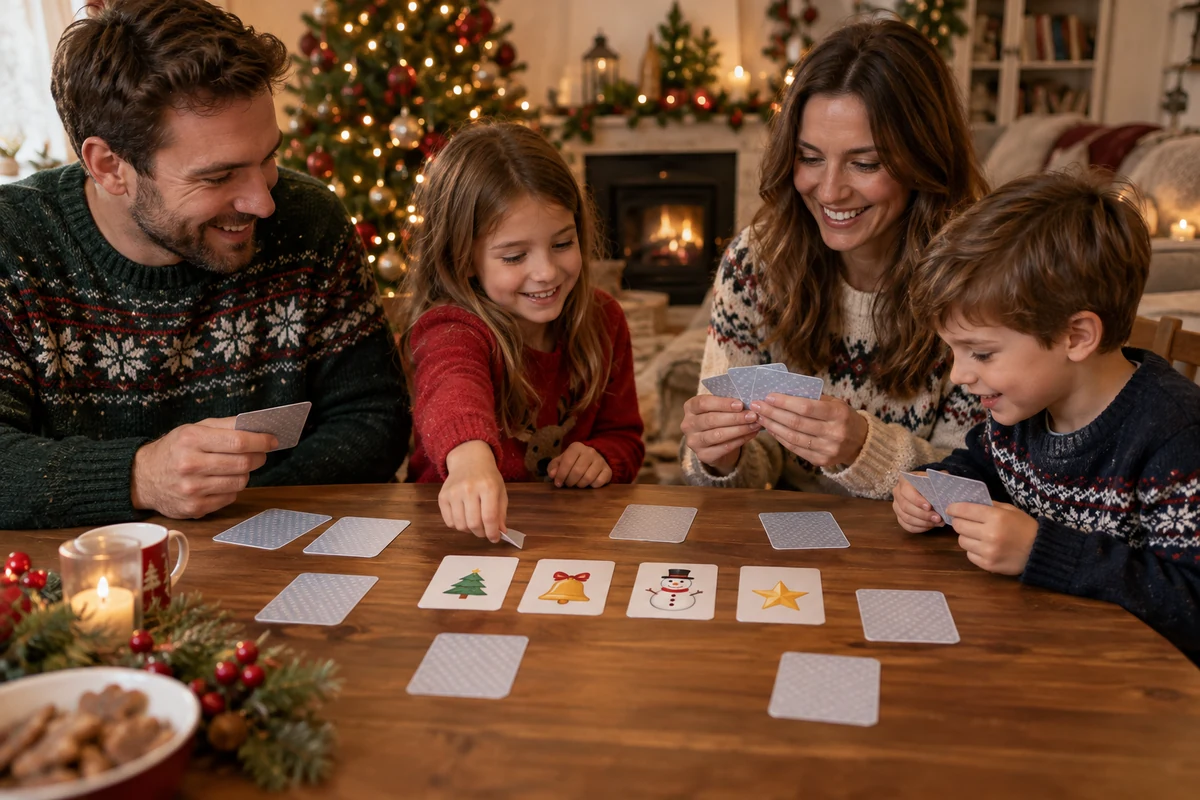
Theme rounds add variety and give different players their moment. Combine several categories rather than relying on one person’s specialist knowledge.
Music
Ask about song titles, performers or a short audio example you are entitled to use. Possible questions include:
- Can you identify this song from its opening?
- Which word comes before Navidad in the title of José Feliciano’s famous Christmas song?
- Who performs this particular recording?
Prepare the answers for the exact recordings you choose. A small speaker can help at home; public or commercial events require separate attention to music permissions.
Films
Questions about characters and plots can bring back shared memories without needing to reproduce dialogue or film clips.
- Name the film in which Kevin McCallister is accidentally left at home.
- What does the Grinch learn about Christmas by the end of the story?
- Match a short description of a scene to the film title.
Use your own written descriptions or material you have permission to show. A short clip is not automatically free of copyright restrictions.
Traditions
Explore customs from different places, keeping questions precise and avoiding claims that every household follows the same tradition.
- Which country is associated with La Befana?
- Which country is particularly associated with the decorated indoor Christmas tree tradition?
- Match clearly described traditions to the places associated with them.
Maps or illustrated cards can help, provided there is a spoken alternative for players who need one.
Christmas food
Questions about dishes and ingredients can prompt lively conversation about favourite festive meals.
- Name a dish shown in a photograph you are entitled to use.
- Which ingredients would you expect in a traditional fruit panettone?
- What is the name of the creamy festive drink made with eggs, milk or cream, sugar and spices?
Photographs work well without serving food. If offering tasting samples, explain ingredients and allergens and make participation optional.
Balancing the themes
Alternate categories and difficulty levels. For example: use one round each of music, films, traditions and food, with five questions in each. Keep the total at 20 unless you deliberately add another round.
Optional resources
- A phone or tablet for permitted audio or video material.
- Printed images or slides for visual questions.
- Coloured and labelled category cards.
- Clearly labelled food samples, if suitable for the group.
Turning your quiz into a keepsake or a product

A personalised quiz can make an enjoyable party favour. Creating one to sell is a separate project that requires original content, practical pricing and appropriate permissions; income is not guaranteed.
Possible formats
- Digital download: a PDF with 20 original questions, an answer key and instructions; include an editable version only if you can support it.
- Printed kit: question cards, envelopes, answer sheets and optional small prizes.
- Hosted event: a live quiz service for a private party or organisation.
- Business licensing: offer your own material to venues or event organisers under clear terms.
- A workshop: teach others how to write and host an original themed quiz.
Preparing something people can use
- Choose the format: a print-ready PDF, editable file or assembled physical kit.
- Check the content: provide 20 clearly categorised questions with reliable answers and consistent difficulty labels.
- Add useful extras: answer cards, an optional QR link to your own answer page and versions for different audiences.
- Prepare print files: ask the printer about colour mode, resolution, bleed and margins; 300 dpi is a common image requirement, not a substitute for their specification.
- Include instructions: explain timing, scoring and how the host should reveal the answers.
- Offer personalisation: add an agreed host name, date or authorised company logo.
Pricing and packaging
- Calculate your own price: include writing and design time, printing, materials, delivery and platform charges. The original’s Brazilian price ranges are not a reliable UK price guide.
- Optional bundles: combine a quiz with matching favour cards or prize vouchers where they add useful value.
- Simple packaging: paper envelopes, reusable boxes and ribbon can work well. Bulk buying only saves money if you will use the stock.
- Quantity pricing: work out whether a larger order actually reduces your costs before offering a discount.
Selling and sharing your work
- Online sales: choose a marketplace or shop that supports your product type and location, checking its current terms and charges.
- Social channels: show accurate product photographs and use genuine customer comments only with permission.
- Local partnerships: discuss suitable arrangements with venues, decorators or event organisers.
- Search descriptions: use accurate phrases such as printable Christmas quiz and show what buyers actually receive, without promising traffic or sales.
Making an interactive party favour
- A mini quiz: put three to five questions on a folded card inside an envelope.
- A QR code: link to a page you control containing the full quiz or answers, and include a readable URL as an alternative.
- A small extra: add a suitable sweet or a playful voucher, checking dietary and age requirements.
- Brief instructions: explain how to play and where to find answers in one or two sentences.
Copyright and permissions
- Use music carefully: ask about titles or performers rather than reproducing lyrics. Playing recorded music publicly or at a business can require a licence; a short extract is not automatically exempt. Source: GOV.UK: playing live or recorded music
- Check image and film rights: use your own work or material licensed for the intended purpose. Royalty-free does not mean unrestricted, and public film showings can need permission.
- Explain permitted use: state clearly whether buyers may use your original kit privately, commercially or for resale. Do not grant rights you do not hold.
Practical preparation tips
- Test before offering it: try the quiz with a small group and revise unclear questions or awkward timings.
- Provide an honest preview: let people see a representative sample without promising a larger product that does not exist.
- Make delivery clear: explain the file format, what is included and how the buyer receives it.
- Use real product photographs: show the actual kit and distinguish any illustrative mock-up from a physical item.
Ready to play?
A Christmas quiz can bring laughter, memories and conversation to a gathering. Clear questions, a fair answer key and a relaxed pace make it easier for everyone to enjoy taking part.
Thank you for reading. Follow our social channels for more festive ideas and explore the I Love Christmas blog for seasonal inspiration. The questions above can be used as the starting point for your own gathering.
Tell us which questions your guests enjoyed most, share your own ideas and invite a few friends to play. Happy Christmas!
Christmas quiz: frequently asked questions
How long should a Christmas party quiz last?
Allow around 20–40 minutes, depending on team numbers, discussion and breaks. Four short rounds of five questions work well for this quiz.
What materials do I need?
Prepare the questions and answers, answer sheets, pens and a score sheet. A timer is optional, and slides are useful only if they suit the group.
How can I adapt the quiz for different ages and needs?
Offer clear wording, spoken and written questions, suitable picture alternatives and extra time where needed. Large print and multiple choice can also help.
How do I keep the scoring fair and enjoyable?
Award one point per correct answer and announce any bonus rules in advance. Accept clear equivalents consistently and avoid changing rules during play.
Could I make my own quiz into a product or a party favour?
Yes. Develop original questions and a checked answer key, then choose a digital or printed format. Use only material you have rights to include, especially for commercial use.
Which prizes work without spending much?
Small homemade treats, playful vouchers, handmade decorations or a shared film night can work well. Choose options appropriate to the guests rather than assuming one prize suits everyone.
Sources and Further Reading
- Victoria and Albert Museum: Victorian Christmas traditions
- Royal Horticultural Society: poinsettias
- Charles Dickens Museum: A Christmas Carol
- GOV.UK: playing live or recorded music
- Netherlands tourist board: public holidays and Sinterklaas
- Italia.it: Epiphany and La Befana
- GOV.UK: showing films in public