Christmas traditions in north-eastern Brazil include church services, novenas, reisado performances, handmade nativity scenes and family meals. Customs vary across the region’s nine states. Regional dishes and crafts can enrich the celebration, but maracatu and Maranhão’s bumba-meu-boi belong principally to other festive cycles and should not be described as universal Christmas customs.
Christmas traditions in north-eastern Brazil bring together music, food and religious or family customs. From novenas and reisado to a table featuring regional favourites, there is much to discover without reducing a diverse region to one celebration.
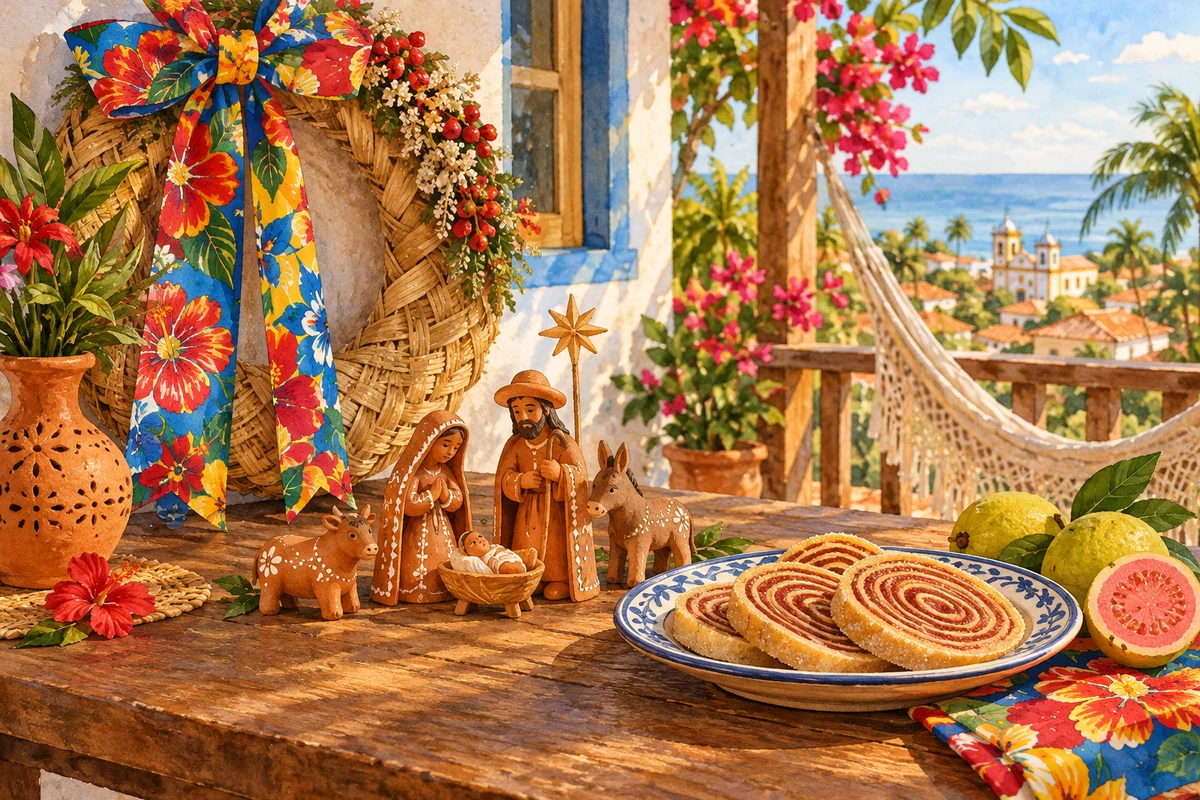
Illustrations in this article are conceptual images, not documentary photographs or evidence of a particular historical event, destination, venue or access route.
The history of Christmas celebrations in the Nordeste
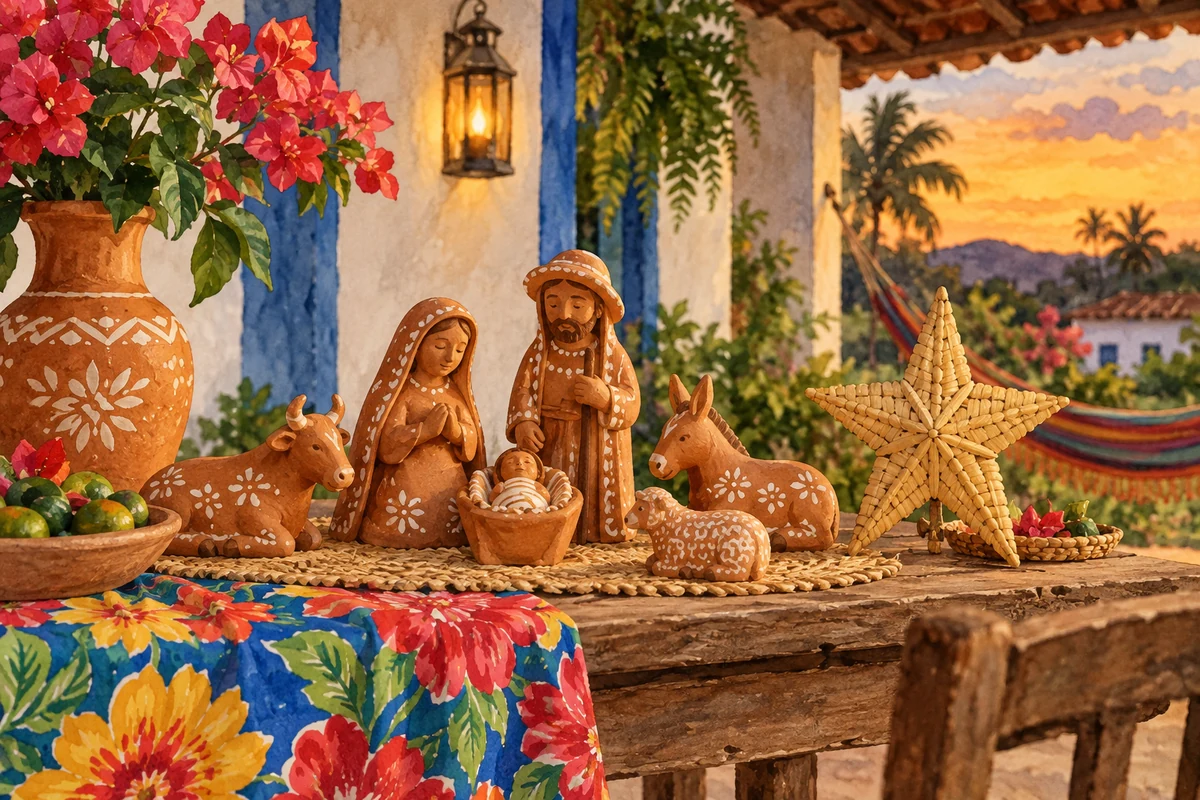
Christmas traditions in north-eastern Brazil developed through Portuguese Catholic colonisation and the histories of Indigenous, African and other communities. These encounters were not always equal or peaceful, and their cultural legacies differ considerably between places.
Cultural influences
Catholic practices include the Missa do Galo and Christmas novenas. Local communities have shaped music, performance, food and craft over generations. It is more accurate to recognise specific traditions and their makers than to assign every instrument, ingredient or dance to a single broad ancestry.
Popular cultural expressions
Reisado is associated with the Christmas and Epiphany cycle. Maracatu has a distinct history and is especially visible at Carnival. Some regional boi performances are connected with Christmas or Epiphany, but Maranhão’s bumba-meu-boi reaches its festive peak in June. These traditions should not be treated as interchangeable. Source: Fundação Joaquim Nabuco: Reisado Source: UNESCO: bumba-meu-boi in Maranhão
Regional differences
The Nordeste is not uniform. Pernambuco, Bahia, Maranhão and the other states contain many urban, rural and community traditions. Elaborate church displays and intimate family gatherings can be found in different settings; neither hospitality nor religious devotion belongs exclusively to the coast or the sertão.
Preservation and community meaning
For many participants, seasonal gatherings express belonging as well as faith. Community groups, schools, families and craftspeople help pass on skills and memories, while the people who practise a tradition remain central to how it changes.
Reisado, maracatu and bumba-meu-boi: different festive traditions
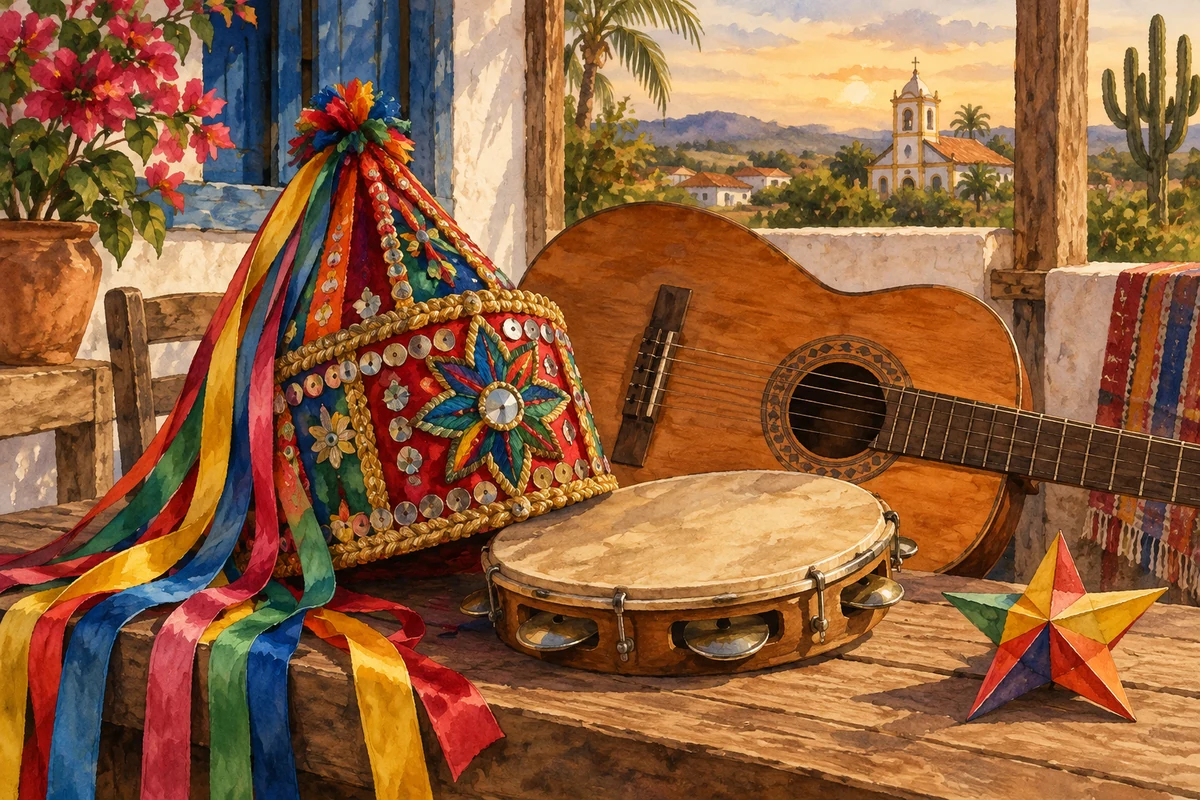
Reisado, maracatu and bumba-meu-boi all involve rich combinations of performance and community life, but they have different calendars and meanings. Reisado is the clearest Christmas connection here; the comparisons below help distinguish the traditions rather than place them all in December.
Instruments and rhythms
Ensembles vary between groups and regions. These examples are not a fixed instrument list for every performance.
- Reisado: groups may use zabumba drums, pandeiro tambourines, ganzá shakers, accordion, fiddle or string instruments alongside singing.
- Maracatu nação: deep alfaia drums, snare drums, the iron gonguê bell and other percussion accompany the procession. Different forms of maracatu have different musical arrangements.
- Bumba-meu-boi: Maranhão’s styles, or sotaques, include distinct combinations of drums, matraca clappers and other instruments; a single ensemble does not represent them all.
Figures and characters
Characters and costumes have meanings specific to the groups that perform them:
- Reisado: kings, masked or comic figures and other characters may appear in sung and dramatic sequences, depending on the local form.
- Maracatu nação: royal-court processions include a king and queen, standard-bearers and other figures within an Afro-Brazilian tradition. Source: IPHAN: Maracatu Nação
- Bumba-meu-boi: a decorated ox costume and characters such as cattle herders and comic figures feature in narratives that vary among groups; this is a performed figure, not a live ox.
Community preparation
Rehearsals, costume-making, music and shared meals can involve many people. Some Christmas-cycle groups visit homes, while other traditions have different venues and ritual calendars. Follow the particular group’s account of its own practice.
Taking part respectfully
If you attend a performance, let the community’s arrangements guide you:
- Ask before photographing people and avoid disruptive flash.
- Respect sacred spaces and do not interrupt a performance.
- Buy food or crafts directly from local makers where possible.
- Join an open workshop or rehearsal only when participation is invited.
- Agree any donation with organisers instead of assuming what they need.
Cultural preservation
Careful documentation, support for practitioners and opportunities to teach younger generations can help sustain traditions. Workshops and public recognition should support communities rather than turn their practices into a generic tourist spectacle.
Regional food ideas for a Christmas table
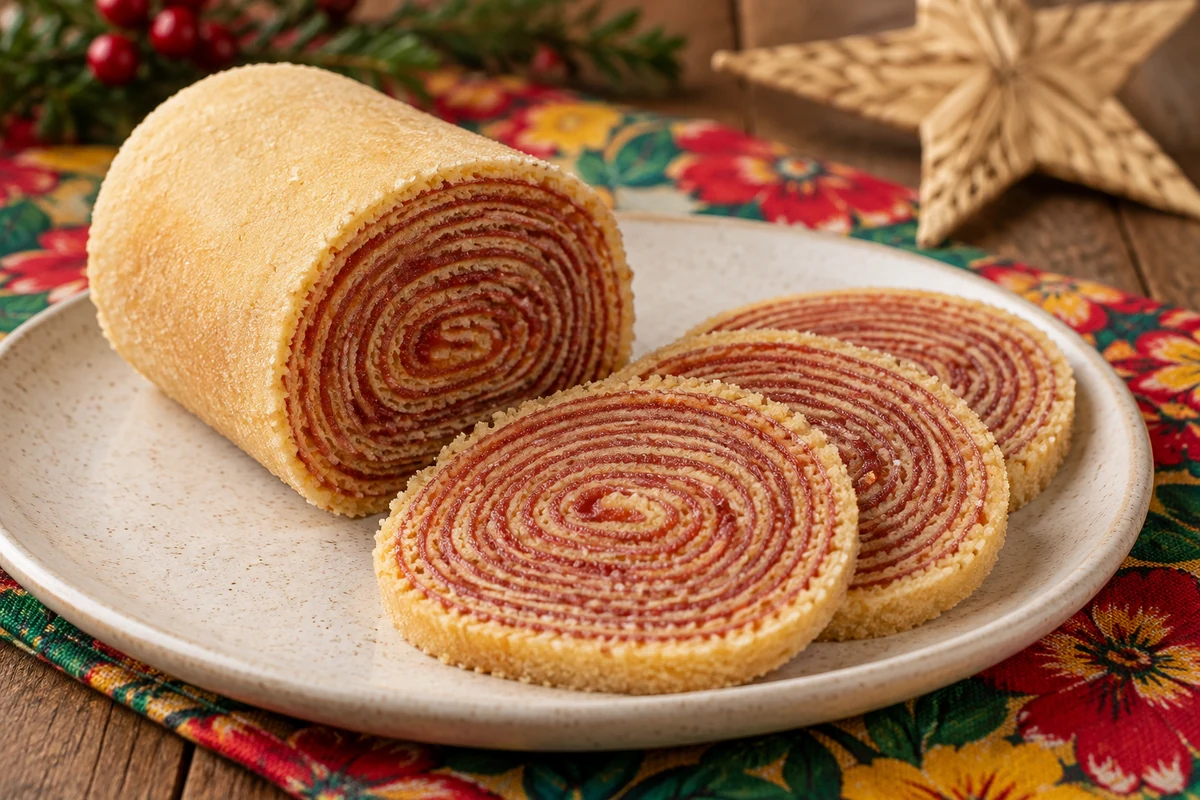
Family Christmas meals may include regional favourites such as carne de sol with macaxeira, bolo de rolo and rabanada. These foods are not exclusive to Christmas, and there is no single menu for the whole Nordeste. The following home-style recipes retain the source’s quantities and have not been kitchen-tested for this edition.
Carne de sol with macaxeira
This dish pairs lightly salted, cured beef with sweet cassava, known locally as macaxeira or aipim. Buy both from a reputable food supplier and follow their preparation instructions.
Ingredients:
- 1kg carne de sol – prepared for cooking according to the supplier’s desalting instructions and cut into pieces.
- 1kg sweet cassava (macaxeira or aipim) – peeled and cut into pieces; use a food-grade variety intended for home cooking, not unidentified or bitter cassava.
- 2 tablespoons manteiga de garrafa – Brazilian clarified butter; ordinary butter gives a different result and should be heated carefully.
- 1 large onion – chopped.
- 2 garlic cloves – chopped.
- Salt and black pepper – season cautiously because the beef may already be salty.
- Fresh coriander or cheiro-verde – to taste; cheiro-verde is a local herb mixture whose composition varies.
Method:
- Prepare the beef: follow the supplier’s desalting instructions. If soaking is required, keep it covered in the fridge and change the water as directed; do not leave raw meat on the worktop for six to twelve hours.
- Cook the cassava: boil prepared sweet cassava in plenty of water until thoroughly cooked and tender, following the supplier’s directions. Drain and discard the cooking water. Do not taste it raw or reuse the water. Source: Canadian Food Inspection Agency: natural toxins in fruit and vegetables
- Cook the beef: heat the butter in a large frying pan and brown the pieces, then continue cooking as needed. Browning the outside alone does not establish that cured meat is safely cooked; follow the product’s instructions and check the centre. Source: FSA: cooking food safely
- Add the aromatics: cook the onion with the beef until softened, adding the garlic towards the end so it does not burn.
- Finish: adjust pepper and herbs, then serve the fully cooked beef with the cassava and the buttery pan juices.
Bolo de rolo
This Pernambuco speciality is known for very thin layers of cake and guava paste rolled together. It differs from a thick sponge Swiss roll and takes practice to assemble neatly.
Ingredients:
- 6 eggs – whites and yolks separated.
- 200g sugar – for the cake mixture.
- 200g butter at room temperature – use butter for the stated version; alternative spreads may change the texture.
- 200g sifted plain flour – for the batter.
- A pinch of salt – to balance the flavour.
- 300g goiabada – guava paste, gently softened over a bain-marie until spreadable. Dulce de leche makes a different variation rather than the classic guava version.
Method:
- Prepare the oven: preheat to 180°C conventional and grease a shallow rectangular baking tray. The source does not specify tray dimensions, so the number and baking time of layers will depend on how thinly the batter is spread.
- Beat the eggs and sugar: whisk the egg whites to firm peaks and set aside. Beat the yolks with the sugar until pale.
- Mix in the butter: beat the softened butter into the yolk mixture until combined.
- Fold in flour and whites: incorporate the flour and salt, then gently fold in the whisked whites without overmixing.
- Bake thin layers: spread a very thin, even layer in the tray. The source suggests about five to eight minutes, but watch closely: it should be cooked while still flexible, not dry and crisp. Repeat with the remaining batter; four to six layers is only an approximate guide.
- Roll the cake: spread a thin layer of warm guava paste over the first baked sheet and roll carefully. Spread the next sheet, place the existing roll at one edge and roll it up inside that layer. Repeat, keeping the layers thin.
- Cool and slice: allow the cake to cool and firm up before cutting thin slices. If chilling for the source’s suggested hour, wrap it once cool to help prevent drying.
Oven-baked rabanada
Rabanada is a sweet bread-and-egg dish enjoyed in many parts of Brazil. This baked home-style version is not presented as a recipe unique to the Nordeste.
Ingredients:
- 1 large day-old bread loaf – cut into eight to ten thick slices. Loaf sizes vary, so the liquid may coat different amounts of bread.
- 2 eggs – beaten.
- 200ml milk – or a suitable unsweetened plant-based alternative; the recipe still contains eggs.
- 50g sugar – for the soaking mixture.
- 1 teaspoon ground cinnamon – for the mixture, with extra only if you want a cinnamon topping.
- 50g butter – the source’s allowance for greasing; use only what is needed for your tray.
- Optional: 1 tablespoon rum – omit for an alcohol-free version; baking does not guarantee that all alcohol disappears.
Method:
- Preheat the oven: set it to 180°C conventional and grease a baking tray.
- Make the mixture: combine the eggs, milk, sugar, cinnamon and optional rum.
- Dip the bread: briefly coat each slice without soaking it until it falls apart.
- Bake: arrange in one layer and bake for approximately 15–20 minutes, turning halfway through. Thickness and ovens vary: the egg mixture should be fully set and the slices hot throughout, not merely browned outside.
- Serve: enjoy warm. An additional sprinkle of sugar and cinnamon, honey or dulce de leche is optional and is not included in the measured mixture above.
Variations and practical ideas
A recipe designed for coconut milk can provide another rabanada variation. Cashew-apple preserve instead of guava changes the cake’s flavour and should be described as an adaptation. Include suitable vegetarian dishes, such as roasted vegetables or meat-free farofa, according to guests’ needs.
Religious traditions: Christmas Mass, novenas and nativity scenes
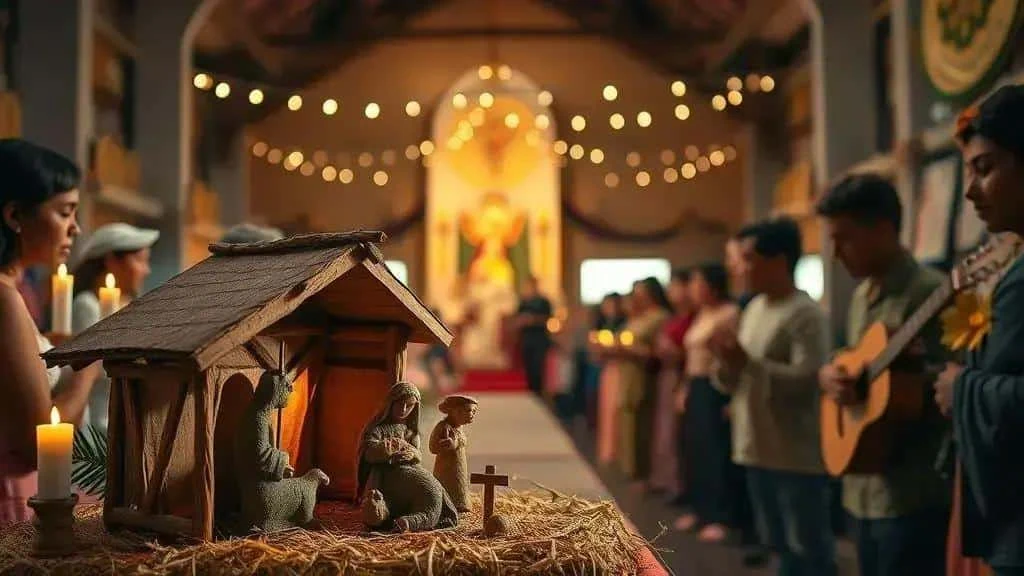
The Missa do Galo and Christmas novenas are important to many Catholic communities. Pilgrimages also have a strong regional presence, but their calendars are not necessarily connected with Christmas.
Christmas Mass and novenas
The Missa do Galo is celebrated on Christmas Eve, with the time set by each parish. Novenas involve nine days of prayer and may take place in homes or churches, sometimes with songs and refreshments afterwards.
Nativity scenes and performances
Nativity scenes range from small clay or ceramic figures to community performances. Some makers incorporate local materials and visual references, while others follow familiar Christian imagery.
Pilgrimages and processions
Romarias are pilgrimages to religious sites, sometimes involving walking and sometimes other transport. Their dates and purposes vary. Check local information rather than assuming a major pilgrimage takes place at Christmas.
Prayer and music
Church choirs, hymns and local musical practices may accompany services and gatherings. Arrangements depend on the parish or group; it would be misleading to claim that regional dialect readings are a standard feature throughout the Nordeste.
Joining respectfully
- Dress appropriately: follow the expectations of the church or organisers and choose comfortable clothing for the weather.
- Ask before photographing: respect prayer and avoid disruptive flash.
- Support local initiatives: buy from craftspeople or contribute to an agreed community collection.
- Follow local guidance: respect timings, routes and participation rules.
Local variation and transmission
Some communities focus on elaborate nativity displays, others on home prayers or popular performances. Families, churches and cultural groups can create opportunities for children to learn, without every place following the same pattern.
Decorations, crafts and small gifts inspired by the Nordeste
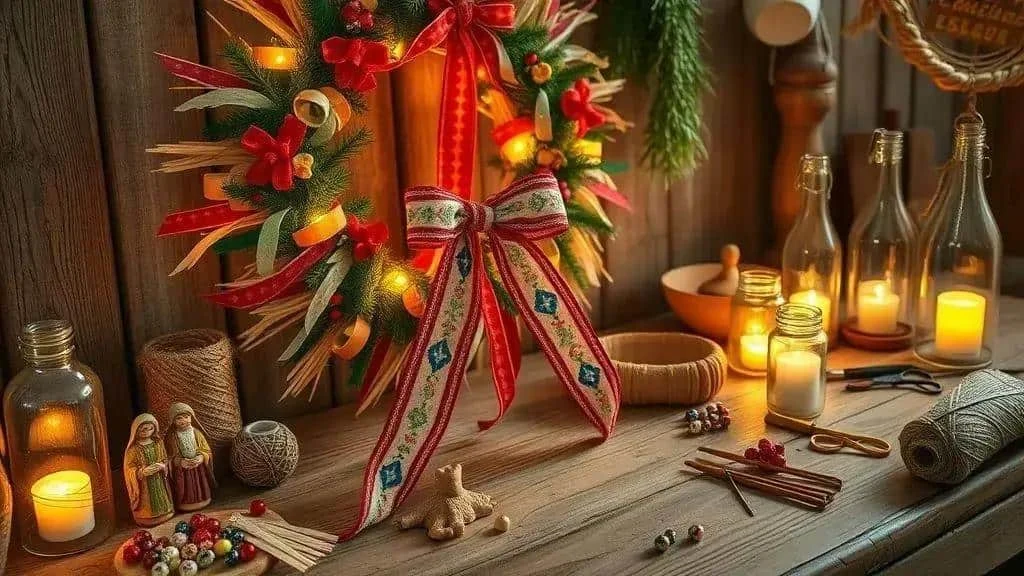
Christmas traditions in north-eastern Brazil can inspire decorations using straw, floral chita fabric and ceramics. These materials do not automatically make a piece traditional: recognise the individual maker and describe home projects as adaptations.
Materials and techniques
Consider locally available or reused materials, and choose those suitable for your project:
- Prepared palm fibre or corn husks – for some woven or rustic decorations.
- Chita fabric – brightly patterned cotton for bows, covers and decorative figures.
- Clay and ceramics – for small nativity figures and handmade objects.
- Sisal, raffia and cord – for hanging loops and textured details.
- Beads and colourful ribbons – for finishing, kept away from very young children.
- Reused glass bottles – for decorative LED lights intended for that use, without drilling or modifying electrical equipment.
Simple project ideas
These are home craft ideas inspired by regional materials rather than claims of traditional designs:
- A straw wreath with floral chita bows and colourful pompoms.
- Tree ornaments made from clean fabric scraps and suitable reused stuffing.
- A small hand-painted clay nativity scene in earthy colours.
- Clean bottles decorated with lace and cord, using suitable battery-operated LED lights.
- Christmas cards with fabric cut-outs or a simple print inspired by woodcut art, respecting artists’ original designs.
Supplies for a straw-and-chita wreath
- A 20–30cm straw wreath base – ready-made or securely assembled.
- Chita fabric strips – the source suggests a 50cm length as a starting supply; the amount needed depends on the number and size of bows.
- Thin craft wire or hot glue – for fixing decorations, handled by an adult.
- Ribbon and beads – optional finishing details.
- Scissors and strong thread – basic tools.
Making the wreath
- Prepare the base: choose or shape a firm straw ring and secure it, tucking away sharp wire ends.
- Cut the fabric: make 10–15cm strips for small bows, adjusting to your design and reserving a longer piece for hanging.
- Attach the bows: use thread or carefully applied hot glue, balancing the colours around the ring.
- Add details: fix pompoms, beads or ribbon between the bows. Avoid small detachable pieces where children could reach them.
- Hang securely: attach a strong loop, check the fixing and display away from heat or open flames.
Small handmade gifts
Simple handmade pieces can become personal gifts. Selling them requires realistic costing and any relevant product or food-safety checks:
- Fragrant sachets using suitable dried lemongrass or fennel, clearly labelled as decorative rather than edible.
- Small clay nativity figures in boxes decorated with fabric.
- Bead-and-cord keyrings made with secure fittings.
- Homemade sweets packed appropriately, with ingredients, allergens and storage instructions rather than an assumed shelf life.
Assembly and storage tips
Set up a clear work area and protect delicate pieces:
- Choose adhesive suitable for the materials and test it on a spare piece first.
- Store straw and clay items dry, cushioned and protected from damp or crushing.
- Use suitable LED lighting and keep battery compartments secure.
- Photograph stages if useful for repeating the project, and adapt tools and tasks to children’s ages.
Valuing the maker’s work
When displaying or selling a craft, describe its materials and maker honestly. Share a cultural connection only when it is known, rather than inventing an origin to make the piece seem more valuable.
Conclusion
Christmas in the Nordeste brings together many forms of faith, music, food and family life. Learning the differences between communities and festive calendars makes these traditions more meaningful, not less colourful.
Thank you for reading. Visit the I Love Christmas blog for more festive food, cultural guides and decorating ideas.
Share your own memories where comments are available, and credit the people and places whose traditions you describe.
FAQ: Christmas traditions in north-eastern Brazil
What are some Christmas traditions in the Nordeste?
Christmas Mass, novenas, nativity scenes, reisado and other local Christmas-cycle performances are examples. Maracatu is especially associated with Carnival, while Maranhão’s bumba-meu-boi peaks in June; they should not all be labelled Christmas traditions.
Which regional dishes could I include in a festive meal?
Carne de sol with macaxeira, Pernambuco’s bolo de rolo and family versions of rabanada are possible choices. They are not a universal Christmas menu. Plan portions and dietary options around your guests.
How can I attend a cultural celebration respectfully?
Ask before photographing, follow organisers’ directions and participate only when invited. Support local makers and avoid interrupting religious or performance spaces.
How can I make a nativity display inspired by regional crafts?
Choose clay or ceramic figures, a stable base and suitable fabric or straw details. Buy from identified makers where possible, keep materials dry and describe your own design as an adaptation.
Learn from practitioners, involve children in suitable music or craft activities, share family recipes and discuss the meaning of events rather than copying only the appearance.
Where can I find regional crafts and festive foods?
Look for local markets, community fairs, church bazaars and makers’ own shops or verified profiles. Direct purchases can support practitioners; confirm the origin rather than relying on a generic regional label.
Sources and Further Reading
- Fundação Joaquim Nabuco: Reisado
- IPHAN: Maracatu Nação
- UNESCO: bumba-meu-boi in Maranhão
- Canadian Food Inspection Agency: natural toxins in fruit and vegetables
- FSA: cooking food safely