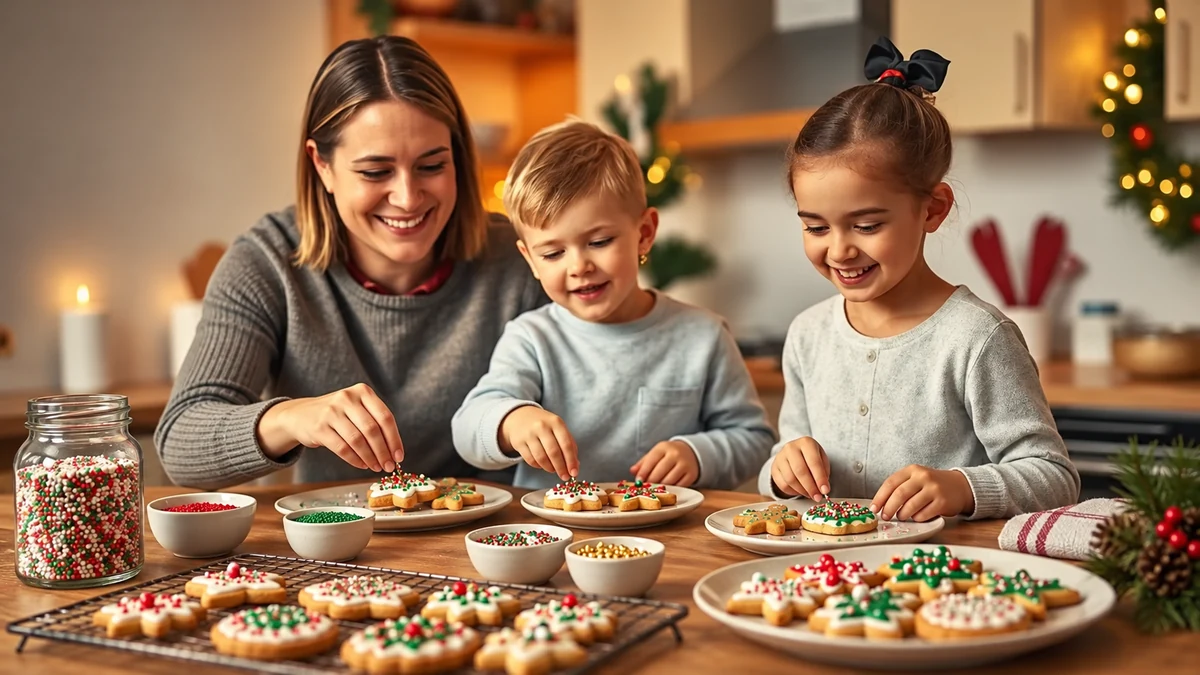
Christmas cooking with children brings together measuring, mixing and decorating in short, manageable activities. Plan around each child’s abilities, keep adults in charge of heat and sharp tools, and check ingredients and allergies before turning festive preparations into family time.
Christmas cooking with children can make preparing a festive meal a chance to learn together. These activities and recipes offer practical ways to involve little helpers and build happy memories in the kitchen.
Preparing the Kitchen: Safety and Organisation
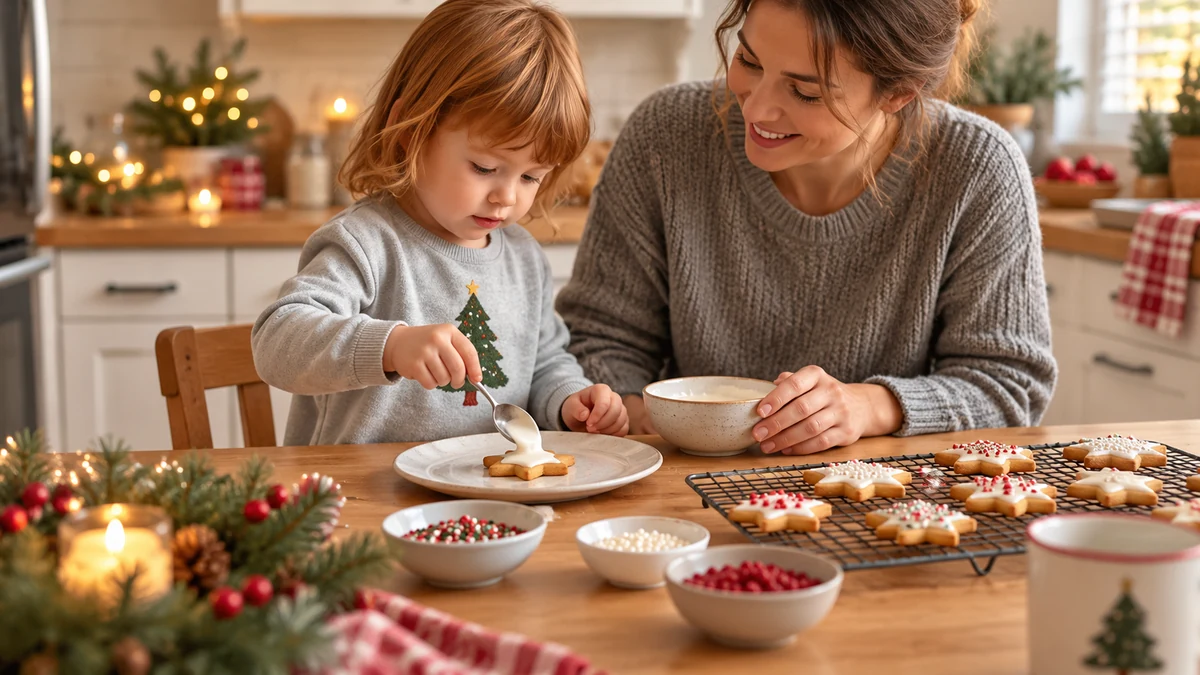
Start by setting up a clear, supervised workspace away from the hob, oven and other hot surfaces.
- A suitable workspace: use a low table where possible. If using a purpose-designed kitchen step, ensure it is stable and suitable for the child, and supervise closely; do not let children balance or stretch across a worktop.
- Keep heat separate: use back hob rings where possible, turn pan handles away from the edge, and keep children away from hot pans and oven doors. Adults handle cooking and hot drinks. Source: Child Accident Prevention Trust — Burns and scalds
- Prevent slipping: keep the floor dry and clear. Any step should stand securely on a level, non-slip surface, without a loose rug underneath.
- Good lighting: make sure everyone can see the work area clearly.
- Be prepared: keep first-aid supplies accessible to adults but out of children’s reach, and know how to seek help in an emergency.
Organisation Checklist
- Set out suitable utensils: easy-grip spoons, blunt biscuit cutters and lightweight bowls.
- Portion ingredients into small containers on a tray before starting.
- Lock away knives and other sharp equipment, or store them securely out of reach.
- Keep liquids and eggs well back from the edge of the table or worktop.
- Have cloths and kitchen paper ready so an adult can deal promptly with spills.
Setting Up Activity Stations
- Measuring station: put measuring spoons, cups and scales on a tray so children can explore quantities with less mess.
- Mixing station: use a stable bowl with a non-slip base and a silicone spoon.
- Decorating station: offer small portions of icing and age-appropriate edible decorations, checking ingredients for allergens.
- Cleaning station: keep a bin nearby, bags and cleaning products out of reach, and provide soap and water for handwashing. Hand sanitiser is not a substitute for washing hands after handling raw ingredients.
Suitable Utensils and Alternatives
- Silicone spoons and spatulas are lightweight and have no sharp points.
- Child-friendly blunt cutters can help with soft foods or dough under supervision; adults should handle sharp knives.
- Bowls with non-slip bases are useful. A suitable non-slip mat underneath can also help keep a bowl steady.
- Use unbreakable food-safe measuring containers instead of glass where practical.
Simple Rules for Children
- Ask an adult to cut hard ingredients or handle anything hot. Never touch the oven or pans without permission and appropriate adult help.
- Wash hands before starting and after handling raw ingredients, including flour and eggs. Do not taste raw dough or batter. Source: UK Health Security Agency — Handling flour safely
- Tie back long hair and roll up loose sleeves.
- Tell an adult about anything dropped or spilt, rather than reaching for something sharp or hot.
A defined workspace and clear rules make close supervision easier. Children can practise coordination and hygiene while taking part in jobs matched to their abilities; equipment alone does not remove the need for an attentive adult.
Easy Activities and Recipes for Young Helpers
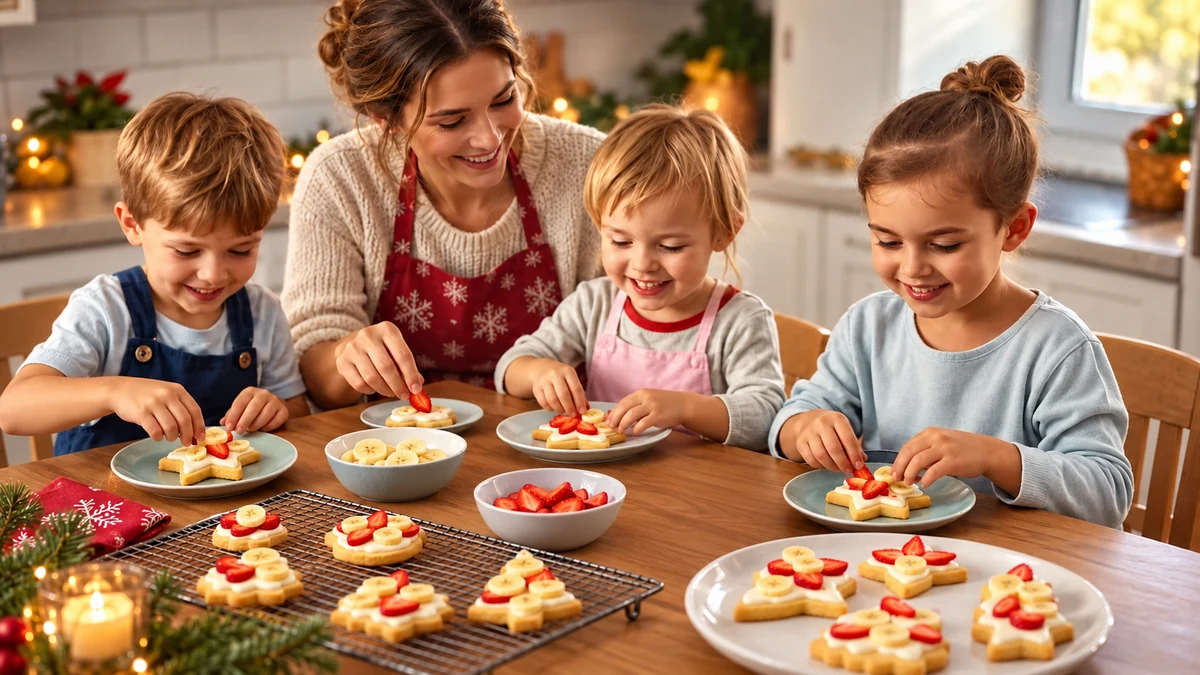
Choose short activities with a clear beginning and end. Small jobs are often easier for children to follow than preparing an entire meal at once.
Activities Without an Oven
- Guided measuring: let children use measuring spoons and cups to portion small amounts of ingredients.
- Gentle mixing: offer a light mixture or icing in a stable bowl, with an adult close by. Raw mixtures must not be tasted.
- Creative decorating: decorate biscuits that have already been baked and completely cooled.
- Festive fruit plates: arrange appropriately prepared fruit in colourful patterns on small plates. For young children, leave out pointed wooden skewers.
- Snack assembly: make simple sandwiches or small salads together, letting children choose from suitable ingredients.
Easy Recipe: Christmas Sugar Biscuits
This recipe gives children jobs in measuring, mixing and decorating, while an adult handles the oven. Ingredient substitutions can change the result; the alternatives below are suggestions, not separately tested recipes.
- 200 g plain flour – the original suggests 150 g gluten-free flour plus 50 g cornflour as an alternative, but blends vary and may need a recipe designed for them.
- 100 g unsalted butter, at room temperature – a baking margarine may be an alternative; check its ingredients and baking guidance.
- 80 g caster sugar – demerara gives a different flavour and a coarser texture.
- 1 egg – a suggested egg-free alternative is 1 tablespoon ground linseed mixed with 3 tablespoons water. It changes the texture; for a vegan version, the butter and all other ingredients must also be suitable.
- 1 teaspoon vanilla essence – optional.
- A pinch of salt
Method:
- Cream the butter and sugar: put them in a bowl and help the child stir with a large spoon until creamy.
- Add the egg and vanilla: mix until incorporated, then wash hands and any surfaces affected by raw egg.
- Add the flour: gradually mix in the flour and salt until the dough is even and fairly firm. Do not taste it raw.
- Roll out: lightly flour the work surface and help the child roll the dough to about 0.5 cm thick.
- Cut the biscuits: let children choose festive cutters and help place the shapes on a baking tray. An adult takes over for baking.
- Bake, with an adult in charge: use a preheated oven at 180°C for about 8–12 minutes, until baked through and lightly golden at the edges. Ovens and biscuit sizes vary. Leave to cool completely before decorating.
- Decorate: use small spoons or piping bags for icing, with edible decorations suitable for the child’s age and dietary needs.
Quick Recipe: Festive Fruit Plates
This colourful, no-bake activity replaces pointed skewers with small plates. An adult prepares the fruit to suit the youngest child taking part.
- 1 apple – thinly slice, grate or soften as appropriate for young children, rather than serving hard cubes. Pear is an alternative, prepared to a suitable texture.
- 1 banana – cut into manageable pieces; ripe mango is another option.
- 150 g seedless grapes – wash and cut lengthways into quarters for young children; do not leave them whole. Source: NHS — Preparing food safely for children
- 100 g strawberries – wash, remove the stalks and quarter or cut further as needed. Blackberries can be used if prepared appropriately for the child.
- Small plates – use these for arranging the fruit instead of wooden sticks.
- Prepare the fruit: an adult washes and cuts it into suitable shapes and textures. Children should sit down and be supervised when eating.
- Sort by colour: place the prepared fruit in separate bowls so children can choose pieces easily.
- Arrange together: make colour sequences or simple festive patterns on the plates.
- Serve: enjoy promptly, with a little plain yoghurt if wanted and suitable for everyone’s dietary needs. Keep cut fruit and yoghurt chilled if not serving straight away.
Learning and Safety Tips
- Explain one step at a time in short sentences, then ask the child to tell you what comes next.
- Offer a few suitable choices of shapes, colours or fruit to encourage independence.
- Keep sharp tools, the hob and hot trays under adult control throughout.
- Praise effort and small improvements. Ask what the child noticed or learnt.
- Use a simple picture sequence showing preparation, waiting and decorating time.
Teaching Measuring, Mixing and Decorating
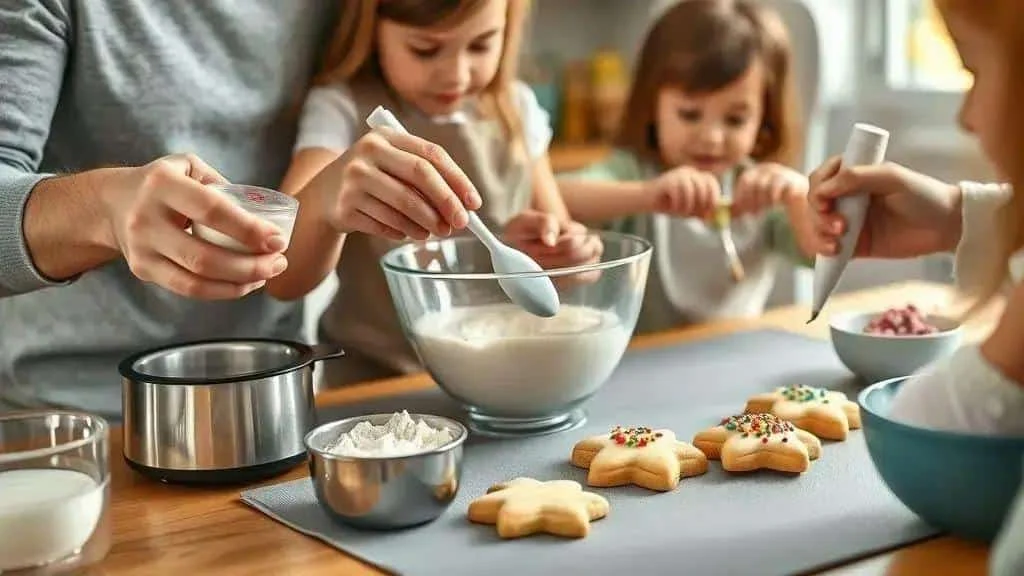
Basic cooking skills build confidence through practice. Demonstrate each action slowly, then let children try a manageable part of it.
Useful Equipment
- Measuring cups and spoons – choose sturdy, easy-grip sets.
- Kitchen scales – helpful for showing how recipes measured in grams work.
- Non-slip bowls – help prevent the bowl sliding while mixing.
- A silicone spoon and spatula – lightweight tools for small hands.
- Piping bags with simple nozzles – use with supervision and keep small detachable parts away from young children.
Teaching Measuring
- Explain the units: show the difference between a measuring cup, tablespoon and teaspoon, as well as the grams on the scales.
- Demonstrate: measure half a cup of flour as a counting exercise, explaining each step. For the biscuit recipe, use the stated weight in grams rather than guessing a cup conversion.
- Guide their practice: show how to fill a measuring spoon and level it with a suitable blunt straight edge, not a sharp knife.
- Measure liquids: put a clear measuring jug on a level surface and show how to read the mark at eye level.
- Compare sizes: a standard UK measuring tablespoon holds 15 ml and a teaspoon 5 ml. Compare the actual measures rather than ordinary cutlery, which varies in size.
Teaching Mixing
- Hand position: demonstrate holding the bowl with one hand and the spoon with the other.
- Basic movements: practise gentle circles and back-and-forth movements, explaining how thicker mixtures need more effort.
- Start slowly: gentle stirring gives children more control and reduces splashes.
- Watch the texture: describe what to look for, such as a smooth mixture or no visible dry flour, according to the recipe.
- Practise with a simple recipe: sugar biscuits provide a clear sequence from mixing to shaping and baking.
Teaching Decorating
- Set out the choices: arrange small bowls of icing and suitable edible decorations within easy reach.
- Using a piping bag: show how to hold it with both hands and squeeze gently, starting with simple lines.
- Adding decorations: explain how to place small amounts on the icing and press lightly where needed. Avoid hard decorations unsuitable for young children.
- Encourage creativity: suggest stripes, dots or a simple face, then let the child choose colours.
- Take your time: slower movements make decorating easier to control.
Tips for Learning Safely
- Break the task into short stages and recognise each small achievement.
- Supervise actively: remain attentive throughout, with adults handling sharp tools, the oven and hot water.
- Reinforce hygiene: wash hands before starting and after touching raw ingredients.
- Give encouraging feedback: praise attempts and explain mistakes calmly.
- Repeat simple exercises: measuring and mixing become more familiar with practice and can be turned into small games.
Adapting Activities for Ages and Dietary Needs
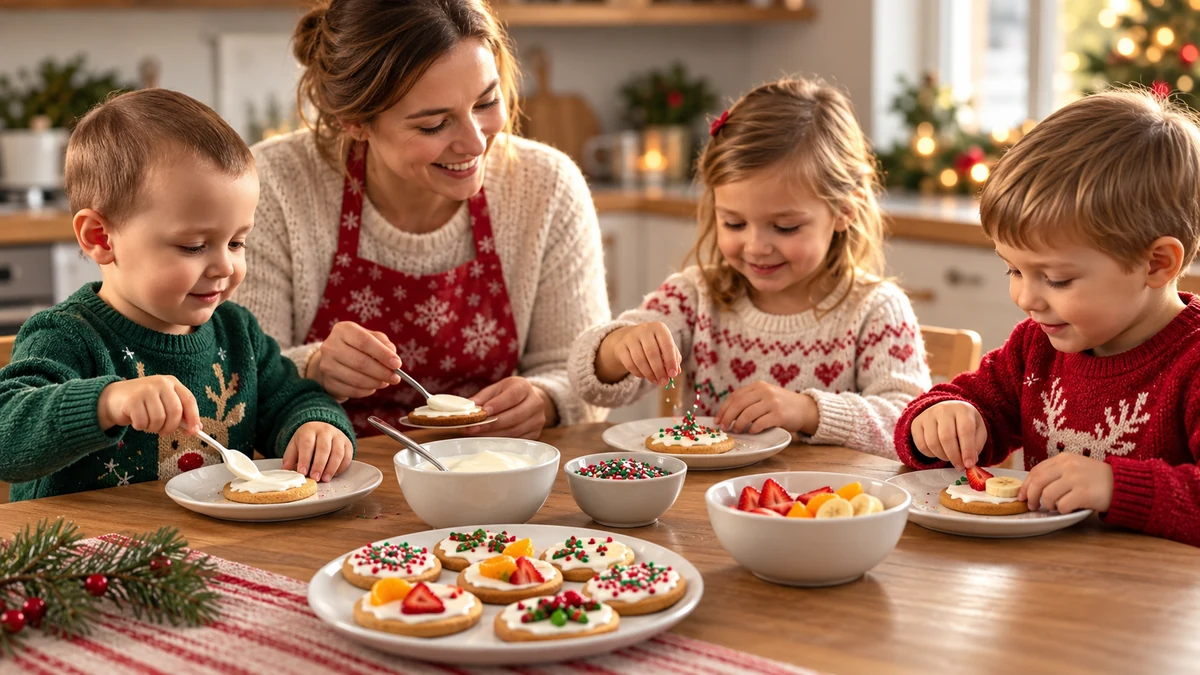
Match tasks to the individual child’s abilities, attention and dietary needs. Age ranges are suggestions, not permission to use equipment without supervision.
Ideas by Age Group
- Toddlers and young children, roughly 2–4 years: try arranging prepared fruit or spreading a little ready-to-eat icing on a cooled biscuit, with direct adult supervision. Avoid raw-flour sensory play and tasting dough.
- Around 4–6 years: offer short, repeated jobs such as counting spoonfuls, pressing a blunt biscuit cutter or decorating cooled biscuits.
- Around 7–10 years: introduce weighing, mixing and watching a timer. Adults should still handle hot trays and the oven.
- Around 11–14 years: practise following recipes, accurate measuring and piping. If introducing an electric mixer, follow its instructions, supervise closely and keep hands and utensils away from moving beaters; switch off and unplug before adjustments.
Ingredient Substitutions
- Gluten-free: choose a suitable gluten-free recipe or follow the flour manufacturer’s guidance. Blends do not all behave like wheat flour, and some already contain a binder; do not add xanthan gum automatically.
- Milk-free versus lactose-free: these are not interchangeable. Lactose-free dairy still contains milk proteins and is not suitable for a milk allergy. Check plant drinks and baking fats carefully, including other allergens such as soya or nuts; substitutions can change baking results. Source: Cambridge University Hospitals — Milk allergy
- Egg-free: the original suggests 1 tablespoon ground linseed with 3 tablespoons water, left for 5 minutes, or 60 g apple purée per egg in some sweet recipes. These are recipe-dependent alternatives, not guaranteed swaps. Egg-free alone does not mean vegan.
- Nut-free: do not assume seeds or oats are suitable for everyone. Check individual allergies, product labels and cross-contact risks, and avoid whole nuts or hard seeds where they pose a choking risk.
- Reducing sweetness: use a recipe designed with less sugar when possible. Replacing sugar with syrups or sweeteners can alter texture and cooking behaviour; it is not a straightforward health or baking equivalent.
A Possible Biscuit Adaptation
Gluten-free, milk-free Christmas biscuits — proposed ingredients: check every product and the child’s needs first. This adaptation has not been separately tested, and different flour blends or egg alternatives may give different results.
- 200 g gluten-free plain flour blend – check that the product is suitable for biscuits and follow its baking guidance.
- 100 g milk-free baking margarine or baking block – at room temperature, with the ingredients checked.
- 80 g sugar – the original suggests reducing this to 60 g for a less sweet version, but texture and spread may change.
- 1 egg or an appropriate egg alternative – the suggested linseed mixture is 1 tablespoon ground linseed with 3 tablespoons water.
- 1 teaspoon vanilla essence – optional.
Adaptation method:
- Cream the baking fat and sugar with a large spoon.
- Add the egg or alternative and mix evenly.
- Gradually add the gluten-free flour to form a workable dough; its behaviour depends on the blend.
- Roll and cut into shapes as in the main recipe. An adult should bake them, using that recipe’s temperature and approximate timing as a starting point and checking they are properly baked. Cool before decorating, and never taste the raw dough.
Planning for Allergies and Inclusion
- Communicate clearly: ask parents or carers about allergies in advance and agree which ingredients and activities are suitable.
- Reduce cross-contact: clean surfaces thoroughly and use separate, clean utensils for agreed alternatives.
- Label clearly: use written ingredient labels that adults can read. Different-coloured bowls can help organisation, but colour alone must not replace ingredient information.
- Plan alternatives ahead: have suitable products ready and keep their packaging for checking. Do not confuse lactose-free with milk-free.
- Include children in choices: let them choose between options already agreed as suitable.
Turning Cooking into Family Memories

Small rituals, shared jobs and patient attention can make kitchen activities memorable without elaborate preparations.
Simple Ways to Make It Special
- Start together: choose some Christmas music and wash your hands before beginning.
- Give everyone a role: measuring, mixing or decorating can help each child feel involved.
- Keep sessions manageable: allow around 15–30 minutes for an activity if it suits the children, with shorter turns or breaks when needed.
- Tell a story: connect a recipe with a genuine family memory or a festive character.
- Record a few moments: take photos or short videos without interrupting supervision. Respect children’s privacy when deciding what to share.
Activities That Combine Learning and Affection
- Make a family recipe book: children can draw a page and write or dictate the ingredients.
- Explore familiar aromas: an adult can hold a closed or carefully opened spice container nearby. Do not let children inhale loose powders or handle small whole spices that could be swallowed.
- Make thank-you cards to accompany a food gift, checking the recipient’s dietary needs first.
- Tell a family story while the biscuits bake and the adult keeps track of the oven.
Making a Recipe into a Memory, Step by Step
- Choose a recipe: pick something simple to repeat, such as sugar biscuits or a festive fruit plate.
- Explain the connection: tell children why it matters to your family, or suggest starting a new tradition.
- Share the jobs: one child measures, another mixes, and an adult manages the oven.
- Keep a record: photograph a few details, from the ingredients to the finished food, when it is safe to do so.
- Finish together: taste the safely prepared, cooled food and talk about what everyone enjoyed or learnt.
Small Habits Worth Keeping
- Tidy up as a team: give children suitable cleaning jobs, keeping sharp tools and hot washing-up water for adults.
- Use a timer: make waiting and watching the time part of the activity.
- Value the effort: ask, “What would you try differently next time?” without making a mistake feel like a failure.
- Save a keepsake: put photos, drawings and notes in an album or envelope, with the date and names of those who took part.
These everyday practices combine learning, care and routine, giving family skills and relationships room to grow together.
Ready to Begin?
Christmas cooking with children can be simple and enjoyable. Keep activities short, choose appropriate tasks and stay attentive throughout.
Thank you for making time for young helpers. Follow the I Love Christmas Blog for more recipes and family ideas, and share your creations only in ways that respect everyone’s privacy.
Thank you for cooking with us — come back for more seasonal ideas to enjoy together.
Christmas Cooking with Children: Frequently Asked Questions
How old should children be before helping in the kitchen?
Some children around two can enjoy closely supervised observation or simple ready-to-eat food activities. Choose tasks by individual ability and attention, not age alone, and keep raw dough, heat and sharp tools away from young helpers.
How can I make cooking with children safer?
Use a workspace away from heat, choose suitable utensils and supervise actively. Adults handle hot trays and sharp tools. Explain simple rules, keep the floor clear and know where first-aid supplies are kept.
What if someone has a food allergy?
Ask their parent or carer in advance, agree ingredients, read product labels and reduce cross-contact with clean surfaces and separate utensils. Label ingredients clearly; lactose-free dairy is not suitable for a milk allergy.
Which recipes are good for a first cooking activity?
Try fruit arranged on plates, decorating cooled, already-baked biscuits or assembling simple sandwiches. Prepare fruit appropriately for the child’s age, leave out pointed skewers and work in short stages.
How can I make the activity educational and fun?
Turn measuring into a small counting game, tell a story connected with the recipe and invite children to draw the result. Praise effort and progress rather than a perfect finish.
How can I teach hygiene and responsibility?
Wash hands before starting and after handling raw ingredients, tie back hair and explain why raw dough must not be tasted. Finish with small, age-appropriate cleaning jobs while adults handle hazards.
Sources and Further Reading
- Child Accident Prevention Trust — Burns and scalds
- UK Health Security Agency — Handling flour safely
- NHS — Preparing food safely for children
- Cambridge University Hospitals — Milk allergy