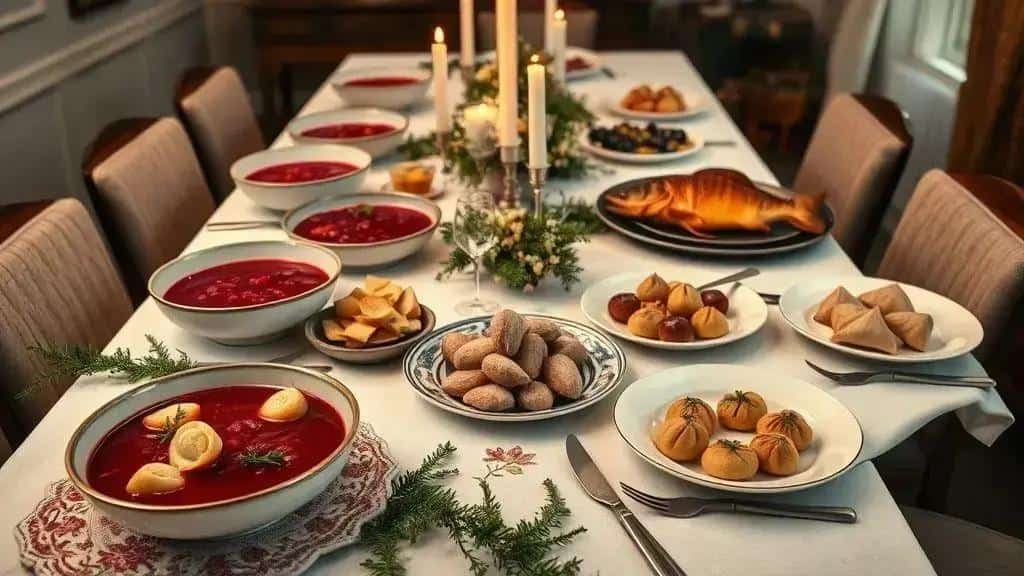
Wigilia is the family Christmas Eve celebration in Poland. In many homes, the table includes fish, mushrooms, vegetables and sweets, without poultry or red meat. Customs vary between regions, generations and families; there is no single compulsory menu for everyone.
Well-known customs include waiting for the first star, setting an extra place and sharing opłatek, a thin Christmas wafer, with good wishes. It should not be confused with a consecrated communion host. The twelve-dish tradition is often associated with the apostles. Culture.pl, from the Adam Mickiewicz Institute, explores the meal’s variety.
Home recipes for exploring the flavours
The formulas below are practical home-kitchen adaptations. They are a starting point rather than a claim to reproduce one family’s or region’s recipe. Dried and fresh mushrooms have different weights and preparation needs; they are not interchangeable gram for gram. Use only edible mushrooms from a reliable supplier.
Beetroot soup inspired by barszcz: 6 portions
- 1kg peeled beetroot in small cubes, 100g chopped onion and 15ml oil
- 1.5 litres vegetable stock, 1 bay leaf and 15–30ml lemon juice
- Salt and pepper to taste
- Soften the onion in the oil for 5 minutes. Add the beetroot, stock and bay leaf.
- Bring to the boil, reduce the heat and simmer for about 35–45 minutes until the beetroot is tender. Remove the bay leaf.
- For a clear broth, strain without pressing; save the cooked beetroot for another dish. For a thicker soup, carefully blend some of it, following your appliance instructions for hot liquids.
- Season and add the lemon juice gradually. Serve with separately cooked uszka.
Mushroom uszka: about 50 small dumplings
- Dough: 300g plain flour, 150ml warm water, 15ml oil and ½ teaspoon salt; up to 20ml extra water only if needed
- Filling: 30g dried mushrooms, water for soaking and cooking according to the packet, 100g chopped onion and 15ml oil
- Salt and pepper for the filling; up to 15g flour for rolling
- Soak and cook the mushrooms for the time directed on the packet. Drain and chop very finely. Soften the onion in the oil, add the mushrooms and cook until no visible liquid remains. Season and cool.
- Combine the flour, salt, water and oil. Knead for 5–8 minutes until supple; if dry, add the extra water gradually. Cover and rest for 30 minutes.
- Roll thinly, about 1–2mm. Cut approximately 5cm squares, put up to ½ teaspoon filling in the centre and seal into triangles, removing trapped air. Join the opposite corners to form a little ear.
- Cook in batches in gently boiling water for about 2–3 minutes after they rise. Check one: the dough should be cooked without a raw band. Lift out with a slotted spoon.
Baked fish: 4 portions
Use 800g carp fillets, 30ml olive oil, 30ml lemon juice, 1 teaspoon lemon zest, salt and pepper. Check carefully for bones. Arrange in one layer in a roasting dish, season and bake at 200°C conventional or 180°C fan for approximately 20–25 minutes depending on thickness, until hot, opaque and flaking. Remove any remaining bones when serving. Thin tilapia or trout fillets may cook sooner: these are adaptations, not the same fish under another name.
Cabbage and mushroom pierogi: about 30 dumplings
- Dough: 300g plain flour, 150ml warm water, 15ml oil and ½ teaspoon salt; up to 20ml extra water if necessary
- Filling: 300g cooked cabbage weighed after thorough draining, 200g chopped fresh mushrooms, 100g chopped onion and 30ml oil
- Salt and pepper to taste; up to 15g flour for rolling
Cook the onion and mushrooms in the oil until excess moisture has evaporated. Add the chopped cabbage, season, cook for a few more minutes and cool. Make and rest the dough as for the uszka. Roll about 2mm thick and cut 8cm discs. Place approximately 2 teaspoons filling on each, fold and seal firmly. Cook in batches in gently boiling water for about 3–4 minutes after they rise, checking that the dough is cooked. Drain to serve.
A puff-pastry alternative is a baked turnover inspired by this filling, not a traditional pierogi. For 12, use 500g puff pastry, up to 360g cold filling and 1 egg for brushing. Cut 12 rectangles, fill each with about 30g filling, seal, make a steam vent and brush with egg. Bake at 200°C conventional or 180°C fan for 25–30 minutes until the pastry is fully cooked.
Sweet poppy seed bread inspired by makowiec: 1 roll
- Dough: 300g plain flour, 5g instant dried yeast, 40g caster sugar, ½ teaspoon salt, 120ml lukewarm milk, 1 medium egg and 50g softened butter
- Filling: 150g food-grade ground poppy seeds, 250ml milk, 50g sugar, 20g butter and 30g raisins
- Finishing: 1 beaten egg for brushing and up to 15g flour for rolling
- Combine the flour, yeast, sugar and salt; add the milk and egg. Knead until combined, incorporate the butter gradually and continue until elastic. Cover and let rise until nearly doubled, approximately 1–2 hours depending on temperature.
- Cook the filling ingredients over low heat, stirring for about 15–20 minutes, until a thick paste forms without free milk. If liquid remains, continue reducing. Cool completely before filling.
- Roll the dough into an approximately 30 × 35cm rectangle. Spread with filling, leaving a 2cm border. Roll from the 30cm side, seal and place seam-side down on a lined baking tray.
- Cover loosely and leave for another 45–60 minutes until visibly lighter. Brush with egg.
- Bake at 180°C conventional or 160°C fan for approximately 35–45 minutes until golden and the dough is cooked at the centre. Cover loosely with foil if it browns early. Cool on a rack before cutting into about 10 slices.
Putting the meal together without excess
For a table inspired by Wigilia’s variety, combine small portions of soup, uszka, fish, pierogi, potato salad, cabbage and carrot salad, prepared herring, buckwheat, mushrooms, bread, poppy seed bread and dried-fruit compote. This is a home suggestion, not an official list of the twelve dishes. Choose fewer dishes if that suits your group better.
Do not promise a gluten-free version simply by replacing wheat flour with rice or chickpea flour: filled dough needs its own formula. Check milk, eggs and fish as well, including in wafers and prepared products. Use separate utensils where needed and agree adaptations with anyone who has dietary restrictions.
Making ahead and storage
Prepare fillings and soup the day before, cool promptly and keep covered at 0–5°C. Use within 48 hours of preparation, without restarting the clock when assembling another dish. Reheat once until piping hot throughout. Once cool, the filled bread can also be refrigerated for 48 hours or frozen in slices. Serve small amounts and replenish rather than leaving all the food out for hours.
Sharing family stories, writing good wishes and making room for arrivals are simple ways to take part. Ask guests which customs matter to them and describe your adaptations clearly.
AI-generated illustration, not a documentary photograph of a Polish celebration.